
Archie.AI – Medium
Why Data is Important for Small, Personal Web Projects
Read source article

You may have heard of predictive coding; it's a theory that gets around. In fact, it's been used to understand everything from the retina to consciousness. So, before we get into the details, we start this episode by describing our impressions of predictive coding. Where have we encountered it? Has it influenced our work? Why do philosophers like it? And, finally, what does it actually mean? Eventually we settle on a two-tiered definition: "hard" predictive coding refers to a very specific hypot
Join Survey Design and Analysis Services and Provalis Research founder and President Normand Peladeau for a 2-day training course in Sydney and Brisbane on the unstructured data analytics tool WordStat. The training in Sydney will be held from July 19 to 20 at the University of Sydney and the training in Brisbane will be held […]

New product: Stack Overflow for Teams lets you direct questions to members of your own team, company, or organization. Read more "Announcing Stack Overflow for Teams"

There is a tension when it comes to the study of behavior in neuroscience. On the one hand, we would love to understand animals as they behave in the wild---with the full complexity of the stimuli they take in and the actions they emit. On the other hand, such complexity is almost antithetical to the scientific endeavor, where control over inputs and precise measurement of outputs is required. Throw in the constraints that come when trying to record from and manipulate neurons and you've got a r
There's this popular idea among developers that when you face a problem with code, you should get out a rubber duck and explain, to the duck, exactly how your code was supposed to work. Read more "Strange and maddening rules"

UPDATE: Unfortunately my Pull-Request to Keras that changed the behaviour of the Batch Normalization layer was not accepted. You can read the details here. For those of you who are brave enough to mess with custom implementations, you can find the code in my branch. I might maintain it and merge it with the latest […]
I had to think for a minute to realize that Stack Overflow has “gamification" too. Not a ton. Maybe a dusting of gamification, most of it around reputation. Read more "A Dusting of Gamification"

On this unique episode of Unsupervised Thinking, we talk not about a particular area of science, but about the process of doing science itself. In particular, we're discussing how scientists take in information from their niche research areas and beyond. The topic for this free-form conversation stemmed from interviews we collected at the latest Computational and Systems Neuroscience Conference (Cosyne), where we asked people to tell us about a research finding from outside their area that they
At the most recent Computational and Systems Neuroscience Conference ("Cosyne"), held in Denver, we collected some interviews from attendees. The goal was to get people talking about work outside of their own immediate research area. Cosyne is a great conference to get exposed to ideas from other areas, particularly across the experiment-theory boundary. In total we collected 11 interviews from grad students, postdocs, and professors. We prompted people by asking them to first give
This is an archive of the original "fsyncgate" email thread. This is posted here because I wanted to have a link that would fit on a slide for a talk on file safety with a mobile-friendly non-bloated format . From:Craig Ringer Subject:Re: PostgreSQL's handling of fsync() errors is unsafe and risks data loss at least on XFS Date:2018-03-28 02:
Sleep is such a ubiquitous part of our lives we may forget just how weird of a thing it is to spend a third of our days laying in darkness. In this episode on the science of sleep, we start by describing types of sleep (while appreciating its strangeness) and the negative cognitive effects of missing out on it. We also discuss the potential role of rapid eye movement (REM) sleep in training neural connections and how that idea has been ported to artificial intelligence. We then take a rare (for
Provalis Research is holding a three-day training workshop for QDA Miner 5 and WordStat 7 in Montreal, Quebec, Canada. The training will be held from June 6 to June 8, 2018 at the Provalis Research head office. QDA Miner training: June 6 and June 7 – 9am to 5pm, 9am to 12pm WordStat training: June 7 and June 8 – […]
We have a new trainer/consultant Christopher Tomanek. You can access his profile on our training page: https://provalisresearch.com/trainers-christopher-tomanek/ Chris is based in Poland and an expert in QDA Miner, WordStat, Simstat. He used our software for more than 8 years. He speaks English and Polish and is available for training on our software and consulting projects.

8 minute read Production engineers (PE) are expected to be incident management experts. Still, incident handling is difficult, often messy, and exhausting. We encounter new incidents, search high and low for possible explanations, sometimes tunnel on symptoms, and, under pressure, forget some best practices. At Shopify, we care not only about handling incidents quickly and efficiently, but also PE well-being. We have a special IMOC (incident manager on call) rotation and an incident chatbot to a
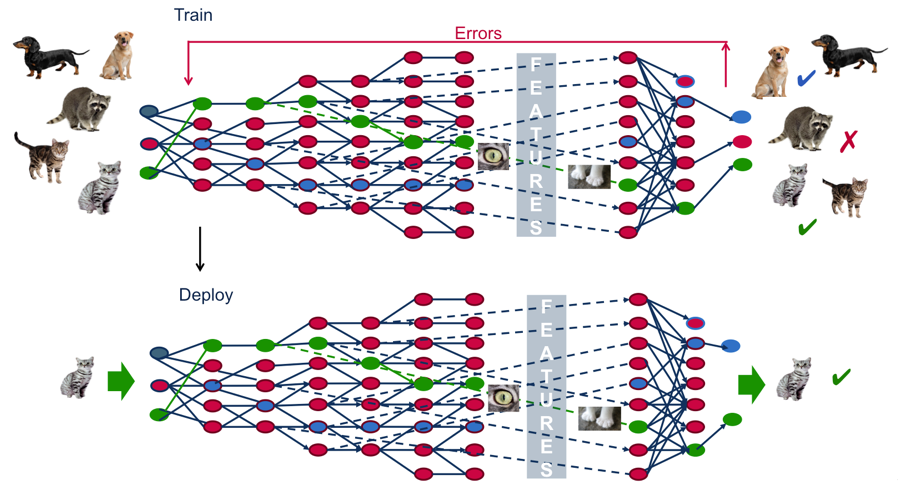

Deep Learning (the favourite buzzword of late 2010s along with blockchain/bitcoin and Data Science/Machine Learning) has enabled us to do some really cool stuff the last few years. Other than the advances in algorithms (which admittedly are based on ideas already known since 1990s aka “Data Mining era”), the main reasons of its success can […]



I've had this nagging feeling that the computers I use today feel slower than the computers I used as a kid. As a rule, I don’t trust this kind of feeling because human perception has been shown to be unreliable in empirical studies, so I carried around a high-speed camera and measured the response latency of devices I’ve run into in the past few months. Here are the results: table {border-collapse:collapse;margin:0px auto;}table,th,td {border: 1px solid black;}td {text-align:ce
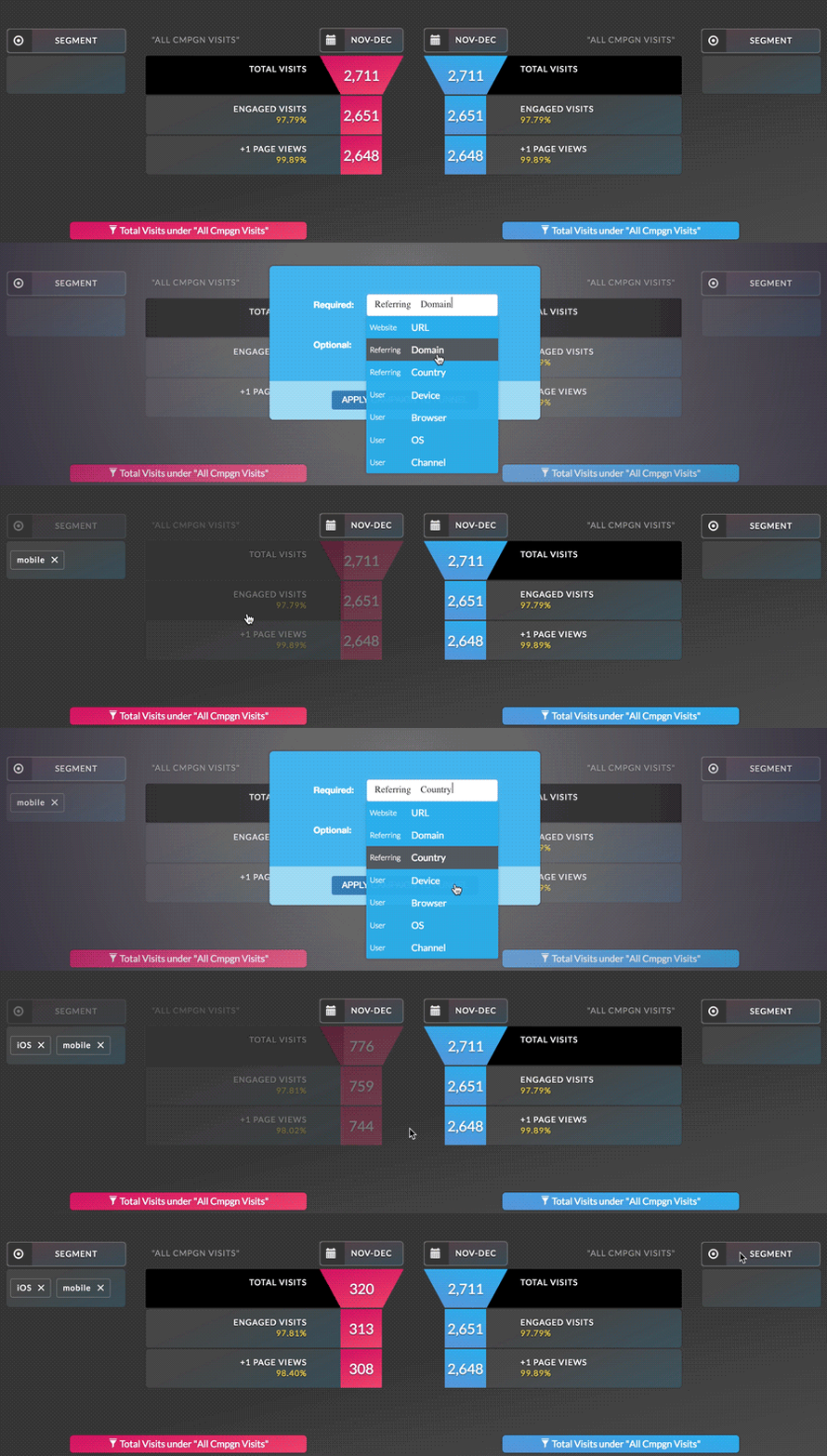
A popular topic in Silicon Valley is talking about what year humans and machines will merge (or, if not, what year humans will get surpassed by rapidly improving AI or a genetically enhanced species). Most guesses seem to be between 2025 and 2075. People used to call this the singularity; now it feels uncomfortable and real enough that many seem to avoid naming it at all. Perhaps another reason people stopped using the word “singularity” is that it implies a single moment in time, and it now loo
By creating user interfaces which let us work with the representations inside machine learning models, we can give people new tools for reasoning.
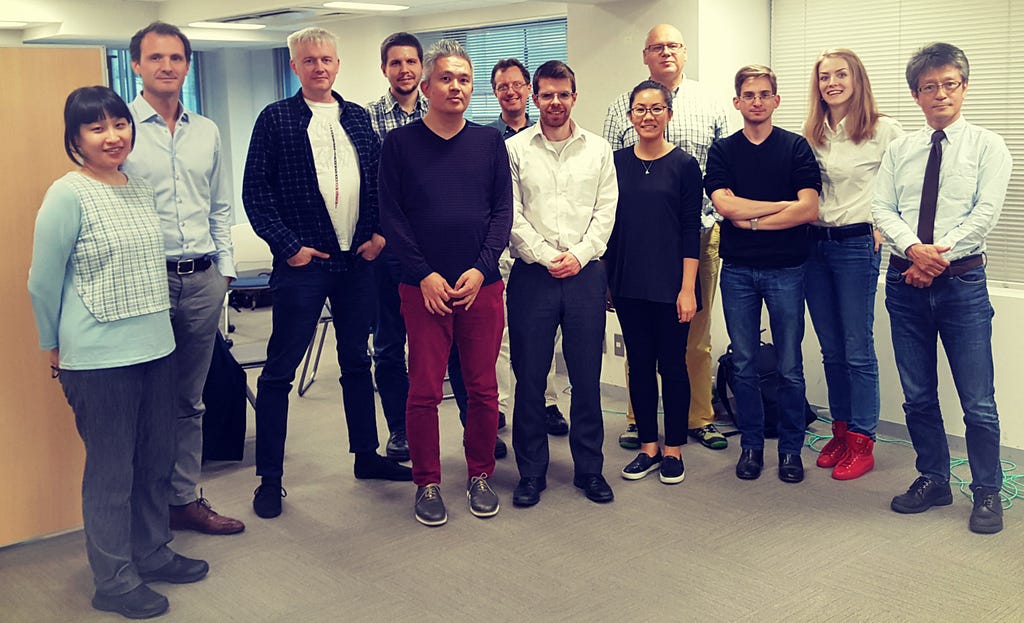
Provalis Research is holding a two-day training workshop for QDA Miner 5 and WordStat 7 in Ottawa, Ontario, Canada. The training will be held from February 20 to February 21, 2018 at Carleton University, Dunton Tower, Room 701. QDA Miner training: February 20 – 9am to 5pm WordStat training: February 21 – 9am to 5pm Click here for a detailed description of the […]
A visual guide to Connectionist Temporal Classification, an algorithm used to train deep neural networks in speech recognition, handwriting recognition and other sequence problems.
A statement I commonly hear in tech-utopian circles is that some seeming inefficiency can’t actually be inefficient because the market is efficient and inefficiencies will quickly be eliminated. A contentious example of this is the claim that companies can’t be discriminating because the market is too competitive to tolerate discrimination . A less contentious example is that when you see a big company doing something that seems bizarrely ineffic
It's common knowledge that Android device tend to be more out of date than iOS devices, but what does this actually mean? Let’s look at android marketshare data to see how old devices in the wild are. The x axis of the plot below is date, and the y axis is Android marketshare. The share of all devices sums to 100% (with some artifacts because the public data Google provides is low precision). Color indicates age: blue: current (API major version) yellow: 6 months<
About once a month, an app that I regularly use will change its UI in a way that breaks muscle memory, basically tricking the user into doing things they don’t want. Zulip In recent memory, Zulip (a slack competitor) changed its newline behavior so that ctrl + enter sends a message instead of inserting a new line. After this change, I sent a number of half-baked messages and it seemed like some other people did too. Around the time they made that
We’re going to reproduce some results from papers on filesystem robustness that were written up roughly a decade ago : Prabhakaran et al. SOSP 05 paper , which injected errors below the filesystem and Gunawi et al. FAST 08 , which looked at how often filesystems failed to ch
If you look at “gaming" keyboards, a lot of them sell for $100 or more on the promise that they’re fast. Ad copy that you’ll see includes: a custom designed keycap that has been made shorter to reduce the time it takes for your actions to register 8x FASTER - Polling Rate of 1000Hz: Response time 0.1 milliseconds Wield the ultimate performance advantage over your opponents with light operation 45g key switches and an actuation 40% faster than standard Cherry MX
Montreal, Canada’s second largest city, known for its European flair, its culinary prowess, and its many festivals, is also home to Provalis Research. We are very proud of our city, and one of the things that makes us proudest is the tech scene. Major players are converging on Montreal because of its burgeoning AI scene. […]
Tomorrow (10/10) is our eagerly anticipated first talk of the year, Philosophy of The Mind: I Think Therefore I Am? There will be two amazing speakers for this session: – Prof. Mark Mon-Williams will talk about the Philosophy of the Mind from a psychological point of view. – And Marc Cole will give us the philosophical point of view. After the talks, we’ll be going …
