Hacker News AILLMs
Grassroots AI: Beyond the Moonshot
Article URL: https://www.cosotateam.com/post/grassroots-ai-beyond-the-moonshot Comments URL: https://news.ycombinator.com/item?id=48660985 Points: 2 # Comments: 0
Read source article
Article URL: https://www.cosotateam.com/post/grassroots-ai-beyond-the-moonshot Comments URL: https://news.ycombinator.com/item?id=48660985 Points: 2 # Comments: 0
Named Jalapeño, the new processor was designed specifically for the unique needs of OpenAI's inference systems.
Article URL: https://techstrong.ai/articles/for-most-of-the-world-open-source-ai-is-the-only-way-forward/ Comments URL: https://news.ycombinator.com/item?id=48660839 Points: 3 # Comments: 0
Orchid (Orchestration interactive debugger) is a zero-instrumentation proxy that captures every API & LLM call in your agent pipeline, then lets you inspect and replay the entire run locally, step by step. No instrumentation, no vendor lock-in, no cloud dependency. It also provides a visual inspector and MCP server, so you can inspect the session yourself or use your favorite agentic coding IDE to debug your agent runs. I built it because I was tired of debugging agent failures by grepping throu
Article URL: https://www.informationweek.com/machine-learning-ai/time-for-an-ai-exit-strategy-how-cios-are-cutting-ai-waste Comments URL: https://news.ycombinator.com/item?id=48660776 Points: 2 # Comments: 0
Article URL: https://rubyllm.com/ Comments URL: https://news.ycombinator.com/item?id=48660711 Points: 16 # Comments: 3
OpenAI has just revealed a new "intelligence processor" chip for AI servers made in partnership with Broadcom. The chip, called Jalapeño, is designed to power current and future large language models, according to an announcement on Wednesday. Jalapeño is an ASIC (Application-Specific Integrated Circuit), meaning it's designed for a specific purpose: AI inference. With AI […]

<p> Let AI agents run your next deal, fundraise or data room </p> <p> <a href="https://www.producthunt.com/products/papermark-2?utm_campaign=producthunt-atom-posts-feed&utm_medium=rss-feed&utm_source=producthunt-atom-posts-feed">Discussion</a> | <a href="https://www.producthunt.com/r/p/1180086?app_id=339">Link</a> </p>
<p> Learn to build AI agents by actually building them </p> <p> <a href="https://www.producthunt.com/products/sidegent?utm_campaign=producthunt-atom-posts-feed&utm_medium=rss-feed&utm_source=producthunt-atom-posts-feed">Discussion</a> | <a href="https://www.producthunt.com/r/p/1180085?app_id=339">Link</a> </p>
Article URL: https://www.scmp.com/opinion/world-opinion/article/3333190/will-ai-kill-middle-class Comments URL: https://news.ycombinator.com/item?id=48660596 Points: 3 # Comments: 2
Article URL: https://github.com/budhasantosh010/ai-coding-project-templates Comments URL: https://news.ycombinator.com/item?id=48660491 Points: 2 # Comments: 0
<p> Generate UI prototypes, videos, and posters with AI </p> <p> <a href="https://www.producthunt.com/products/genspark-design?utm_campaign=producthunt-atom-posts-feed&utm_medium=rss-feed&utm_source=producthunt-atom-posts-feed">Discussion</a> | <a href="https://www.producthunt.com/r/p/1180077?app_id=339">Link</a> </p>
Article URL: https://www.hope.net/a-statement-on-ai-talks-at-hope/ Comments URL: https://news.ycombinator.com/item?id=48660311 Points: 2 # Comments: 0
<p> AI to turn vertical UGC into widescreen ads </p> <p> <a href="https://www.producthunt.com/products/outpaint-com-ad-reframe?utm_campaign=producthunt-atom-posts-feed&utm_medium=rss-feed&utm_source=producthunt-atom-posts-feed">Discussion</a> | <a href="https://www.producthunt.com/r/p/1180072?app_id=339">Link</a> </p>
Hi HN, I’m building Drip. It’s an API that lets AI agents access premium finance newsletters on a pay-per-use basis. Agents will not subscribe to newsletters like humans do. A person subscribes for the ongoing relationship. An agent usually needs one narrower thing: the exact piece of research that helps answer a question right now. We just launched a stock-picks endpoint for what many people are calling vibe investing / agentic investing. Using Drip, an agent can generate a cited report on the
Article URL: https://papermill.io/ Comments URL: https://news.ycombinator.com/item?id=48660219 Points: 2 # Comments: 0
Article URL: https://buildaharness.com/ Comments URL: https://news.ycombinator.com/item?id=48660207 Points: 1 # Comments: 2
<p>Healthcare is one of the most data-rich industries on the planet — and one of the slowest to act on that data. That is changing fast.</p> <p>AI is no longer a research curiosity in clinical settings. It is running in production: reading radiology scans, flagging high-risk patients before they deteriorate, and automating the administrative overhead that burns out clinicians. Here is a grounded look at where AI is genuinely delivering value in healthcare, the real engineering challenges involve
<p>About a month and a half ago, I unboxed a Mac Mini and had no idea what I was doing.</p> <p>I'm not being humble — I literally had zero coding experience. My background was service industry: restaurants, hospitality, managing people, solving problems on the fly. I'd never written a line of Python. I'd never deployed anything. I didn't know what an API was beyond the acronym.</p> <p>Today, I've got two live AI agent systems running. One's a trading agent that makes real decisions. The other is
Article URL: https://flower.ai/ Comments URL: https://news.ycombinator.com/item?id=48660082 Points: 1 # Comments: 0
Article URL: https://spectrum.ieee.org/ai-radio-chip-design Comments URL: https://news.ycombinator.com/item?id=48660021 Points: 2 # Comments: 0
<p>Let me start with a question my clients ask me a lot:</p> <p><em>"Can't we just use ChatGPT for this?"</em></p> <p>My answer is always the same: <strong>it depends on what "this" is.</strong></p> <p>When "this" involves client intake forms for a law firm, tax documents for an accounting practice, or patient records for a medical office — the answer is no. And once I explain why, they always get it.</p> <p>This post is about that explanation, and the toolchain I actually use instead.</p> <h2>
Article URL: https://kevinboone.me/ai.html Comments URL: https://news.ycombinator.com/item?id=48659960 Points: 3 # Comments: 1
Article URL: https://www.giskard.ai/knowledge/best-ai-agent-red-teaming-tools-in-2026-understanding-features-functions-and-solutions Comments URL: https://news.ycombinator.com/item?id=48659901 Points: 2 # Comments: 0
<p>For those of us who can’t drive due to disabilities, the drawbacks of these vehicles are vastly outweighed by the possibilities they offer</p><p>The robotaxis are coming! The robotaxis are coming! Well, actually, they’re already here. Until now they’ve been the stuff of science fiction, but this summer<strong> </strong>London’s streets have seen Silicon Valley-based company Waymo testing out self-driving cars. It hasn’t been the smoothest of introductions – from cars getting stuck in <a href=

<p> Build agents & apps on top of your context with one prompt. </p> <p> <a href="https://www.producthunt.com/products/zaro?utm_campaign=producthunt-atom-posts-feed&utm_medium=rss-feed&utm_source=producthunt-atom-posts-feed">Discussion</a> | <a href="https://www.producthunt.com/r/p/1180059?app_id=339">Link</a> </p>
OpenAI is adding custom hardware to its tech stack. The "Jalapeño" chip, developed with Broadcom, is tailored for large language model inference and is set to run at scale by late 2026. The article OpenAI and Broadcom unveil "Jalapeño," a custom chip built for LLM inference appeared first on The Decoder .

Our team kept running into the same thing: the coding agent would jump from a vague plan straight to code, and all the reasoning lived in a linear chat we couldn't revisit. So we built inplan. It's a Markdown editor where you and the agent plan together in one doc: - Comment on a specific sentence and have a threaded conversation right there — ask, get the agent's opinion, decide — and it stays anchored to that line for later. - When the agent changes the plan, you review the diff and apply it,
<div class="hs-featured-image-wrapper"> <a href="https://www.marketingaiinstitute.com/blog/podcast-ai-gap-marketing" title="" class="hs-featured-image-link"> <img src="https://www.marketingaiinstitute.com/hubfs/MAII%20blog.624.png" alt="Is There an AI Gap Growing Inside Your Marketing Team?" class="hs-featured-image" style="width:auto !important; max-width:50%; float:left; margin:0 15px 15px 0;"> </a> </div> <p><span style="font-weight: bold;"><span>Most marketing leaders will tell you their tea
A practical walkthrough using text-to-SQL as the example The post Why I Stopped Using One Agent and Built a Multi-Agent Pipeline Instead appeared first on Towards Data Science .
<pre style='white-space:pre-wrap;width:81ex'>fix(cron): stop stamping an unenforceable default toolsAllow cap on CLI runs #91499 auto-stamps the creator's tool surface as a default toolsAllow cap on agentTurn cron payloads whenever the creating session is tool-restricted (a narrowing allow-policy or an explicit deny). CLI backends cannot enforce a runtime toolsAllow — cli-runner/prepare.ts rejects any defined allow-list — so every scheduled agentTurn that resolves to a CLI backend (e.g. claude-c
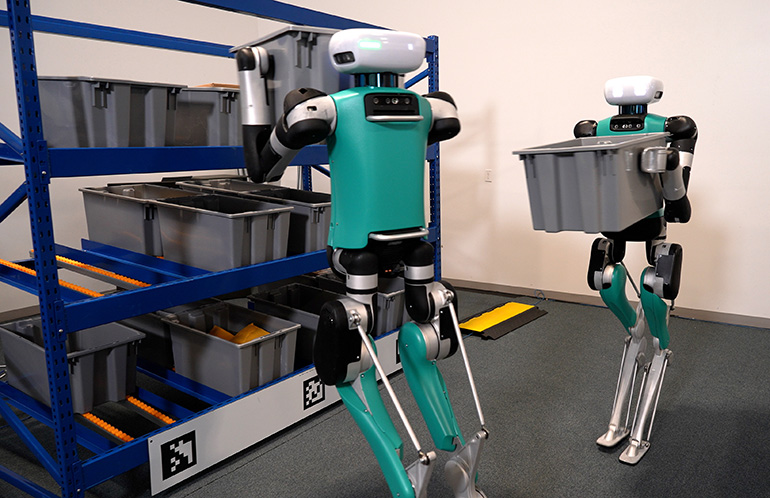
Agility Robotics will merge with Churchill Capital Corp XI, raising $620 million to advance Digit v5 and fulfill growing customer orders. The post Humanoid maker Agility Robotics to go public through SPAC merger appeared first on The Robot Report .
Hi, I'm a PhD student in Bioinformatics/Computational Biology with a software engineering background, I'm trying to pivot toward AI/ML research. I'm familiar with the practical side of AI as in using, Scikit learn, R, Pytorch, ONNX Runtime etc... I was thinking if LLMs could be used as a research assistant to create better AIML algorithms. So I asked ChatGPT to help find better way to solved one of the most computationally intensive problems in Transformer architecture based model. I instructed
Article URL: https://openai.com/index/openai-broadcom-jalapeno-inference-chip/ Comments URL: https://news.ycombinator.com/item?id=48659257 Points: 141 # Comments: 1
Article URL: https://github.com/croustibat/Pinpoint Comments URL: https://news.ycombinator.com/item?id=48659188 Points: 1 # Comments: 0
Article URL: https://hamanlp.org/small-kernels.html Comments URL: https://news.ycombinator.com/item?id=48659158 Points: 1 # Comments: 1
Consumption-based pricing and scant cost controls are sending monthly bills into five figures, Gartner warns
Article URL: https://northwoodsystems.ai/research/open-source-models-big-board Comments URL: https://news.ycombinator.com/item?id=48659077 Points: 2 # Comments: 0
OpenAI deployment chief Arnaud Fournier explains in an interview how DeployCo wants to embed AI deep inside large corporations using its own engineers. He talks about explosive Codex growth, the feedback loop from customers back into model development, and why he thinks the price of AI intelligence has dropped sharply. The article OpenAI's deployment chief on Codex growth, falling AI prices, and the ROI question appeared first on The Decoder .

Google's new speaker is a modest update, but the question is whether Gemini is a good smart home assistant.