
Hacker News AILLMs
GeoSQL: Showing AI a map increased its accuracy by 4× (Korean)
Article URL: https://ideas.paasup.io/geosql/ Comments URL: https://news.ycombinator.com/item?id=48921874 Points: 1 # Comments: 0
Read source article
Article URL: https://ideas.paasup.io/geosql/ Comments URL: https://news.ycombinator.com/item?id=48921874 Points: 1 # Comments: 0
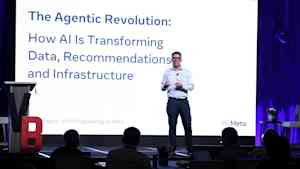
Organizations need to transform to meet the needs of agentic AI. Meta VP of Engineering Barak Yagour opened his talk at VB Transform 2026 wearing a pair of Ray-Ban Meta AI glasses, a small sign of how far AI has already worked its way into physical life. His argument went further: enterprise infrastructure was built for humans, not for agents, and it's starting to show. Yagour, who leads its data infrastructure organization, told the audience that agentic queries hitting Meta's data systems grew
Article URL: https://www.gamingonlinux.com/2026/07/linux-creator-linus-torvalds-puts-foot-down-on-anti-ai-comments/ Comments URL: https://news.ycombinator.com/item?id=48921843 Points: 11 # Comments: 2
Article URL: https://thenextweb.com/news/most-americans-now-say-the-public-should-own-half-of-the-big-ai-companies Comments URL: https://news.ycombinator.com/item?id=48921838 Points: 1 # Comments: 2
Article URL: https://arxiv.org/abs/2607.12624 Comments URL: https://news.ycombinator.com/item?id=48921816 Points: 2 # Comments: 0
<p>This is more of a thought experiment than a firm stance.</p> <p>I’m not really here to be pro-AI or anti-AI. I use it almost every day when I’m searching for concepts, learning something new, writing, or programming. So I can’t pretend it hasn’t become a useful part of how I work. At the same time, I do think there are real pros and cons to it, and I’m still not fully settled on how I feel about everything it brings with it.</p> <p>One thing I’ve been thinking about lately is whether using AI
Article URL: https://lowlatencyclub.ai/blog/posts/ai-negotiation-practice-phone-python Comments URL: https://news.ycombinator.com/item?id=48921718 Points: 2 # Comments: 0
<p> Give every AI agent trusted context </p> <p> <a href="https://www.producthunt.com/products/fluree?utm_campaign=producthunt-atom-posts-feed&utm_medium=rss-feed&utm_source=producthunt-atom-posts-feed">Discussion</a> | <a href="https://www.producthunt.com/r/p/1197378?app_id=339">Link</a> </p>
Just an interesting thought I had while ruminating on the rapid advancement of LLMs over the past decade, particularly how amazing locally hostable open source models have gotten. If I could transport myself back to 2016 and take with me just one Dell Pro Max GB10 running Qwen3.5:122b I could probably own the world in a year or so, 6 months if I bring my image/video gen models with me. I'd be like a wizard. Just 10 years ago. All I need is a time machine. Comments URL: https://news.ycombinator.c
Co-authored by Sarah Hanson, FPF Health & Wellness Intern This article discusses suicidal ideation, which may be distressing for some readers. (If you or someone you know is struggling, help is available. You can call or text the Suicide & Crisis Lifeline at 988 or visit 988 Lifeline for free, confidential, 24/7 support.) As many […]
<p>The Model Context Protocol is how an AI agent gets tools. You stand up an MCP server, it advertises a set of tools with typed inputs, and the agent calls them. For a huge number of real MCP servers, those tools are thin wrappers around a database: search these records, create this row, update that field. The server is mostly a translator between JSON-RPC and SQL.</p> <p>Which raises an obvious question. If an MCP server spends its life talking to Postgres, why does it so often run somewhere f
<p>Quantum Elements and Planckian recently established a development agreement focused on utilizing artificial intelligence to create digital twins for quantum hardware. This collaboration intends to refine error correction strategies for superconducting quantum processors by simulating complex noise environments. The partnership addresses the technical challenges of scaling quantum systems while maintaining computational accuracy and reliability.</p> <h3> New Frontiers in Quantum Hardware Simul
<h2> 🚀 Building Two AI-Powered Solutions at HACKHAZARDS '26: VeritasFlow & PermitFlow </h2> <blockquote> <p><strong>How our team built two AI-powered solutions—VeritasFlow and PermitFlow—during one of the world's largest community-driven hackathons.</strong></p> </blockquote> <h2> Introduction </h2> <p>Innovation begins with identifying real-world problems and building technology that creates meaningful impact.</p> <p>That belief guided our team throughout <strong>HACKHAZARDS '26</strong>, a gl
<p><em>Part 1 of a series on building a production banking AI chatbot.</em></p> <p>When our team kicked off the banking chatbot project, I genuinely thought my job was already solved.</p> <p>I was the Node.js developer. My part sounded almost embarrassingly simple:</p> <ul> <li>Open a WebSocket when a user connects</li> <li>Send their message to the AI service</li> <li>Stream the response back</li> </ul> <p>That's it. That's the whole job.</p> <p>WebSockets are second nature to me — I've built e
A working captcha service that let's robots through and keeps humans out. Comments URL: https://news.ycombinator.com/item?id=48921612 Points: 1 # Comments: 0
Article URL: https://arxiv.org/abs/2607.11262 Comments URL: https://news.ycombinator.com/item?id=48921609 Points: 2 # Comments: 0
Article URL: https://www.ibm.com/think/news/what-does-ai-look-like Comments URL: https://news.ycombinator.com/item?id=48921597 Points: 9 # Comments: 1
New Delhi announced a $6.5 billion smartphone manufacturing program and a $13.3 billion semiconductor push to deepen India's electronics supply chain.
The Luddites are remembered as people who opposed machines. But while reading contemporary accounts of the 1811 1813 textile disturbances, I found that many of their complaints focused on wage cuts, deskilling, changes in labor relations rather than the existence of machinery itself. That made me think how much of today's debate around AI echoes those earlier arguments. The Industrial Revolution largely automated physical work over several decades. Large language models are automating parts of k
Both ChatGPT and Claude, Enter sends the message. I have to use Shift+Enter for line break. A few years ago, I often pressed Enter instead of Shift+Enter by mistake. I needed to click stop button to edit my input again. Recently, I have become relatively good at it. I now press Shift almost automatically when I want a line break. Comments URL: https://news.ycombinator.com/item?id=48921475 Points: 1 # Comments: 1
Article URL: https://www.strix.ai/blog/n8n-cross-issuer-account-takeover Comments URL: https://news.ycombinator.com/item?id=48921422 Points: 14 # Comments: 1
Article URL: https://hillnote.com Comments URL: https://news.ycombinator.com/item?id=48921416 Points: 1 # Comments: 0
How does ChatGPT Work compare with Claude Cowork for desktop automation? My testing reveals similar results, similar strengths, and one major reason Claude currently feels considerably safer right now.
I built this because I wanted to learn from my past session and align with Claude Code better right from the first prompt. I was spending a bunch of my session steering, restating the same preferences, answering questions that I felt I've answered before. By the end of a session I can now have a prompt library entry for that kind of work. I might try to help turn these into skills quickly as well. Comments URL: https://news.ycombinator.com/item?id=48921343 Points: 1 # Comments: 2
Apple will reportedly partner with Chinese firms Baidu and Alibaba to roll out its AI service in the country.

<p><strong><a href="https://www.ayush.digital/blog/the-memory-heist">How I tricked Claude into leaking your deepest, darkest secrets</a></strong></p> I've <a href="https://simonwillison.net/2025/Sep/10/claude-web-fetch-tool/">been impressed</a> by the way the Claude <code>web_fetch</code> tool is designed to avoid data exfiltration attacks. Ayush Paul found a hole in that design.</p> <p>To recap: regular Claude chat is at risk of <a href="https://simonwillison.net/2025/Jun/16/the-lethal-trifecta
<p>Star Wars director calls AI technology ‘the future’ of film-making and says ‘there’s nothing you can do about it’</p><p>The Star Wars director, George Lucas, has added his voice to the growing chorus of film-makers receptive to the rising use of AI tools in moviemaking.</p><p>Speaking in an interview with <a href="https://a-rabbitsfoot.com/editorial/confessions/the-last-picture-show-a-conversation-with-george-lucas/">A Rabbit’s Foot</a>, Lucas, 82, said: “Artificial intelligence means it’s mu

Article URL: https://bomly.dev/blog/coding-agents-with-and-without-bomly-mcp Comments URL: https://news.ycombinator.com/item?id=48921067 Points: 2 # Comments: 0
Article URL: https://logoteddy.com/ Comments URL: https://news.ycombinator.com/item?id=48921016 Points: 2 # Comments: 0
Article URL: https://iaamalia.com/ Comments URL: https://news.ycombinator.com/item?id=48921013 Points: 2 # Comments: 0
Comments URL: https://news.ycombinator.com/item?id=48920951 Points: 4 # Comments: 3
With the iOS 27 public beta available to download, is it worth testing the waters?

Article URL: https://reduck.ai/ Comments URL: https://news.ycombinator.com/item?id=48920925 Points: 2 # Comments: 0

Article URL: https://github.com/bitjaru/styleseed Comments URL: https://news.ycombinator.com/item?id=48920888 Points: 2 # Comments: 0
<p>AI in the near term may drive cybersecurity back to its roots, when widespread vulnerabilities, not deceptive intrusions, drove incidents.</p>
Article URL: https://inferall.ai/?src=hn Comments URL: https://news.ycombinator.com/item?id=48920849 Points: 2 # Comments: 0
Article URL: https://openmarkdown.dev/ Comments URL: https://news.ycombinator.com/item?id=48920800 Points: 2 # Comments: 0
<!-- SC_OFF --><div class="md"><p>Hey everyone,</p> <p>Seeing a ~170× slowdown running a point-tracking model on an NVIDIA T4 compared to an A100. On A100 the tracker takes ~0.5 seconds per half-video. On T4 the same call takes ~85 seconds. Video is 47 frames at 256×256, batch 1. I expect a meaningful gap between these cards, but 170× feels too large to explain by generational hardware differences alone.</p> <p>Setup:</p> <ul> <li>Precision: pure FP32</li> <li>Architecture: builds local 4D corre