

TenalogAudio transcription AI Tool
Automated speech therapy documentation.
Audio transcriptionFree + from $10
Automated speech therapy documentation.
Overall
Average of 2 data signals below
Basic pricing published
3 of 4 content areas filled (features, FAQs, pros/cons, description)
This score is calculated automatically from this listing's available data (community rating, capabilities, pricing transparency, and documentation). It is not a paid or sponsored review.
Pricing & Model
freemium
Free + from $1
Open Source & API
Proprietary
No Public API
Foundational Model
Proprietary Engine
Key Integrations
Web App Only
Free + from $1
See full pricing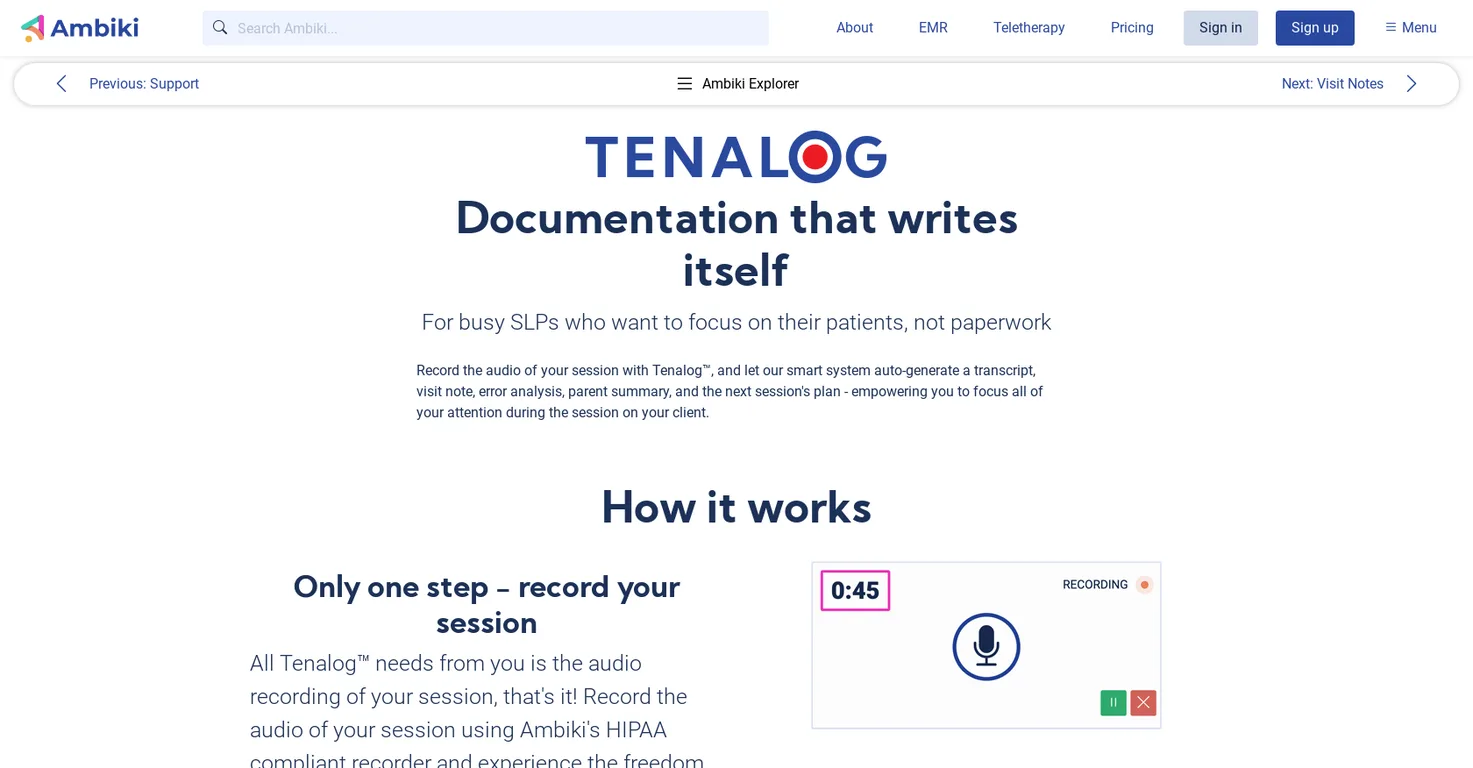
Common queries about Tenalog answered
Tenalog is an advanced tool designed to assist Speech-Language Pathologists (SLPs) by automating their documentation processes. This includes automatic transcription of therapy sessions, automated generation of visit notes, error analysis, progress tracking, and session planning for future visits. The tool also provides parent-friendly summaries and research reference links tailored to each session.
Tenalog works by recording therapy sessions using Ambiki's HIPAA compliant recorder. After the session, it automatically transcribes the audio, identifies speakers, and marks timestamps in the transcription. It analyses the pronunciation of significant patient words and phrases. Additionally, it generates a variety of documents like a detailed transcript, error analysis, visit notes, and session planning. Moreover, it ties up structured data extracted from the session to the patient's goals for progress tracking.
Real ratings and feedback from the community
Be the first to share your rating and comments for this AI tool!
How Tenalog stacks up against top competitors
| Feature | Tenalog | Transkriptor | SubEasy.ai | Revoldiv |
|---|---|---|---|---|
| Rating | ★ 3 | ★ 4.8 | ★ 3 | — |
| Pricing Model | freemium | freemium | freemium | freemium |
| API Access | No | No | No | No |
| Open Source | No | No | No | No |
| Link | Visit Website | Visit Website |
Explore similar AI tools in this category
Tenalog automatically generates a variety of documents: a detailed audio transcript with timestamps and speaker labels, visit notes based on the audio transcript (including a detailed speech sound chart), an error analysis of the pronunciation of significant patient words and phrases, goal-level progress charts and articulation charts for progress tracking, parent-friendly summaries of the session, and session planning for the next visit including ideas and resources from Ambiki's library of therapy tools.
Yes, Tenalog analyses the pronunciation of significant patient words and phrases at the phoneme level. It automatically scores the pronunciation and includes this analysis in its automatically generated visit notes.
Tenalog extracts structured data from the session and ties it back to the patient's goals, allowing SLPs to track progress easily. This data is represented in beautiful goal-level progress charts and articulation charts. SLPs can also revisit patient progress through a history of audio clips. Moreover, Tenalog also provides MVP Reels, which highlight a patient's progress through automatically generated before/after clips.
Yes, Tenalog aids in planning for future therapy sessions by automatically generating session plan ideas based on the previous session. It also recommends relevant resources and activity lists from Ambiki's library of therapy tools, supporting SLPs in their session planning.
Parent-friendly summaries provided by Tenalog are simplified summaries of therapy sessions. They are designed to be easily understood by parents or guardians of the patients. These summaries can be shared with the family through Ambiki's Patient Portal.
Yes, Tenalog recommends relevant resources and activity lists from Ambiki's library of therapy tools for session planning. These resources are automatically recommended based on the content of the previous session and the patient's goals.
Tenalog saves time for SLPs by automating the various aspects of documentation. Rather than manually creating transcripts, visit notes, error analyses, and progress tracking documents, Tenalog automatically generates these from the audio recording of the therapy session. This leaves SLPs with more time to focus on providing quality therapy to their patients.
Yes, Tenalog is HIPAA-compliant. It uses Ambiki's HIPAA-compliant recorder for recording sessions and all the data processing and storage also strictly adheres to HIPAA regulations.
Tenalog is engineered to identify different speakers during a session. It adds speaker labels in the transcription to distinguish between the Speech-Language Pathologist and the patient. Currently, it is designed to support one-on-one sessions, i.e., one therapist and one patient.
At present, Tenalog supports transcription in English language only. Its pronunciation scoring is based on the General American English dialect. However, it does not explicitly support multiple languages or accents.
Yes, Tenalog works in areas with poor Wi-Fi. It allows the upload of an audio file or the ability to record directly online. Therefore, if Wi-Fi is poor, the session can be recorded locally on the device and uploaded later when a stable Wi-Fi connection is available.
Yes, Tenalog can work well with background noise during a session. While it filters out background noise to a large extent, it is highly recommended to conduct sessions in a quiet setting for best results.
Yes, Tenalog provides an Editor that lets users have full control over its output. SLPs can use this to edit any part of the generated transcript, correct speaker labels, timestamps, and adjust the scored segments.
Yes. While Tenalog is primarily designed for SLPs, Occupational Therapists (OTs) and Physical Therapists (PTs) can also use it, with some modifications to how they narrate their sessions.
It is not mandatory to have a pre-established Plan of Care (POC) or patient goals prior to using Tenalog. However, having these details on Ambiki adds more depth to the data analysis, visit note creation, and progress tracking that Tenalog performs.
The processing duration for an audio file using Tenalog is approximately 1.5 times the length of the file. For example, a 20-minute audio session typically takes about 30 minutes to be processed by Tenalog.
While there might be minor additional review work in the initial usage phase as therapists familiarize themselves with Tenalog, in the long run, Tenalog significantly reduces the time spent on creating visit notes, transcriptions, and tracking progress. So, it does not create overall additional administrative work for therapists.
Regarding consent, the necessity and format may depend on local laws and the rules of the licensing board. However, it is highly recommended to obtain written consent from the patient or their legal guardian before recording or uploading a session on Ambiki. Ambiki provides a sample consent form for Tenalog and the same can be used as an electronic form through the patient intake forms feature.
| Visit Website |
| Visit Website |


