

DiagramGPTInfo maps AI Tool
Transform natural language into detailed diagrams.
Info mapsFree0
Transform natural language into detailed diagrams.
Overall
Average of 2 data signals below
Basic pricing published
3 of 4 content areas filled (features, FAQs, pros/cons, description)
This score is calculated automatically from this listing's available data (community rating, capabilities, pricing transparency, and documentation). It is not a paid or sponsored review.
Pricing & Model
free
Free
Open Source & API
Proprietary
No Public API
Foundational Model
Proprietary Engine
Key Integrations
Web App Only
Free
See full pricing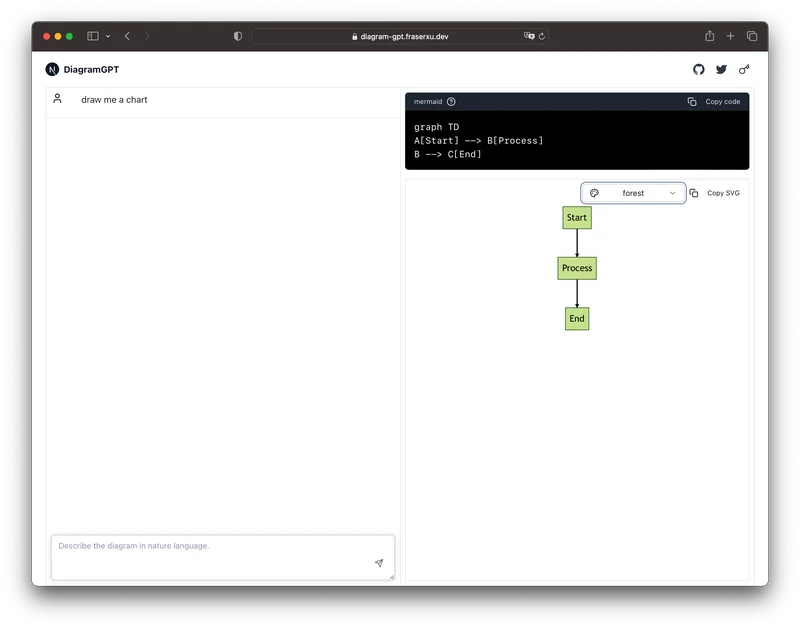
Common queries about DiagramGPT answered
DiagramGPT is an advanced AI tool that allows users to create various types of diagrams such as flowcharts, sequence diagrams, class diagrams, user journey maps, Gantt charts, and C4C diagrams. It utilizes natural language processing to transform user inputs into these graphical representations. DiagramGPT also features integrations with GitHub and Twitter for easy sharing and collaboration, and offers an interface for editing the diagrams. Additionally, diagrams can be customized using the Mermaid Editor.
DiagramGPT utilizes natural language processing (NLP) to turn user-provided text into structured diagrams. This technology interprets the semantics of the input, translating them into comprehensible visual formats.
Real ratings and feedback from the community
Be the first to share your rating and comments for this AI tool!
How DiagramGPT stacks up against top competitors
| Feature | DiagramGPT | Mindmap | Whimsical Mind Maps | Vizionova |
|---|---|---|---|---|
| Rating | ★ 3 | ★ 3 | — | — |
| Pricing Model | free | freemium | freemium | Free |
| API Access | No | No | No | No |
| Open Source | No | No | No | No |
| Link | Visit Website | Visit Website |
Explore similar AI tools in this category
DiagramGPT enables the creation of a variety of diagrams, including flowcharts, sequence diagrams, class diagrams, user journeys, Gantt charts, and C4C diagrams.
Primary users of DiagramGPT consist of developers, designers, project managers, and professionals requiring a quick and efficient tool for creating diverse forms of diagrams.
DiagramGPT integrates with GitHub and Twitter. This allows users to easily share their created diagrams on these platforms and engage in collaborative efforts.
The Mermaid Editor is a feature that complements DiagramGPT, allowing for advanced customization of diagrams. Users can edit their diagrams using a simple, intuitive interface hosted on mermaid.live.
Yes, DiagramGPT is capable of generating scalable vector graphics (SVG) that can be easily exported or copied to other applications.
DiagramGPT's uniqueness comes from its application of natural language processing to transform user inputs into a wide range of diagrams. This technical capability sets it apart from other traditional diagram creating tools.
Yes, DiagramGPT is designed to be user-friendly. The use of NLP technology streamlines the diagram creation process, making it more accessible to users who may not be familiar with technical jargon.
DiagramGPT's application of NLP allows it to convert complex data into comprehensive visuals, aiding in more effective visual data analysis. By translating user inputs into diagrams, it allows complex data and processes to be visually articulated, hence improving understanding and interpretation.
Yes, DiagramGPT provides an option to edit already created diagrams. Users can do so through its basic interface or the Mermaid editor for a more advanced customization.
In DiagramGPT, natural language is transformed into diagrams through the application of natural language processing. This technology interprets the semantics of the user input and translates it into a structured diagram.
Yes, DiagramGPT can be used for system design and process mapping. It creates accurate visual representations of systems or processes based on user input, which can be instrumental in these fields.
DiagramGPT's integration with platforms like GitHub and Twitter is designed for easy sharing and collaboration. Users can directly share their diagrams on these platforms for others to view or contribute to.
As a project manager, DiagramGPT can be highly beneficial. Its capabilities to generate various forms of diagrams, such as flowcharts and Gantt charts, can aid in project planning, scheduling, progress tracking, and visual representation of complex project steps.
UX/UI designers can benefit from DiagramGPT in several ways. With its help, they can easily create and customize user journey maps or sequence diagrams, which are crucial elements in UX/UI design. The use of natural language for diagram creation further simplifies their work.
Yes, DiagramGPT allows for the exportation of created diagrams to other applications. It creates scalable vector graphics that can be easily exported or copied.
Yes, DiagramGPT provides the option for users to copy code. This facilitates the easy integration and use of created diagrams in other applications or platforms.
DiagramGPT assists in planning by allowing users to visually articulate complex processes or plans. Through the generation of various types of diagrams, users can map out detailed steps, sequences, or flows, facilitating better understanding and execution.
Machine learning in DiagramGPT is deployed in the interpretation and translation process of user inputs. These technologies work together to comprehend the semantics in the user's input, and then translate it into graphic forms in various types of diagrams.
| Visit Website |
| Visit Website |


