

SceneWebsite building AI Tool
Where ideas become websites. Twice as fast! ⚡️
Website buildingFree + from $31/mo0
Where ideas become websites. Twice as fast! ⚡️
Overall
Average of 2 data signals below
Basic pricing published
2 of 4 content areas filled (features, FAQs, pros/cons, description)
This score is calculated automatically from this listing's available data (community rating, capabilities, pricing transparency, and documentation). It is not a paid or sponsored review.
Pricing & Model
freemium
Free + from $31/mo
Open Source & API
Proprietary
No Public API
Foundational Model
Proprietary Engine
Key Integrations
Web App Only
Free + from $31/mo
See full pricing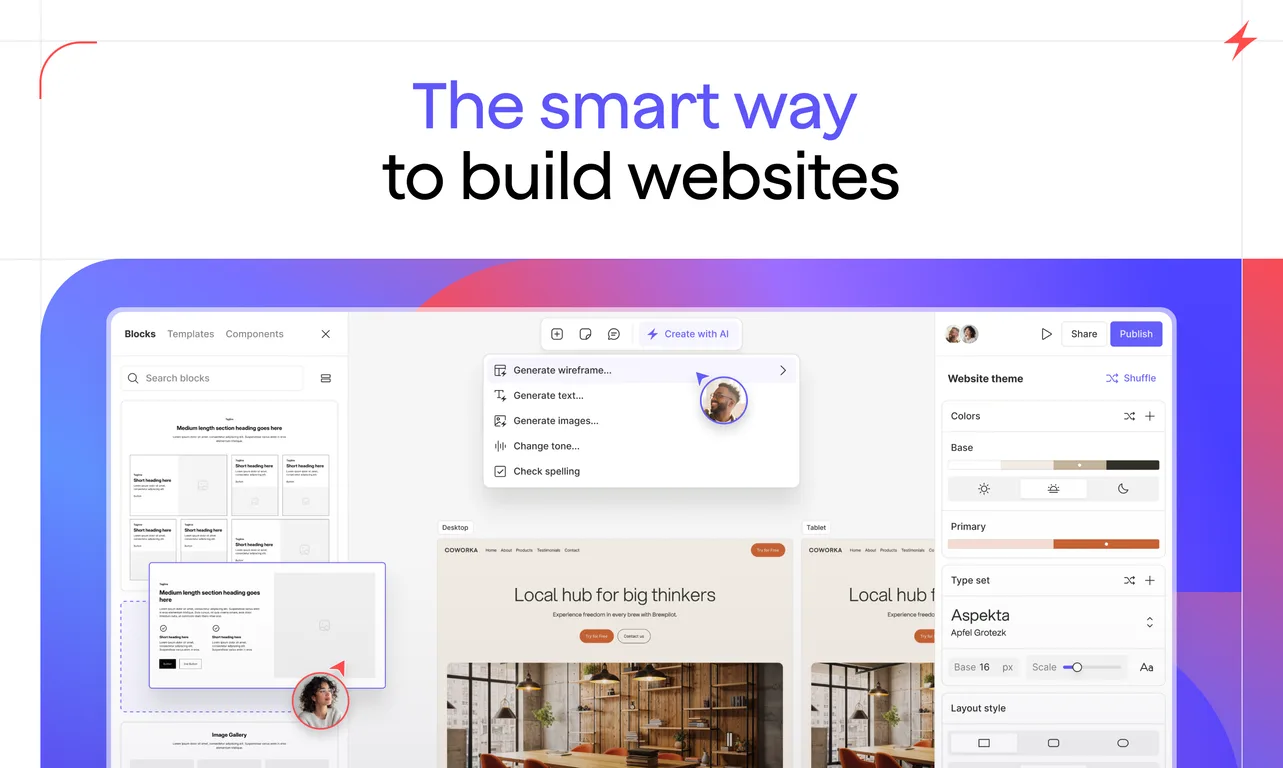
Common queries about Scene answered
Muse is the built-in AI system of Scene designed to assist web designers throughout all stages from concept to deployment. It is instrumental in tasks such as refining website briefs, researching competitors, generating wireframes, and drafting web copy.
Scene assists in the web design process by streamlining every stage from concept to deployment in a single workspace. With the integrated AI, Muse, Scene helps with refining website briefs, researching competitors, generating wireframes, and writing web copy. Additionally, Scene's adaptive block system allows designs for all screens to be developed simultaneously.
Real ratings and feedback from the community
Be the first to share your rating and comments for this AI tool!
How Scene stacks up against top competitors
| Feature | Scene | Framer | Yacss | Stunning |
|---|---|---|---|---|
| Rating | ★ 3 | — | — | ★ 3 |
| Pricing Model | freemium | freemium | paid | free_trial |
| API Access | No | No | No | No |
| Open Source | No | No | No | No |
| Link | Visit Website | Visit Website |
Explore similar AI tools in this category
Absolutely, Scene fosters an environment conducive to team collaboration during design projects. It allows visual co-creation where team members and clients can brainstorm, develop briefs, and propose changes within a single integrated workspace.
The adaptable block system in Scene simplifies the creation of responsive designs. With this feature, designs for all screen sizes can be created at once which subsequently maximizes design efficiency and ensures the site's layout stays consistent across various devices.
One-click publishing in Scene enables users to instantly launch their web designs. This function not only expedites the publishing process but also confirms that what is designed is exactly what will be published, ensuring a perfect replication of the created design.
Scene is available for use at no cost. However, there are upcoming premium plans which will necessitate a fee for advanced features and services.
Yes, Scene does offer hosting services. Users can host their website for free on the Scene.io domain, and there's also an option to publish on custom domains for a transparent and affordable price.
Scene's free plan allows usage of the full library of building blocks, unlimited conversations with Muse AI, and the ability to publish on a custom domain with a limit of 2 active projects. The future Pro plan, on the other hand, will offer unlimited project creation, unlimited editors and viewers, access to version history, and the capability to export web design work to Webflow.
Scene considers feedback from its user community for continuous improvement. The exact medium of communication is not explicitly stated on their website, which could range from feedback forms, surveys, or through social channels like their Scene community on Slack.
In Scene's free plan, users can have up to 2 active projects. However, the future Pro plan provides an option for unlimited project creation.
Yes, Scene is indeed suitable for designing responsive websites. The adaptable block system of Scene allows designs to be created for all screen sizes simultaneously, ensuring a consistent and responsive web design across all devices.
Scene aids competitor research by employing its built-in AI system, Muse, which conducts competitor analysis as a part of its role in assisting designers. The specific details of what this analysis entails are not clearly stated, but it can be inferred it involves evaluating other similar websites or concepts.
Scene, through its integrated AI Muse, offers assistance in drafting web copy. This feature alleviates the burden from designers to produce copy, allowing them to focus on other critical aspects of the design process.
Scene's upcoming premium plans, specifically the Pro plan, offer access to version history records. This feature could provide valuable insights into the progression and evolution of a design project over time.
Scene actively fosters creativity during the design phase, including brainstorming. With visual co-creation, Scene allows team members and clients to brainstorm ideas and create website briefs within one integrated workspace.
Yes, Scene allows clients to propose changes within the workspace. These interactive capabilities foster an environment of inclusive collaboration, enabling a more efficient and successful design process.
Yes, Scene simplifies the process of developing website briefs. Leveraging the integrated AI system, Muse, Scene allows users to refine and construct comprehensive website briefs effortlessly.
Scene's AI, Muse, helps refine website briefs by providing insights and suggestions. While the specific methods used by Muse are not explicitly stated on their website, it is clear that its function is to improve and enhance website briefs.
Muse, Scene's built-in AI assistant, is able to handle a range of tasks from the concept to the deployment of a website. These tasks include refining website briefs, researching competitors, generating wireframes, and writing and revising web copy.
Scene does offer a feature that guarantees the fidelity of design upon website launch. The one-click publishing feature ensures what is designed is precisely what will be published, safeguarding the design's fidelity upon its public release.
| Visit Website |
| Visit Website |
Automates code, layout, and integrates web technologies.
Design professional websites effortlessly with AI.


