

GradeAssistEssay grading AI Tool
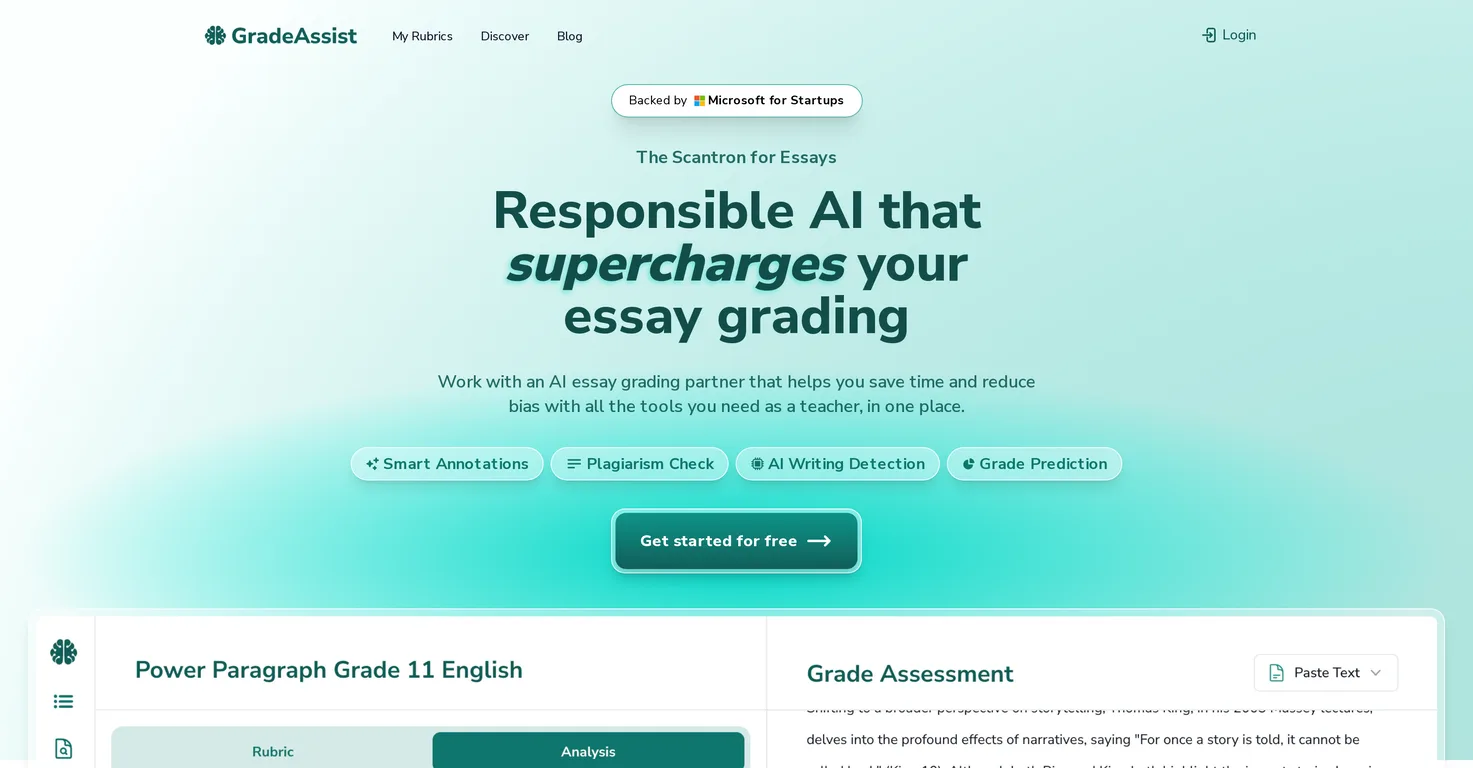
GradeAssist makes grading essays fast and easy.
Essay grading1 views
GradeAssist makes grading essays fast and easy.
Overall
Average of 1 data signal below
3 of 4 content areas filled (features, FAQs, pros/cons, description)
This score is calculated automatically from this listing's available data (community rating, capabilities, pricing transparency, and documentation). It is not a paid or sponsored review.
Pricing & Model
paid
Open Source & API
Proprietary
No Public API
Foundational Model
Proprietary Engine
Key Integrations
Web App Only
Common queries about GradeAssist answered
GradeAssist allows teachers to input their own custom rubric criteria. This user-defined criteria is then used as the basis for the AI analysis of students' essay submissions.
Yes, GradeAssist incorporates a plagiarism checker to promote academic integrity. It compares student submissions with existing works to identify potential cases of plagiarism.
GradeAssist's grade prediction tool works by employing AI analysis based on individual teacher's criteria. It calculates a student's final grade and provides a detailed breakdown, helping to streamline and support the grading process.
Real ratings and feedback from the community
Be the first to share your rating and comments for this AI tool!
How GradeAssist stacks up against top competitors
| Feature | GradeAssist | EasyMark | EssayChecker | GradeWrite |
|---|---|---|---|---|
| Rating | ★ 3 | — | ★ 3 | — |
| Pricing Model | paid | freemium | free | freemium |
| API Access | No | No | No | No |
| Open Source | No | No | No | No |
| Link | Visit Website | Visit Website |
Explore similar AI tools in this category
EasyMark is an AI-powered platform designed to automate grading, generate personalized feedback, and ensure academic integrity for educators. It streamlines the assessment process, saving teachers significant time while providing data-driven insights to improve student learning outcomes across various assignment types.
EssayChecker is an AI-powered essay grading tool that provides instant, accurate and reliable essay analysis for users at all education levels. This tool not only grades the essay but also gives detai

GradeWrite is an artificial intelligence (AI) tool designed to assist in grading assignments and essays. This tool is tailored for educators and offers the facility to upload bulk assignments, offerin
Yes, GradeAssist has a feature called AI Writing Detection. This technology helps teachers discern human-written texts, even from partially written AI texts, safeguarding academic integrity.
GradeAssist uses AI technology to analyze student submissions against teacher-determined rubric. It helps in pinpointing successes and areas for improvement, identifies potential plagiarism, predicts grades, and detects AI-generated text. However, it keeps teachers in control of the final decision, thus acting as a support tool rather than a substitute.
No, GradeAssist does not eliminate the role of teachers in the grading process. It merely acts as a suite of tools that assist teachers by providing an objective preliminary analysis on student work and reducing the time they need to spend on grading.
Yes, GradeAssist can streamline the essay grading process. It performs a range of tasks such as detailed AI feedback, predicting grades based on teacher-specific criteria, plagiarism checking, and AI writing detection. It enables teachers to provide accurate, objective and comprehensive grading faster.
Yes, GradeAssist includes features that aim to prevent grading bias. By providing a preliminary objective analysis based on teacher-defined rubric criteria, it ensures the grading process is as impartial as possible.
Yes, GradeAssist analyzes essay submissions based on teacher-determined rubrics. It utilizes AI technology to perform a detailed evaluation of the essays against the provided rubrics and teacher-set standards.
Yes, GradeAssist provides feedback on essay submissions. It uses AI to analyze the text against the teacher's rubric and pinpoints areas of success and those that require improvement.
GradeAssist's grade prediction feature aims to be as accurate as possible. While some students may receive final marks 1% above their predicted grade, a variation within ± 5% is considered normal.
No, additional tools aren't needed for plagiarism checking when using GradeAssist. It includes a built-in plagiarism checker along with citation technology for promoting academic integrity.
GradeAssist's AI Writing Detection technology works by identifying patterns that differentiate human-written text from AI-generated text. It enables teachers to ensure the integrity of the submitted work.
Yes, GradeAssist is designed to save grading time for educators. It provides an objective preliminary analysis, streamlines grade calculation and feedback provision, which all collectively contribute to more efficient grading.
GradeAssist enhances the objectivity of assessment by using AI to provide an unbiased evaluation of student work based on teacher-defined rubric criteria. This helps to minimize susceptibility to human error or bias.
Yes, GradeAssist has built-in citation technology. It complements the plagiarism checker by ensuring correct referencing and citation.
According to information on the website, it's easy to integrate GradeAssist into the grading process. Teachers simply need to copy the 'Level 4' section of their rubric, and GradeAssist will take care of the rest.
The 'Smart Annotations' feature in GradeAssist operates by analyzing the text in student submissions with precision. It cross-references the teacher's rubric criteria to pinpoint successes and areas for improvement, thus saving time while providing comprehensive feedback.
Yes, GradeAssist features an AI Writing Detection that has the ability to differentiate between human and AI generated text. This is crucial in maintaining the academic integrity of submitted essays.
Yes, there is a free trial option for GradeAssist. The website provides a 'Get started for Free' option, simplifying the process for educators to test and explore the functionalities of the tool.
| Visit Website |
| Visit Website |

AI Essay Grader provides instant, AI-powered feedback on essays, checking grammar, spelling, style, and content. It helps students and writers improve their writing skills efficiently by offering detailed analysis and grade predictions.


