

GPT LawLegal advice AI Tool
Legal info retrieval & understanding.
Legal advice0
Legal info retrieval & understanding.
Overall
Average of 1 data signal below
3 of 4 content areas filled (features, FAQs, pros/cons, description)
This score is calculated automatically from this listing's available data (community rating, capabilities, pricing transparency, and documentation). It is not a paid or sponsored review.
Pricing & Model
freemium
Open Source & API
Proprietary
No Public API
Foundational Model
Proprietary Engine
Key Integrations
Web App Only
Common queries about GPT Law answered
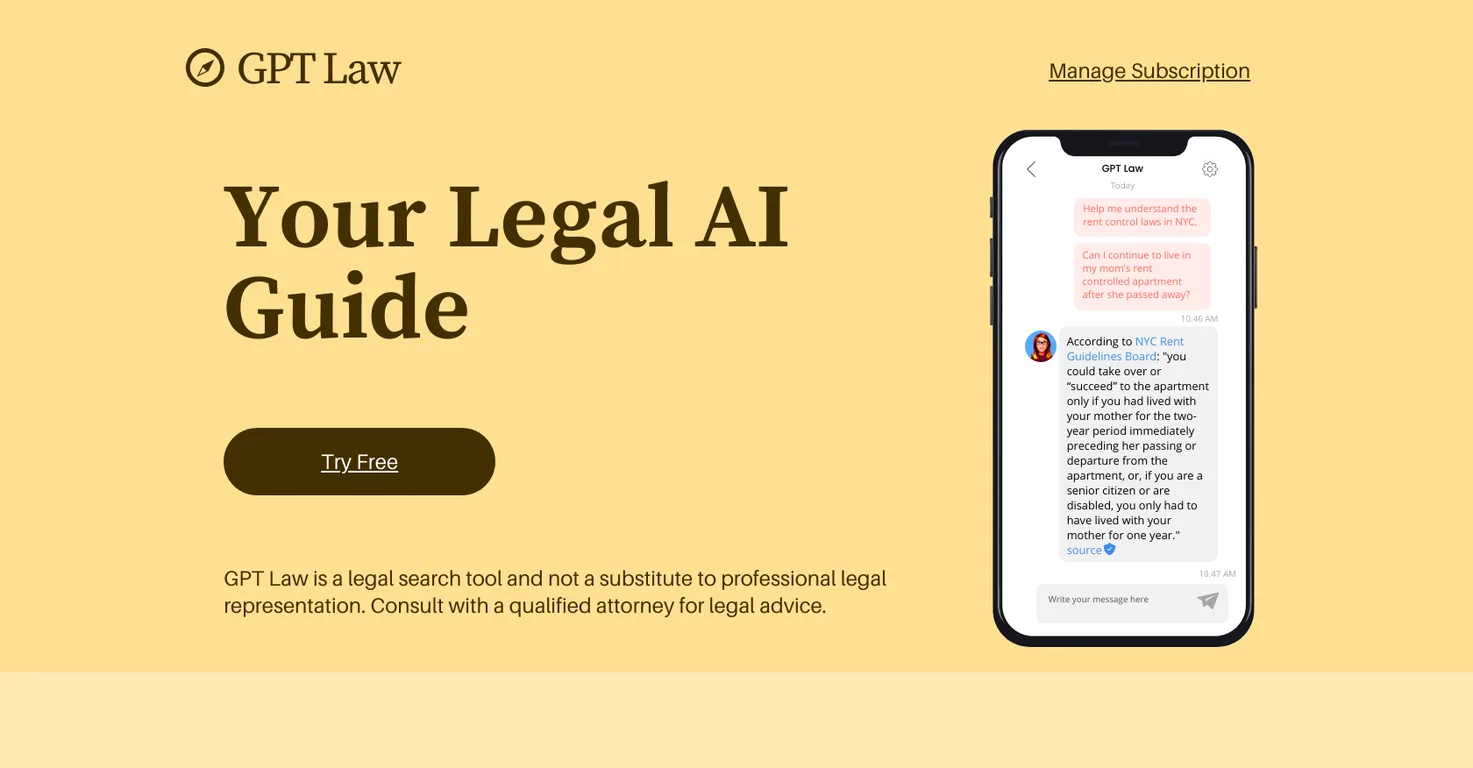
GPT Law is a legal search tool that aids users in understanding US laws, past cases, and regulations. It provides information in plain language, covering various areas of law including family, divorce, personal injury, employment, tenant-landlord disputes, and consumer rights. Its focus is empowering individuals by facilitating their legal journey and allowing them to regain control of their future.
GPT Law stands out due to its emphasis on helping users understand complex legal information in plain language. It aims to empower users, reduce costs, and speed up resolution by making legal information and explanations accessible. However, it is not a substitute for professional legal representation.
Real ratings and feedback from the community
Be the first to share your rating and comments for this AI tool!
How GPT Law stacks up against top competitors
| Feature | GPT Law | Paralegal AI | Layman Law | Casetext |
|---|---|---|---|---|
| Pricing Model | freemium | freemium | freemium | free_trial |
| API Access | No | No | No | No |
| Open Source | No | No | No | No |
| Link | Visit Website | Visit Website | Visit Website |
Explore similar AI tools in this category
No, GPT Law is a legal information tool and not a substitute for professional legal representation. It advises users to consult with a qualified attorney for legal advice.
GPT Law provides support for several areas of law. It includes information on family and divorce, personal injury, employment, tenant landlord disputes, and consumer rights.
GPT Law operates exclusively in English.
No, GPT Law is designed exclusively for US law and does not provide support for laws outside of the United States.
GPT Law offers a user-friendly interface where users can enter their legal questions and receive relevant information.
GPT Law has a specific privacy policy to ensure user privacy. Details about its privacy measures can be found in the privacy policy.
The terms of service for GPT Law are available on their website. They provide clarity about the legal limitations of the tool.
IDK
Yes, GPT Law can assist with tenant landlord disputes by providing relevant legal information and explanations.
GPT Law provides explanations of legal information in plain language, making it easier for users to understand complex legal concepts and statutes.
Yes, GPT Law provides information and understanding for personal injury cases among other areas of law.
No, the search results provided by GPT Law are not considered legal advice. They aim to help users understand legal information but GPT Law advises users to consult with a qualified attorney for legal advice.
The privacy policy of GPT Law can be accessed through the relevant link on their website.
The limitations of GPT Law include being a legal information tool and not a substitute for professional legal representation. Also, it provides services exclusively for US law and operates only in English.
Yes, GPT Law has a feature to search for information about past cases to help users understand prior decisions and outcomes.
Yes, GPT law helps users understand US regulations by providing explanations in plain terms.
IDK
GPT Law can assist with family and divorce issues by helping users understand relevant laws, regulations, and past cases in these areas of law.

Lovable
Lovablev2.2 turns your app ideas into live web apps instantly with AI and simple prompts-no coding required for fast MVPs and prototypes.


