AiAnyTool - Best AI Tools Directory and Artificial Intelligence Software Hub Logo
Loading theme toggle
Real-Time Coverage

AI News Today

Live

10540 stories from 30+ sources, refreshed continuously.

arXiv cs.AIResearch

Quantifying the Memorization-to-Generalization Transition: Scaling Laws and Phase Structure in Grokking

arXiv:2609.10657v1 Announce Type: new Abstract: Neural networks trained past memorization frequently undergo a delayed transition to generalization, a phenomenon known as grokking. Despite theoretical progress on \emph{why} this transition occurs, the quantitative structure of \emph{when} it occurs in hyperparameter space remains uncharacterized. We map the memorization-to-generalization boundary across 384 configurations of two-hidden-layer MLPs on modular arithmetic, fitting a power-law scalin

Read source article
arXiv cs.AIResearch

An Open Recipe for IMO Gold: Training Nemotron for Olympiad Mathematics

arXiv:2609.10712v1 Announce Type: new Abstract: We study how model post-training and test-time inference design affect natural-language proof generation for hard olympiad mathematics. Starting from Nemotron 3 Ultra, we train two specialist checkpoints using supervised fine-tuning and reinforcement learning, and evaluate checkpoint choice, verification, and refinement. Based on these findings, we present an open-model test-time-compute pipeline. The system operates entirely in natural language, w

Read source article
arXiv cs.AIResearch

Finishing the Task Is Not Enough: Evaluating Agent Resilience and Considerate Participation under Accumulating Challenge

arXiv:2609.10724v1 Announce Type: new Abstract: Sustained deployment of generative AI agents requires more than isolated task success. Agents must remain useful across repeated interactions, changing conditions, and dependencies on people within shared workflows, especially as technical, human, and operational disruptions accumulate over time. We propose operational resilience and considerate participation as two complementary aspects of evaluating such agents: the former captures how agents rec

Read source article
arXiv cs.AIResearch

Towards a Deterministic Math Solver for Clinical Language Models

arXiv:2609.10728v1 Announce Type: new Abstract: Large language models are unreliable at arithmetic, which is a problem for clinical calculators where a single numerical error changes the recommendation. The standard response is to hardcode each calculator as a validated function, one at a time. We test an alternative: the model does not calculate. Instead, it writes case-specific Python that a restricted local executor runs as a deterministic solver, and the model's task reduces to deciding how

Read source article
arXiv cs.AIResearch

Studying Without a Syllabus: Task-Agnostic Environment Preprocessing

arXiv:2609.10824v1 Announce Type: new Abstract: Before an LLM agent tackles tasks in a new environment, it can inspect available corpora and tools and construct reusable resources such as indices, scripts, or procedural guidance. Most automated adaptation methods, however, rely on task examples, trajectories, or evaluation feedback to decide what to build. Existing task-agnostic approaches avoid this supervision but commit in advance to a preparation strategy for a particular type of environment

Read source article
arXiv cs.AIResearch

When Validation Stops Learning: Auditing Update Admission for Continual Embodied Agents

arXiv:2609.10873v1 Announce Type: new Abstract: Independent evaluation can reject harmful policy updates yet also prevent useful continual learning. We argue that update admission must be assessed through both error control and retained learning opportunities at a stated interaction budget. We identify a concrete failure: a range-based confidence gate cannot certify unchanged old-task behavior within otherwise substantial budgets. A standard paired-binomial construction reduces this burden when

Read source article
arXiv cs.AIResearch

Decoupling Readiness from Release for Tail-Aware Scheduling of Agentic LLM Workflows

arXiv:2609.10964v1 Announce Type: new Abstract: Agentic LLM workflows consist of sequences of model turns interleaved with tool interactions, so their end-to-end completion time depends not only on inference speed but also on when ready turns are released. Most runtimes release each turn immediately upon readiness. Under contention, this eager release policy can accumulate released but unfinished work; once submitted, those turns can no longer be reordered by the workflow-level policy, increasin

Read source article
arXiv cs.AIResearch

Demystifying the Privacy-Utility Trade-off in LLM Interactions

arXiv:2609.10992v1 Announce Type: new Abstract: The integration of Large Language Models into daily tasks relies on context-rich instructions, inevitably exposing sensitive user information. Current privacy-preserving methods typically employ context-agnostic static rules, causing severe utility degradation. However, the specific mechanisms governing how sanitization impacts downstream performance remain largely underexplored. To address this, we conduct a systematic analysis to deconstruct the

Read source article
arXiv cs.AIResearch

Defining AI Agents: A Compendium of Criteria, Metrics, and Benchmarks

arXiv:2609.11018v1 Announce Type: new Abstract: The term agent in artificial intelligence lacks a standard definition, complicating the evaluation, comparison, and reproducibility of AI agent research. We address this ambiguity through a survey organized around five dimensions of agenticness: environmental interaction, learning and adaptation, autonomy, goal-directed behavior, and temporal coherence. For each dimension, we examine how the underlying capability has been conceptualized across prio

Read source article
arXiv cs.AIResearch

The Agent Incident Registry: Toward Preventing Repeated AI Agent Failures

arXiv:2609.11030v1 Announce Type: new Abstract: AI agents increasingly act through tools and delegated authority, but general incident repositories rarely capture the mechanisms needed to compare public failures with agent-security evaluations. We present the Agent Incident Registry (AIR), a source-linked catalog containing \N{} records of agent-related events disclosed from \Yfirst{} through \Ylast{}. Each record includes supporting evidence, a stable identifier, and missingness-aware labels fo

Read source article
arXiv cs.AIResearch

Grounding Agent Memory: Environment-Probing Curation for Enterprise Agents

arXiv:2609.11060v1 Announce Type: new Abstract: Persistent memory is entering production-oriented agent platforms to help long-horizon agents accumulate experience across sessions. Yet a post-task curator agent restricted to completed trajectories can preserve errors, overgeneralize partial evidence, or retain stale knowledge. We introduce environment-probing curation, a deployment-compatible extension that gives an existing asynchronous curator agent least-privilege, read-only world tools to ch

Read source article
arXiv cs.AIResearch

MOSAIC: Query-Aware Exploration Policy Adaptation for GraphRAG

arXiv:2609.11065v1 Announce Type: new Abstract: Graph Retrieval-Augmented Generation (GraphRAG) can connect evidence distributed across a corpus graph, but most systems use largely shared exploration procedures across queries. This creates a structural mismatch: direct facts may need compact local neighborhoods, comparisons need balanced coverage of multiple targets, and mediated questions may require deeper paths through weakly related connectors. We present Mosaic, a training-free framework th

Read source article
arXiv cs.AIResearch

Benchmark Radar: A Living Database and Search Engine for AI Benchmarks and Evaluation

arXiv:2609.11115v1 Announce Type: new Abstract: Benchmark researchers and developers of large language models (LLMs) and other AI systems need to find relevant evaluations, locate their benchmark datasets and code, and understand the settings behind reported scores. We present Benchmark Radar, a living database and search engine for retrieval and discovery of AI benchmarks, covering LLM evaluation, agentic and tool-use benchmarks, coding, reasoning, safety, and domain-specific evaluations. The s

Read source article
arXiv cs.AIResearch

KuaiRP Series Role-playing Models Technical Report

arXiv:2609.11127v1 Announce Type: new Abstract: This paper introduces the complete technical solution for the KuaiRP series of role-playing models. We aim to achieve four core objectives for a dedicated role-playing model: simplified prompt engineering, highly stable output quality, built-in domain world knowledge, and high-efficiency deployment with a small parameter size. However, effectively injecting deep domain knowledge often leads to a severe catastrophic forgetting of the model's general

Read source article
arXiv cs.AIResearch

Same Day, Same Story; One Day Ahead, a Different Signal: The Dual Validity of Financial Sentiment

arXiv:2609.11144v1 Announce Type: new Abstract: Financial NLP has a standard workflow: validate a sentiment tool against human labels, then trust it to extract market signal. This assumes the two evaluations measure the same thing. We test that assumption in a setting where both can be measured at once: a corpus of securities class actions (2002-2025) linking 70,500 X messages to abnormal stock returns, with a single-annotator human labelled gold sample. Running five instruments (VADER, Loughran

Read source article
arXiv cs.AIResearch

The Oligarch Barely Steers Model Collapse in Multi-Model Ecosystems

arXiv:2609.11146v1 Announce Type: new Abstract: AI-generated text is flowing back into the training corpora of the next generation of models. Recursive training on it drives model collapse, and recent work extends the setting to many models feeding one another -- but almost always with the market split evenly, while real generative AI is an oligopoly. Concentration raises two worries: fewer, more uniform sources may make collapse faster, and later models may be dragged toward the oligarch's outp

Read source article
arXiv cs.AIResearch

Autonomous Chemical Mechanistic Discovery through Agentic Reasoning and Validation

arXiv:2609.11147v1 Announce Type: new Abstract: Unraveling reaction mechanisms is central to modern chemistry, yet automating these investigations remains challenging because computational workflows still rely heavily on expert intervention. Here we introduce ARCHE, an autonomous agentic system that integrates a general-purpose reasoning model, a domain-specialized computational chemistry model, and a structured tool registry to transform mechanistic inquiry into a scalable, self-validating proc

Read source article
arXiv cs.AIResearch

DRG-MAPPO: Hierarchical Dynamic Role-Graph Multi-Agent Reinforcement Learning for Cooperative Air Combat

arXiv:2609.11155v1 Announce Type: new Abstract: Multi-Agent Reinforcement Learning (MARL) has emerged as a pivotal paradigm for complex decision-making in autonomous systems and air combat. While MARL has demonstrated significant potential in air combat, achieving sophisticated tactical coordination remains a non-trivial challenge. This difficulty is largely attributed to two primary limitations: (1) the absence of structured relational modeling hinders agents from capturing complex, time-varyin

Read source article
MIT Tech ReviewResearch

Roundtables: Could AI really kill us all?

Employees at the world’s leading AI labs are saying there’s a real possibility that advanced AI could destroy humanity. Are they right? Or is this more scaremongering and hype? Join MIT Technology Review executive editor Niall Firth for a conversation with senior AI editor Will Douglas Heaven and AI reporter Grace Huckins unpacking AI extinction…

Read source article
r/MachineLearningResearch

Training a 210M text-to-image DiT from scratch on one GPU: what I measured [P]

<table> <tr><td> <a href="https://www.reddit.com/r/MachineLearning/comments/1wdfmvq/training_a_210m_texttoimage_dit_from_scratch_on/"> <img src="https://preview.redd.it/7vrhqzf32woh1.png?width=140&height=71&auto=webp&s=9f2d1cb4a1a423d2fc5a5f1c55ef4aa6774a23b7" alt="Training a 210M text-to-image DiT from scratch on one GPU: what I measured [P]" title="Training a 210M text-to-image DiT from scratch on one GPU: what I measured [P]" /> </a> </td><td> <!-- SC_OFF --><div class="md"><p>I trained a 210

Read source article
Training a 210M text-to-image DiT from scratch on one GPU: what I measured [P]
Apple Machine LearningResearch

DiscoSign: Discourse-Aware Text to Sign Language Gloss Translation

Sign language processing systems have traditionally operated at the sentence level, ignoring critical discourse phenomena fundamental to sign language comprehension. We introduce DiscoSign, a computational approach for discourse-aware text to sign language gloss translation grounded in linguistic research. We address three key phenomena within our modular Large Language Model (LLM)-based translation framework: (i) spatial coreference resolution, where entities maintain consistent spatial locatio

Read source article
Apple Machine LearningResearch

Putting Captions to the Test: Evaluating Video Caption Quality through Multiple-Choice Question Answering

Evaluating video captioning remains a critical challenge for Visual Large Language Models (VLLMs). Existing metrics primarily rely on matching generated text against ground-truth references. This paradigm suffers from the “one-to-many” nature of video description, where high-quality captions are often penalized for lexical mismatches or valid shifts in visual focus. Furthermore, such assessments are typically one-dimensional, failing to provide a fine-grained analysis of caption quality. To addr

Read source article
Apple Machine LearningResearch

SimpleDesign: A Joint Model for Protein Sequence and Structure Codesign

Proteins are fundamental to biological processes, with their function determined by the complex interplay between the amino acid sequence and the three-dimensional structure. Developing generative models capable of understanding this intrinsically multi-modal relationship is crucial for fields like drug discovery and protein engineering. Existing models often rely on a multi-stage training process where autoencoders that tokenize data into latent representations are trained in a first stage. Sec

Read source article
NVIDIA BlogResearch

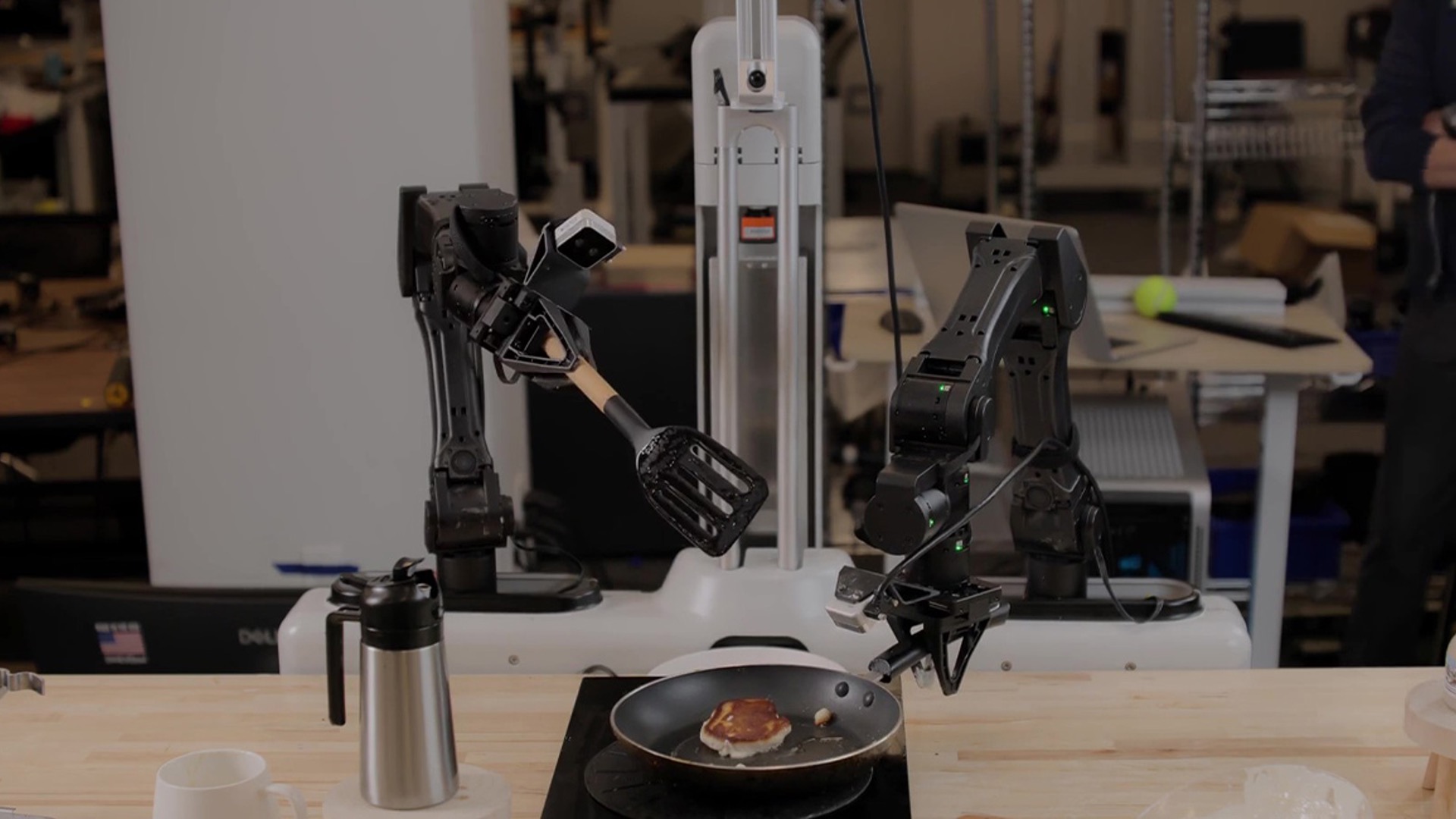
Skild AI Taps NVIDIA Physical AI to Teach Robots New Tasks From a Single Video

Manufacturing floors, warehouses and production lines rarely stay fixed — tasks change, layouts shift and new products arrive, and most robots can’t keep up without significant reprogramming. Skild AI’s new S1 robot foundation model helps address this, designed to learn previously unseen, long-horizon tasks from a single video demonstration. The model, launched last week, uses […]

Read source article
Skild AI Taps NVIDIA Physical AI to Teach Robots New Tasks From a Single Video
NVIDIA BlogResearch

Physical AI Takes the Wheel: How the World’s Robotaxi Leaders Are Building With NVIDIA Technologies

The global robotaxi market — physical AI’s first commercial breakthrough — is projected to reach $400 billion by 2035, with over 6 million commercial vehicles in operation as driverless fleets are already moving people through some of the world’s busiest and most complex streets. Deploying a driverless vehicle is one challenge. Scaling a fleet is […]

Read source article
Physical AI Takes the Wheel: How the World’s Robotaxi Leaders Are Building With NVIDIA Technologies
NVIDIA BlogResearch

d-Matrix Adopts NVIDIA NVLink Fusion for Rack-Scale XPU Deployment

AI inference chipmaker d-Matrix today announced it will use NVLink Fusion to connect its next-generation Raptor XPUs to NVIDIA’s AI infrastructure platform — joining a growing roster of ecosystem partners. By connecting Raptor to NVIDIA NVLink scale-up and Spectrum-X scale-out networking, the NVIDIA MGX rack architecture and the broader NVIDIA AI platform, NVLink Fusion gives […]

Read source article
d-Matrix Adopts NVIDIA NVLink Fusion for Rack-Scale XPU Deployment
MIT Tech ReviewResearch

Powering AI is an architecture problem

On July 22, 2026, a transmission line fault in Ashburn, Virginia—the heart of the world’s largest data center cluster—knocked more than 3 gigawatts of load off the grid in seconds. And it wasn’t the first time. Two years earlier, a single failed surge arrester dropped roughly 60 Virginia facilities and 1,500 megawatts at once. No…

Read source article
Powering AI is an architecture problem
MIT Tech ReviewResearch

Healthcare AI’s next test is integration

The entrance of major AI companies into healthcare is a meaningful and welcome development, accelerating the technical foundation available to the industry. Their models are increasingly capable of processing long clinical records, interpreting complex terminology, comparing documentation against evidence and generating coherent summaries from large volumes of information. For clinicians, operators, and administrative teams who…

Read source article
Healthcare AI’s next test is integration
arXiv cs.CL (NLP)Research

X-CoSD: Communication-Efficient Cross-Vocabulary Collaborative Speculative Decoding

arXiv:2609.09166v1 Announce Type: new Abstract: This paper investigates collaborative speculative decoding (CoSD), a distributed large language model (LLM) inference framework in which an on-device small language model (SLM) drafts candidate tokens and a server LLM verifies them. Existing CoSD methods assume a shared vocabulary between the SLM and the LLM and incur substantial communication load because residual resampling requires token distribution exchange between the user device and the edge

Read source article
arXiv cs.CL (NLP)Research

StochBench: A Domain-Specific Benchmark for Stochastic Processes in Lean

arXiv:2609.09264v1 Announce Type: new Abstract: Leading benchmarks for formal theorem proving with large language models are small collections drawn from competition math, such as the IMO and Putnam, that poorly represent field-specific applications. We introduce StochBench, a Lean 4 benchmark of 450 graduate stochastic-processes problems at varying abstraction levels, each paired with its natural-language source. Addressing a field underrepresented in Mathlib, it covers finite and countable Mar

Read source article
arXiv cs.CL (NLP)Research

Osprey: Target-agnostic Pre-training Makes Stronger Drafters in Speculative Decoding

arXiv:2609.09338v1 Announce Type: new Abstract: Speculative decoding is critical for accelerating LLM inference. However, the speedup is fragile: drafters are typically trained against a narrow distribution for a single target model, and their acceptance rate collapses under workload shifts. This is a striking inversion of modern LLM development, where target models are valued precisely for the broad generalization they acquire through large-scale pretraining. We argue that the natural remedy, p

Read source article
arXiv cs.CL (NLP)Research

SWORD: Wikidata-based Distortions Reveal Hidden Cross-Lingual Inconsistencies in LLM Factual Error Rejection

arXiv:2609.09349v1 Announce Type: new Abstract: Modern LLMs demonstrate impressive multilingual performance, yet standard benchmarks primarily reward selecting correct answers rather than evaluating genuine factual understanding. We introduce Systematic Wikidata-based Object-Relation Distortion (SWORD), a benchmark that evaluates whether models consistently reject factual errors across languages. SWORD generates syntactically well-formed but factually incorrect statements in eight widely spoken

Read source article
arXiv cs.CL (NLP)Research

Auditable Emergency Triage for Maternal and Newborn Care in India

arXiv:2609.09356v1 Announce Type: new Abstract: At Noora Health, our nurses answer more than 50,000 medical queries per month on our WhatsApp-based service that provides caregivers with on-demand support. Their most time-critical task is emergency triage: deciding which queries need immediate in-person attention. To support them, we built a system that uses a large language model (LLM) to classify whether a message is an emergency and provide a rationale for interpretability. But the system was

Read source article
arXiv cs.CL (NLP)Research

Do LLMs Make More Mistakes If They Do Not Believe the Input Data?

arXiv:2609.09363v1 Announce Type: new Abstract: Large language models (LLMs) are prone to hallucinating or misinterpreting facts, which impairs their usability in retrieval-augmented generation or data-to-text systems. We analyse how faithfulness of LLMs to provided context depends on how plausible they perceive the context to be (context-memory conflict). To better identify error patterns, we make use of the increased difficulty of non-English and low-resource language text generation and input

Read source article
arXiv cs.CL (NLP)Research

Benchmarking Hybrid Deep Research Across Database Querying and Web Search

arXiv:2609.09410v1 Announce Type: new Abstract: While autonomous agents have made significant strides in "deep research" by iteratively navigating the open web to synthesize information, real-world problem-solving is rarely confined to a single environment. Complex analytical tasks inherently require agents to weave together evidence from both ambiguous unstructured text (e.g., the open web) and highly precise structured data (e.g., relational databases). However, existing benchmarks evaluate th

Read source article
arXiv cs.CL (NLP)Research

Edu-QuRating: Multi-Dimensional Educational Data Curation with Distilled Pairwise Judgements

arXiv:2609.09425v1 Announce Type: new Abstract: Educational data filters have become a practical way to improve language-model pre-training, but most filters treat educational value as a single scalar property. This may be too broad for some applications, especially if the data set already features a high density of educational material. Useful learning material needs to be accurate, engaging, well structured, and appropriate for the intended audience and application (e.g. learner- vs teacher-fa

Read source article
arXiv cs.CL (NLP)Research

The Mutations of Machine Speech

arXiv:2609.09496v1 Announce Type: new Abstract: Algorithmic outputs now populate the digital environments through which contemporary life is organized. The role of law in facilitating and constituting (rather than merely responding to) these processes is gaining increasing traction across scholarly accounts. This inquiry traces the evolution of algorithmic outputs attending to their legal underpinnings and social implications, surfacing the mutations of machine speech. The first mutation redefin

Read source article
arXiv cs.CL (NLP)Research

BuzzASR: A Swarm of 100+ Monolingual Speech Recognition Models

arXiv:2609.09554v1 Announce Type: new Abstract: We introduce BuzzASR, a collection of language-specialized fine-tuned Whisper models adapted for automatic speech recognition (ASR) in 102 languages. Large end-to-end Transformer-based ASR models such as Whisper have revolutionized ASR, but most prominent models are highly multilingual. As a result, these models often perform poorly on languages less well-represented in their training set. While it has long been known that effective language adapta

Read source article
arXiv cs.CL (NLP)Research

Towards Automatic Evolution Tree Generation from Citation Graphs

arXiv:2609.09561v1 Announce Type: new Abstract: Surveys remain the primary way researchers grasp the lineage of methods within an AI subfield, but they scale poorly against the current rate of publication. Existing taxonomy-induction methods are largely leaf-bound and time-agnostic; they tend to force transitional papers into mature leaves and can create topological inversions between ancestors and descendants. We propose EvoTree, a staged framework that decouples conceptual backbone learning fr

Read source article