Can Government of and by API Still Be Government ‘for the People’?
Government dependence on private AI shifts policymaking from Congress and the civil service to procurement contracts—with no public input.
Three new reports show how AI power is concentrating, and why participation has to include the right to refuse. Source
<img class="webfeedsFeaturedVisual" src="https://lawfare-assets-new.azureedge.net/assets/images/default-source/article-images/scaling-laws-logo.jpg?sfvrsn=7a7b38eb_3" /><p>Kal Clark, co-founder of Zauron Labs, joins Kevin Frazier, the AI Innovation and Law Fellow at the University of Texas School of Law and a Senior Editor at Lawfare, to explain how AI is already reducing diagnostic errors in radiology.<br /></p><p>Kal details how Zauron’s AI system functions as a second-look safety layer, revie
A review of Josh Tyrangiel’s “AI for Good: How Real People Are Using Artificial Intelligence to Fix Things that Matter” (Simon & Schuster, 2026).
<p>Washington’s misplaced assumptions around export control and domestic regulations pose strategic risks to national stability.</p>
<p>Cory Doctorow discusses his perspective on artificial intelligence. </p>
Anthropic raised the possibility of a coordinated, verified AI development pause. Antitrust law might prevent that.
Scott Anderson sat down with his <em>Lawfare</em> colleagues Kevin Frazier, Roger Parloff, and Molly Roberts to talk through some of the week’s big news in AI.
As Washington negotiates AI guardrails with Beijing, it must understand why the AI debate in China is so quiet: control, not consent.
Inside the European Union’s latest bid to achieve technological sovereignty.
By Paige Garvin, FPF Communications Intern The Future of Privacy Forum hosted its third annual DC Privacy Forum: Advancing Principled Data Protection, AI, and Digital Governance Practices on June 10th, 2026. This year’s Forum gathered government officials, academics, civil society representatives, and privacy professionals to discuss developments in AI governance, privacy regulation, youth online safety, […]

<p dir="ltr">The orders direct federal agencies to prepare to defend against cryptographic attacks and contribute to U.S. quantum computing innovation.</p>
<img class="webfeedsFeaturedVisual" src="https://lawfare-assets-new.azureedge.net/assets/images/default-source/article-images/scaling-laws-logo.jpg?sfvrsn=7a7b38eb_3" /><p>Alan Rozenshtein, Research Director at Lawfare, spoke with Robert Wright—author of <em>Nonzero</em>, <em>The Moral Animal</em>, <em>The Evolution of God</em>, and <em>Why Buddhism Is True</em>, and the writer behind the NonZero Newsletter and podcast—about his new book, <em>The God Test: Artificial Intelligence and Our Coming
The new AI executive order disclaims a licensing mandate. Federal procurement can impose one anyway.
FAccT lands in Montreal and the Vatican enters the AI debate. Both circle the same question: who holds power over AI, and who can refuse it? Source
State regulations mandating AI firms to disclose information may run afoul of the First Amendment. California is an early test case.
<img class="webfeedsFeaturedVisual" src="https://lawfare-assets-new.azureedge.net/assets/images/default-source/article-images/scaling-laws-logo.jpg?sfvrsn=7a7b38eb_3" /><p>In this cross-pod episode, Alan and Kevin join Seth Benzell and Andrey Fradkin of <a href="https://podcasts.apple.com/us/podcast/justified-posteriors/id1784022930" rel="noopener noreferrer" target="_blank">Justified Posteriors</a> to explore a big question: what should AI be for?</p><p>The conversation begins with Pope Leo XIV
The latest edition of the Seriously Risky Business cybersecurity newsletter, now on <em>Lawfare</em>.
Accuracy isn’t enough—agencies must detect when trusted AI misuses legitimate access. Enter: AI counterintelligence.
<p>Biomanufacturing data is a critical strategic asset, and the U.S. is failing to use it.</p>
A cross-post conversation about the AI and cyber executive order, workforce disruption, and the future of education.
The government is using export control law to force Anthropic to cut access to its most powerful models. The legal authority is plausible but the facts remain murky.
The country’s counterterrorism strategy cannot address the range of root causes driving conflict across different regions.
A review of Samanth Subramanian, “The Web Beneath the Waves: The Fragile Cables That Connect Our World” (Columbia Global Reports, 2025).
Scott Anderson, Benjamin Wittes, Michael Feinberg, and Molly Roberts talked through the week’s big news in national security.
WASHINGTON, D.C. — The Future of Privacy Forum, a global non-profit focused on data protection, AI, and emerging technologies, announced new recipients of its Career Achievement Award, recognizing exceptional leaders whose work has advanced privacy, responsible data governance, and AI leadership worldwide. The 2026 recipients of the FPF Career Achievement Award are: Alan Raul, FPF’s […]

Regulations that force developers to disclose trade secrets to the public could violate the Constitution. How can regulators respond?
Janel Thamkul, former frontier counsel team member at Anthropic, joins Kevin Frazier to discuss what it means to practice law at the frontier of AI. This episode starts with a review of Janel’s fascinating and varied background. Next, she walks through her initial exploration
As policymakers continue to debate youth online safety regulations, a new FPF report assesses the role of data-driven personalization and its implications for emerging policy and product design WASHINGTON, D.C. — (June 10, 2026) — The Future of Privacy Forum — a global non-profit focused on data protection, AI, and emerging technologies —today released Personalization […]
Introduction It has been an unusually active few weeks for AI safety policy. Following a new frontier model safety bill passed in Illinois, and a White House executive order on AI security, Rep. Jay Obernolte (R-CA) and Rep. Lori Trahan (D-MA) released a bipartisan discussion draft for the Great American AI Act of 2026, adding […]

On Adoption, Sovereignty, and the Questions the Strategy Leaves for Later. Source
✍️ By Ismael Kherroubi Garcia. Ismael is Founder & Co-lead of the Responsible Artificial Intelligence Network (RAIN), and Founder & CEO of Kairoi. 📌 Editor’s Note: This article is part of our Tech Futures series, a collaboration between the Montreal AI Ethics Institute (MAIEI) and the Responsible Artificial Intelligence Network (RAIN). The series challenges mainstream […] Source
Louisiana has become the 22nd U.S. state to enact a comprehensive consumer privacy law—and the third this year following Oklahoma and Alabama—after Governor Landry signed the Louisiana Data Privacy Act (LDPA) (SB 386) on May 29. Overall, this is a fairly standard state privacy law that follows the Washington Privacy Act framework apart from the law’s […]

On May 28, 2026, the 5th Circuit granted a stay on the preliminary injunction blocking enforcement of Texas’s App Store Accountability Act (ASAA)—meaning the law is now in effect while litigation on the merits continues. In 2025, Utah, Texas, and Louisiana enacted App Store Accountability Acts (ASAAs) which impose novel and significant age assurance obligations […]
Is there a role for Privacy Enhancing Technologies (PETs) to play in the context of international data transfers? The answer to this question could be one of the keys to unlock trusted cross-border data flows at scale in the age of AI. This was the topic explored in a session organized by the Future of […]
When I was in college, privacy existed but the privacy profession did not. Some cynics might say that the reverse is true now, but the reality is more complex: even amidst mounting pressures on individual privacy, there are arguably more privacy protections enshrined into law around the world than ever before. One point, though, is beyond […]

The Future of Privacy Forum (FPF) has released a suite of practitioner resources on Privacy Enhancing Technologies (PETs) for the education sector. Building on FPF’s 2025 landscape analysis of PETs adoption by State Education Agencies, the new resources move from landscape analysis to implementation considerations — providing audience-specific guidance for the three practitioner communities most […]
Connecticut’s SB 5 fits a lot of AI obligations into a small bill number. This week, Governor Lamont (D) signed the 39-section bill into law, creating new requirements across several fast-moving areas of AI policy, including companion chatbots, automated employment decision tools (AEDTs), social media, and provenance data. The law also includes provisions related to […]
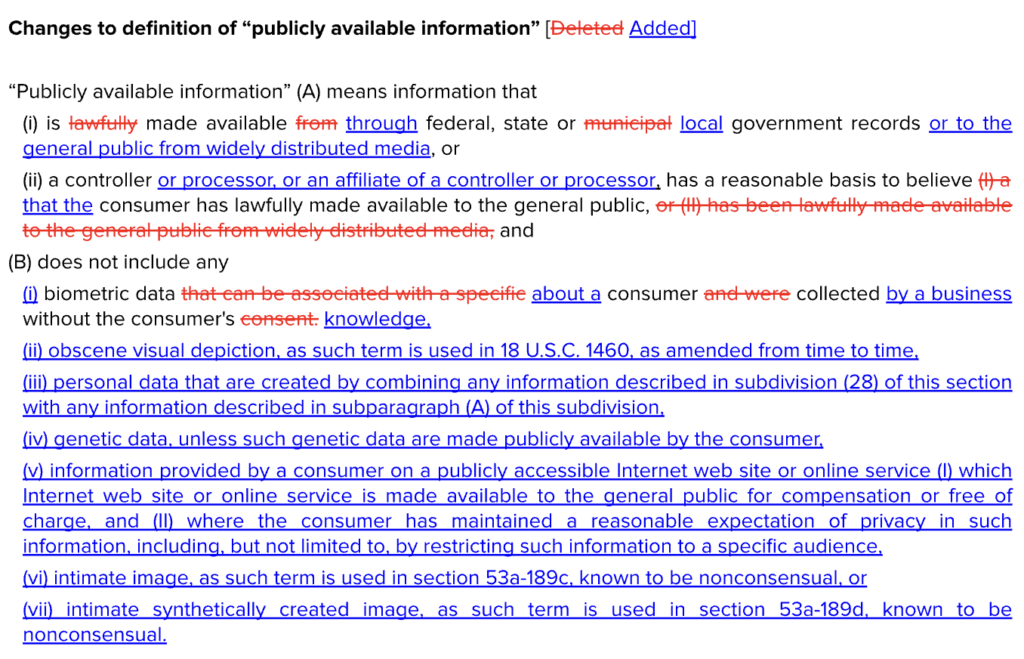
The Connecticut Data Privacy Act (CTDPA) has been revised multiple times since being enacted in 2022: SB 3 added heightened protections for consumer health data and for minors in 2023; and SB 1295 in 2025 expanded the law’s scope, updated and added consumer rights, modified the data minimization and purpose limitation requirements, prescribed impact assessment […]