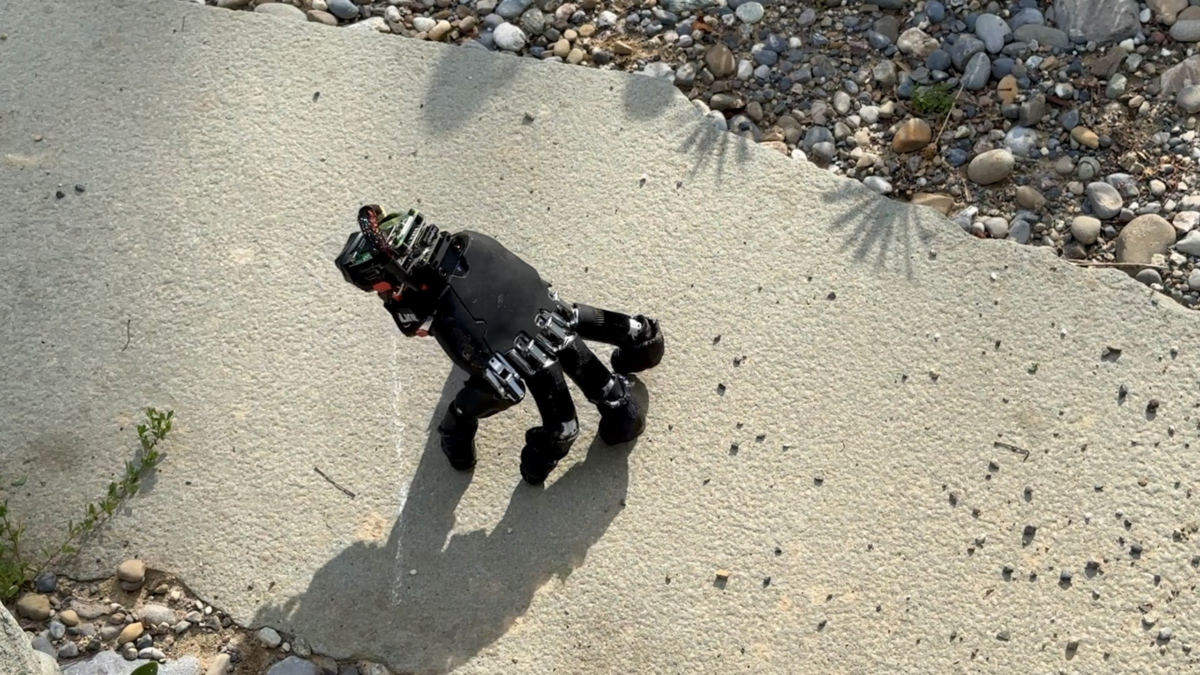
A helping hand, literally. ScienceAlert stories are written, fact-checked, and edited by humans, never generated by AI. Don't miss a story, subscribe here.
Watching a hand walk away on its fingers brings to mind Thing from The Addams Family. Heidi Klum brought a gruesome version to life this Halloween with her giant severed-hand costume.
In a Swiss robotics lab, a mechanical hand is taking its own steps toward something more useful.
Researchers at ETH Zurich taught it to walk on its fingertips, get upright after a fall, and press keyboard keys while balancing on its other fingers.
The idea is to give a robot's hand a way to work somewhere its body can't go.
"A future robot could send its hand into a space its body cannot enter, to inspect something, operate a control or move an object, then retrieve it afterward," roboticist Robert Katzschmann told ScienceAlert.
The team's study, posted as a preprint on arXiv and not yet peer-reviewed, explores how to build those abilities into a commercially available hand without redesigning its fingers.
The fingers themselves presented the first difficulty. Put your hand on a table with only your fingertips touching, then lift one finger. The others keep it steady. To walk, a robotic hand has to keep shifting that support while carrying its entire weight.
"The fingers have different lengths and a thumb off to one side, which makes walking awkward," first author and doctoral researcher Amirhossein Kazemipour told ScienceAlert.
"They also have to keep the hand balanced while interacting with objects."
Robotic hands can already perform delicate tasks, but an arm usually carries them into position. Here, the same fingers are needed to provide both movement and support.
Kazemipour, Hehui Zheng, and Katzschmann started with a WUJI robotic hand, adding a battery, a small computer, and a motion sensor. The complete setup weighs 818 grams, or about 1.8 pounds, and carries its power and computing hardware on its back.
Before the physical tests, the researchers trained its control software in simulation using reinforcement learning. Useful movements, such as progressing in the requested direction, earned numerical rewards.
Unwanted movements, such as excessive rocking, incurred penalties that lowered the score. Through repeated attempts, the system learned which actions scored highest.
To account for the unequal fingers, each fingertip received a reference position based on the hand's resting stance. Moving farther from that position reduced the score, with more freedom along the direction of travel. This guided the hand toward a workable gait without prescribing every step.
Transferring those movements to the real hand required measurements of how its joints responded to commands and how its fingertips slid against a surface.
ScienceAlert
Original Reporting Source
Explore features, ratings, and alternatives from our 19,000+ AI tools catalog.

AssistLoop's AI chatbots slash response times by 70% and boost satisfaction, scaling support for e-commerce and SaaS without extra hires.

Design professional websites effortlessly with AI.
Hypertxt.ai is an AI-powered SEO content writing tool that helps create high-quality, optimized content for improved search engine rankings. It offers various features to streamline the content creation process, from keyword research to content optimization and plagiarism checks.

