Who are you calling 'chicken'? ScienceAlert stories are written, fact-checked, and edited by humans, never generated by AI. Don't miss a story, subscribe here.
Discerning dinosaur lovers have a new name to drop when asked about their favorite dino.
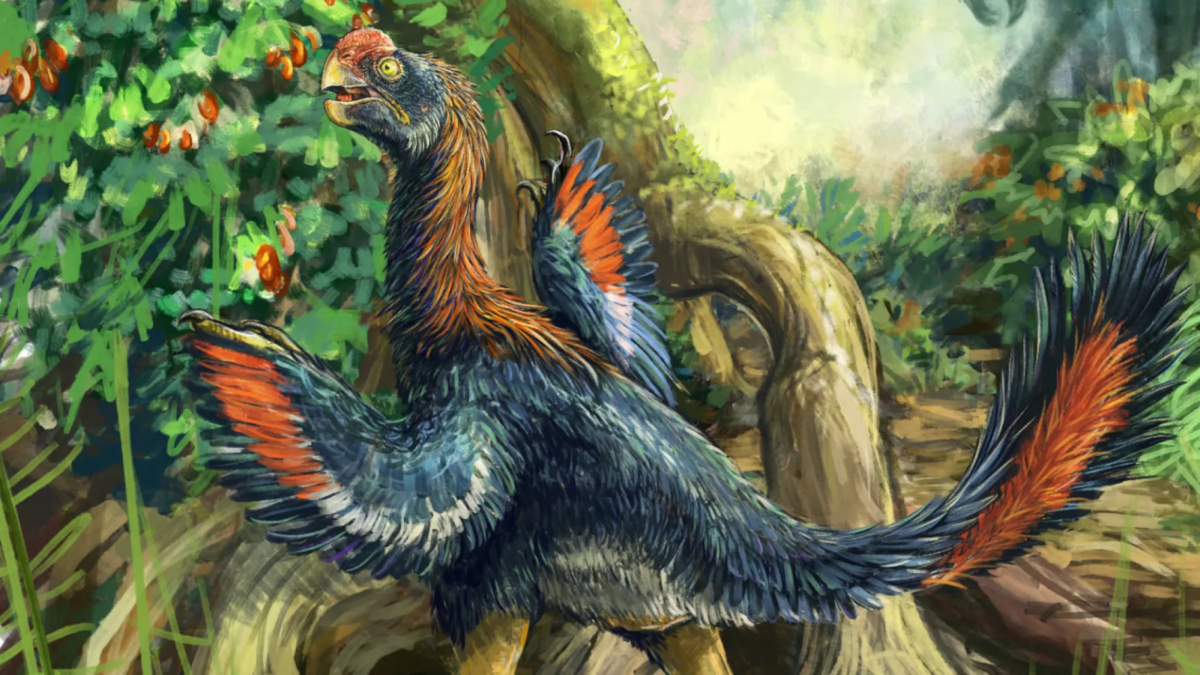
Meet Infernogallus jamesi – the 'hell chicken' that lived alongside icons like Tyrannosaurus rex and Triceratops.
Despite its fearsome name, Infernogallus was only about the size of a turkey, weighing around 12 kilograms (26 pounds).
It wouldn't have been anything to worry about – unless you were a juicy piece of fruit.
The newly named species and genus seems to have been one of the first known "frugivorous" dinosaurs.
"It's pretty rare for animals to become specialized for a diet of fruit, so when it happens, it comes with some remarkable adaptations," says Thomas Dudgeon, an evolutionary biologist at the Royal Ontario Museum in Canada.
"The anatomy of Infernogallus is bizarre among dinosaurs, and we quickly realized that we were dealing with something special."
In a new paper published in Nature Communications, scientists from the US and Canada formally described Infernogallus, based on analysis of five specimens. Its skull, in particular, revealed clues to its fruity lifestyle.
Infernogallus sported a curved beak, similar to a modern-day parrot or turtle. However, the bite force of that beak was much weaker than in similar animals, so it wasn't cracking tough nuts, seeds, or shells.
Nor did it seem to snack on fibrous foods like ferns, as some herbivorous dinosaurs did – Infernogallus didn't have the teeth to grind that kind of material down, and no signs of gizzard stones were found in the gut of the most complete specimen.
Instead, the hell chicken seemed to have a taste for mushing up soft foods, like fruit.
CT scans showed that the muscles in the hell chicken's jaws were positioned in a front-to-back direction, rather than up-and-down. This means that when it was chewing, its jaws would have moved forward and backward to grind up its food.
This muscular arrangement is relatively rare, seen mostly in animals with complex jaws like humans and parrot species that eat almost exclusively fruit.
Another clue came from the dinosaur's palate. Instead of teeth, Infernogallus packed a pair of bony surfaces with a complex pattern of ridges and grooves that would have served a similar purpose.
"During anteroposterior movement of the mandible, contact between the highly textured upper and lower jaws would have provided a mechanism for shearing, mashing, or crushing soft foods, similar to a mortar and pestle," the researchers write.
ScienceAlert
Original Reporting Source
Explore features, ratings, and alternatives from our 19,000+ AI tools catalog.

AssistLoop's AI chatbots slash response times by 70% and boost satisfaction, scaling support for e-commerce and SaaS without extra hires.

Design professional websites effortlessly with AI.
Hypertxt.ai is an AI-powered SEO content writing tool that helps create high-quality, optimized content for improved search engine rankings. It offers various features to streamline the content creation process, from keyword research to content optimization and plagiarism checks.

