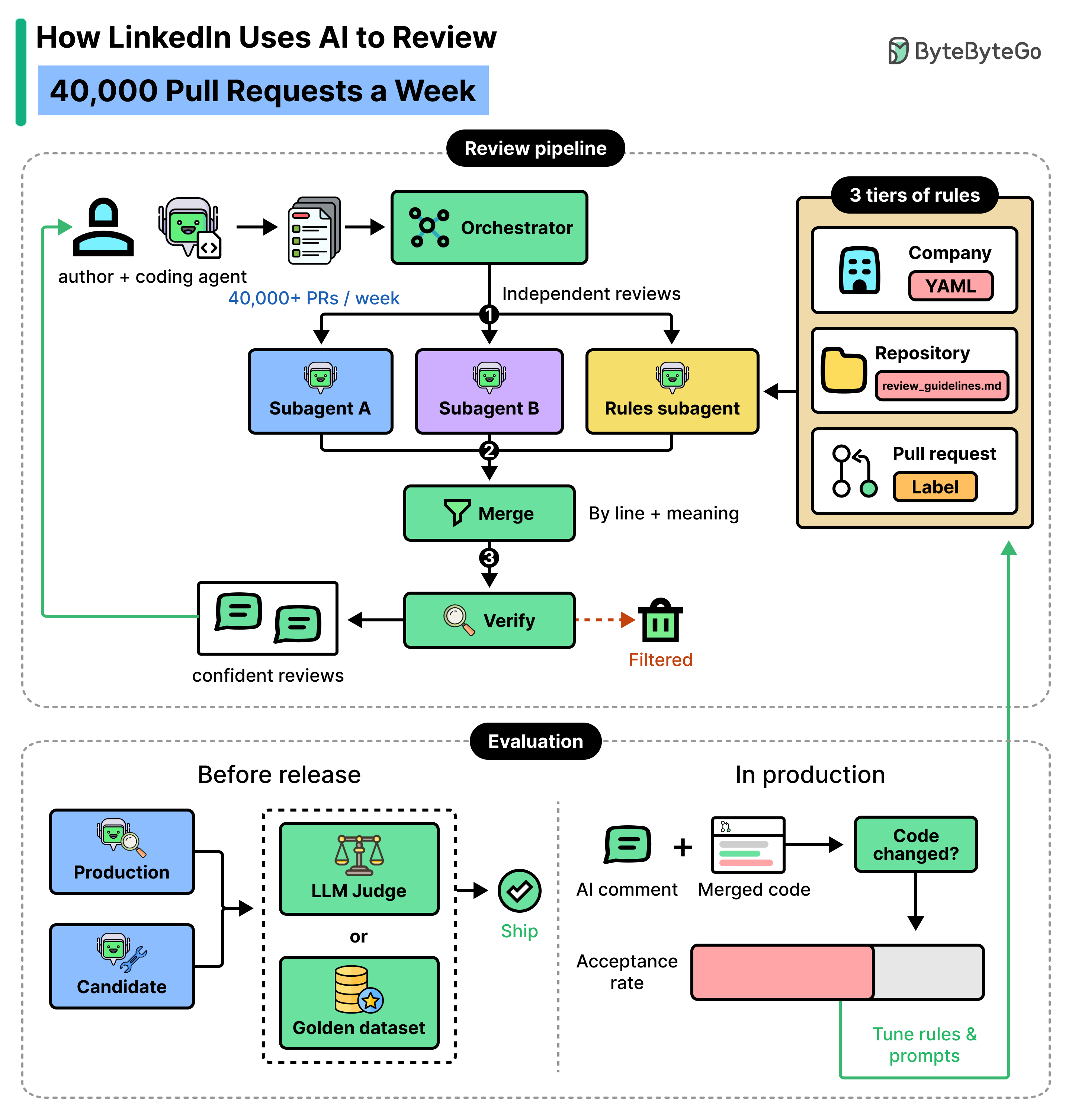
Most of its reviews are posted before the first human reviewer even opens the PR
ByteByteGoNov 09, 2026270178Share4 Key Insights for Scaling LLM Applications (Sponsored)The challenge of running LLM applications in production is that failures are silent, costs are unpredictable, and security vulnerabilities are hard to detect until it’s too late.
Download this Datadog eBook for practical strategies to monitor, debug, and secure your LLM application workflows end-to-end. You’ll get 4 key insights into how to overcome the challenges of deploying LLMs at scale — from tracing multi-step chain executions and detecting prompt injection attacks to tracking token costs and evaluating output quality in real time.
LinkedIn has more than 10,000 active code repositories, with tens of thousands of pull requests (PRs) being opened each week [1]. As coding agents write more of that code, the slow part of shipping software has moved from writing code to reviewing it.
To overcome the code review bottleneck, LinkedIn built its own AI reviewer. In a typical week, this in-house reviewer covers more than 40,000 PRs, and most of its reviews are posted before the first human reviewer even opens the PR [1].
To better understand the landscape of AI reviewers and how LinkedIn built theirs, we interviewed Min Chen, a Principal Staff Engineer at LinkedIn, and Balaji Srinivasan, Senior Director of Engineering at LinkedIn. Thanks to both of them for their time and for being open about what did not work.
LinkedIn’s AI reviewer system (High-Level)In this article, you’ll learn:
What an AI code reviewer is, and why review is the bottleneck these days
Three main directions for teams and companies to handle the code review bottleneck
How to build a multi-agent AI reviewing system that works in production
Software development has two main steps. An engineer writes a change, and other engineers review it before it merges into the main codebase.
Software development’s two main stepsWhen an engineer writes the code, the change becomes a PR. Then reviewers read its diff, that is, the lines it adds, removes, or changes. Here are the typical steps from when a writer opens a PR to when the PR is merged back into the codebase:
The author opens a PR from a branch that has the change.
The code host, such as GitHub, notifies the reviewers and starts continuous integration (CI), which runs tests and linters (to flag style problems and simple errors).
A reviewer reads the PR and comments on specific lines.
The author pushes fixes. Then the reviewer looks again.
ByteByteGo
Original Reporting Source
Explore features, ratings, and alternatives from our 19,000+ AI tools catalog.

AssistLoop's AI chatbots slash response times by 70% and boost satisfaction, scaling support for e-commerce and SaaS without extra hires.

Design professional websites effortlessly with AI.
Hypertxt.ai is an AI-powered SEO content writing tool that helps create high-quality, optimized content for improved search engine rankings. It offers various features to streamline the content creation process, from keyword research to content optimization and plagiarism checks.

