PARTNER CONTENT: AI agents are making security vulnerabilities easier to find and exploit in your code. Software engineering and application security teams need new ways to find and fix them
PARTNER CONTENT: AI agents are making security vulnerabilities easier to find and exploit in your code. Software engineering and application security teams need new ways to find and fix them
October ’26 might be remembered as a seminal moment for software developers and application security teams. AI agents are investigating unfamiliar systems, testing ways to get in and adjusting their next move when an attempt fails. Anyone with a credit card can use that capability to come after your application.
Coding agents and their tool integrations have introduced new entry points and surface areas that can be exploited. Pillar’s OpenCode disclosure in October showed how a malicious Model Context Protocol (MCP) server could execute commands on a developer’s Windows or WSL machine during authentication. A server-supplied URL reached a shell without tricking the model. In the same month, the discovery of the two PHP2Shell vulnerabilities, remote code execution bugs in the PHP runtime uncovered with the help of OpenAI’s models, brought new urgency to securing longstanding code across much of the internet.
Microsoft revealed that an agent moved from searching GitHub for exposed credentials to stealing Azure Key Vault data in five minutes. When its cloud API requests failed, the agent corrected the API versions and tried again until they succeeded.
A report by Anthropic described individual operators using agent frameworks for multi-victim campaigns that previously required specialist teams. Agents carried out reconnaissance, exploitation and data theft across targets in parallel, making sophisticated operations accessible with less hands-on work.
In a recent analysis, Tomasz Tunguz estimated the model cost of a 100-million-token attack workload using GLM-5.3, a low-cost model: 100 million tokens × $0.902 per million = $90.20. That is roughly 98% to 99% below the $5,000 to $10,000 frontier-model estimate cited by Bank for International Settlements (BIS) for a comparable cyber attack. Tunguz’s figure covers model usage only, not the full cost of an attack. Even still, it shows how trivially cheap it is now for attackers to go after any codebase, with the spend falling from thousands of dollars to under $100.
These new agentic attacks should make every team take another look at the code they’ve been running for years. Engineering and security teams need to find and fix weaknesses in their own applications before an attacker with an army of AI agents gets there first.
Traditional AppSec checks such as rule-based static analysis, dependency scanning and secret detection are no longer enough on their own. Developers, engineering leaders, and security teams also need defensive AI agents that trace attack paths, uncover missing safeguards and business-logic vulnerabilities, and help fix them.
Developers’ responsibility doesn’t stop at the code they’re writing now. An application already in production without known vulnerabilities might still get exploited by an AI agent looking for ways to skip a permission check or business rule. The gap only shows up when a request is traced through the codebase and checked against what users should be allowed to do.
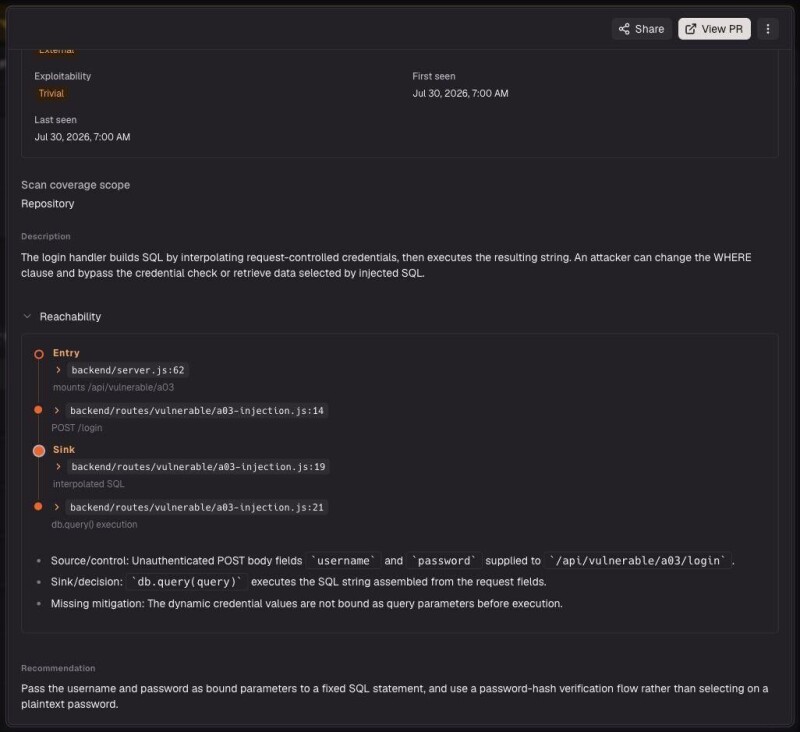
CodeRabbit Secure uses semantic analysis to understand your codebase and reason about it the way a security engineer would, tracing requests and checking whether permissions and business rules are enforced. Agents investigate potential attack paths and verify findings independent of the developer or agent that wrote the code, while CodeRabbit Agent generates reviewable fixes.
Three main use cases that improve your code security: this works across the SDLC:
reviewing each commit in a new PR and flag its security risks;
finding vulnerabilities across the repo with a Deep Scan;
rechecking code with incremental scans and validating findings at runtime.
Deep Scan examines the repository, including older paths outside the latest PR. Agents map entry points, access controls, and sensitive operations, then investigate across functions and files. Linked repositories, when configured, supply context from shared services and libraries. A separate agent challenges each suspected vulnerability, checking reachability, exploitation conditions, and safeguards that could disprove it.
Theregister
Original Reporting Source
Explore features, ratings, and alternatives from our 19,000+ AI tools catalog.
AssistLoop's AI chatbots slash response times by 70% and boost satisfaction, scaling support for e-commerce and SaaS without extra hires.
Design professional websites effortlessly with AI.
Hypertxt.ai is an AI-powered SEO content writing tool that helps create high-quality, optimized content for improved search engine rankings. It offers various features to streamline the content creation process, from keyword research to content optimization and plagiarism checks.

