Even with step-by-step reasoning, the models landed near 33% accuracy, and one quoted the host's rule correctly before ignoring it. The post Change One Monty Hall Rule and Five LLMs Still Say Switch appeared first on Towards Data Science .
Even with step-by-step reasoning, the models landed near 33% accuracy, and one quoted the host's rule correctly before ignoring it.
Prefer us on GoogleShareImage by Author. Made with Python scriptYou already know the answer to this one.
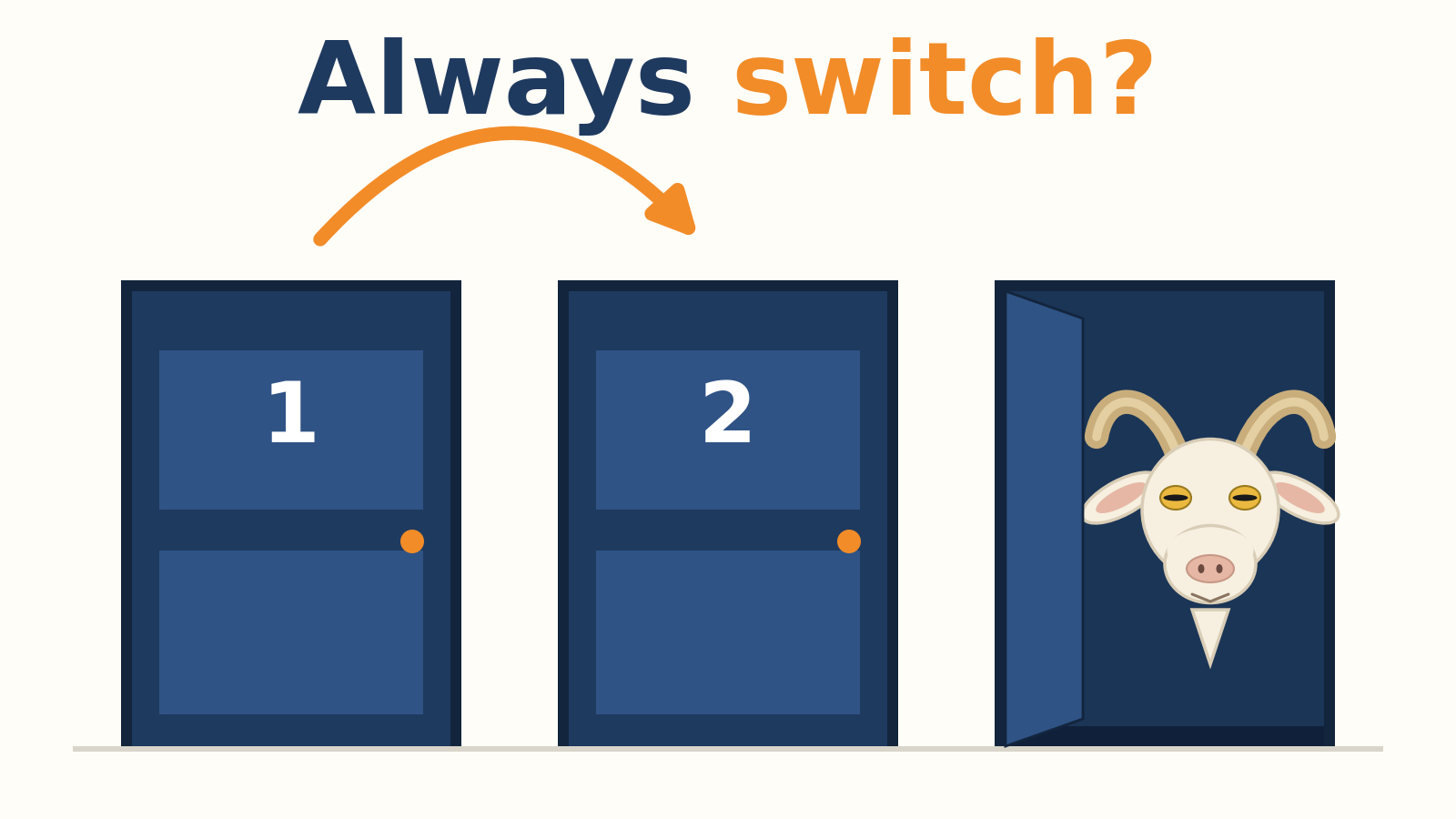
You're on a game show. There are three doors. Behind one is a car, behind the other two are goats. You pick door 1. The host, who knows where the car is, opens door 3 and shows you a goat. Then he asks: do you want to switch to door 2?
Yes. Switching wins two times out of three. When Marilyn vos Savant printed that answer in Parade in 1990, thousands of readers wrote in to tell her she was wrong, and plenty of them were mathematicians [1][2]. She wasn't.
These days nobody argues, and the AI models don't either. Ask one and it says "switch."
So I changed one rule. What if the host doesn't know where the car is, and just happens to open a goat door? What if he only ever offers a swap when you've already picked the car? Same doors, same goats, same question. In that second version, switching loses every single time.
I asked five AI models what to do across six versions of the puzzle. They said "switch" to almost all of them. Including the one where switching can't win.
What bothered me wasn't that they were wrong. It was how sure they sounded, and what their own reasoning looked like when I read it. In one case a model quoted the host's rule back to me, correctly, and then ignored it.
Here's how I tested it, and the one piece of math that explains every version of the puzzle.
Learn this step by step with the interactive AI Engineer roadmap.
Here's the usual explanation. Your first pick is right 1/3 of the time. The host opening a door doesn't change that. So the other door has to be right 2/3 of the time. It's a nice argument and it works, but it works a bit by accident. Jeffrey Rosenthal, a statistician who has written about this, calls it the "shaky" solution, because it falls apart on slight variations of the puzzle [1].
What holds up is a different question: given what the host just did, how likely was he to do that if the car were behind door 1? Behind door 2? Behind door 3? Rosenthal calls this the Proportionality Principle [1]. After you see something happen, the new probability of each possibility is proportional to how likely that thing was to happen under it. It's Bayes' rule without the clutter.
Let's do the classic version. You pick door 1 and the host opens door 3. If the car is behind door 1, the host had two goat doors to choose from, so he'd open door 3 half the time. If it's behind door 2, he had no choice, so he'd open door 3 every time. If it's behind door 3, he can't open it at all, so zero. That gives weights of 1/2, 1 and 0. Scale them so they add up to 1 and you get 1/3, 2/3 and 0. That's the famous answer, and it came entirely from how the host behaves, not from anything about the doors.
Which means you can change the answer by changing the host. Same two steps, different column of probabilities:
Chance the host does this if the car is behind door 1, 2, 3
Towards Data Science - Medium
Original Reporting Source
Explore features, ratings, and alternatives from our 19,000+ AI tools catalog.

AssistLoop's AI chatbots slash response times by 70% and boost satisfaction, scaling support for e-commerce and SaaS without extra hires.

Design professional websites effortlessly with AI.
Hypertxt.ai is an AI-powered SEO content writing tool that helps create high-quality, optimized content for improved search engine rankings. It offers various features to streamline the content creation process, from keyword research to content optimization and plagiarism checks.

