The new approach, known as FLEX, could lead to more intuitive, interactive household and assistive robots.
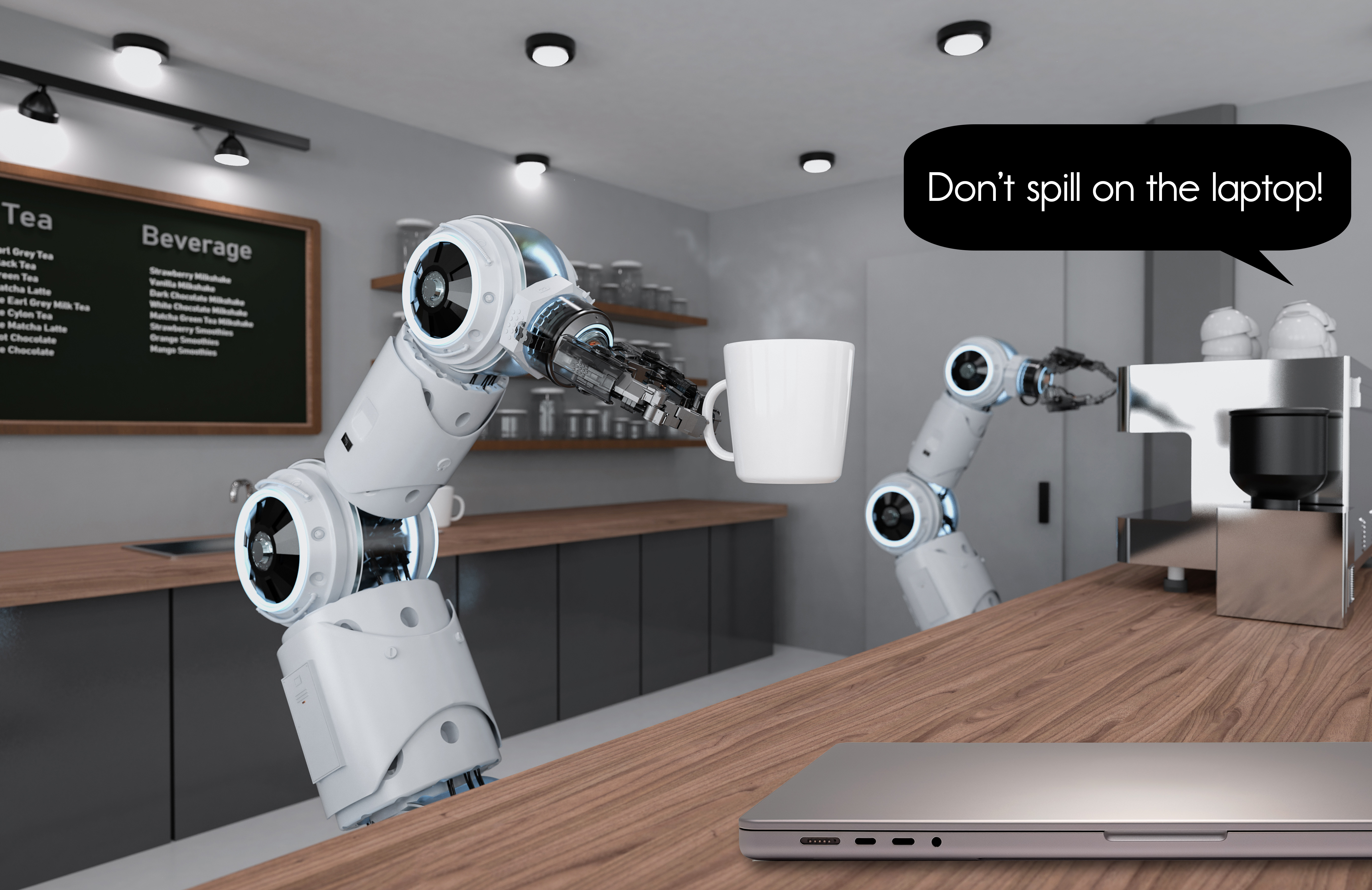
Press Inquiries Press Contact: Abby Abazorius Email: abbya@mit.edu Phone: 617-253-2709 MIT News Office Media Download ↓ Download Image Caption: With a new system designed by researchers from MIT and New York University, humans can interact with a robot by giving it instructions in natural, conversational language. The robot can not only follow the instructions literally, but also read into the words to draw larger generalizations that help to improve its motion-planning task. Credits: Credit: Getty Images, MIT News *Terms of Use: Images for download on the MIT News office website are made available to non-commercial entities, press and the general public under a Creative Commons Attribution Non-Commercial No Derivatives license. You may not alter the images provided, other than to crop them to size. A credit line must be used when reproducing images; if one is not provided below, credit the images to "MIT."
Close Caption: With a new system designed by researchers from MIT and New York University, humans can interact with a robot by giving it instructions in natural, conversational language. The robot can not only follow the instructions literally, but also read into the words to draw larger generalizations that help to improve its motion-planning task. Credits: Credit: Getty Images, MIT News Previous image Next image
Humans are intuitive by nature. We can sense meaning beyond the literal words that we encounter. Now, a new artificial intelligence-assisted learning platform developed by MIT engineers is enabling robots to read larger meaning into a human’s natural language commands.
In a study to be presented at the annual Conference on Robot Learning this month, researchers from MIT and New York University introduce FLEX, a flexible feature-editing pipeline for robot motion-planning.
With FLEX, humans can interact with a robot by giving it instructions in natural, conversational language. The robot can not only follow the instructions literally but also read into the words to draw larger generalizations that help to improve its motion-planning task.
The team demonstrated FLEX in several simulated scenarios, including one in which a robot serves a cup of coffee. In these virtual scenarios, a person interacts with a robotic arm by typing commands in natural language. As the robot moves the coffee cup over a cluttered table, the person might type “Don’t spill on the laptop!” In response, the robot will reason about why it should avoid the laptop. For this, FLEX incorporates a large language model (LLM) — a type of AI system that is trained on enormous libraries of text, including social media posts, video transcriptions, and web content, which the LLM uses to identify larger trends, patterns, and generalizations.
“LLMs have seen so many texts from the internet,” says study author Nathan Dennler, a postdoc in MIT’s Computer Science and Artificial Intelligence Laboratory (CSAIL). “People might have written about, ‘Oh, my phone dropped in the water and now it doesn’t work,’ or ‘I spilled coffee on my computer and now it doesn’t work.’ So LLMs pick up on the idea that liquids plus devices leads to things not working.”
Through the LLM, the robot reasons that it should also avoid bumping into all electronics. In its updated path, the robot adjusts to avoid both the laptop and a nearby phone, without the person having to explicitly spell this out.
“The idea is that there is some higher-level intention behind the words that you say,” Dennler says. “People naturally get this. But you have to carefully explain that to a robot, which takes time and effort. FLEX gives you an interface of communication with a robot to say, ‘When people say this, they mean that.’”
The study was led by Andreea Bobu, assistant professor of aeronautics and astronautics at MIT. Co-authors are Audrey Lee SM ’26 and Ilia Sucholutsky of New York University.
At MIT, Bobu heads up the Collaborative Learning and Autonomy Research (CLEAR) Lab, where her group develops autonomous agents that learn to work for, with, and around people. She is focused on developing assistive and household robots that can carry out physical tasks, and reason and adapt in real-time, in response to a person’s natural, conversational commands.
“Robots use math to do their trajectory planning. But we can’t expect a consumer to learn to do this math in order to tell a robot what to do,” says Dennler, who is a member of the CLEAR Lab. “Instead of having to get people to learn how to use a robot in a specific way, the goal is to interact with the robot through natural language.”
There is a large effort in the robotics community to incorporate natural language into robotic learning pipelines. Various strategies include using language to clarify a task’s goal, redirect a robot’s trajectory, and update its understanding of what is a safe path to take. These existing methods use natural language to tell the robot how to physically perform a task. But a robot could potentially learn much more from what we tell it.
Bobu and her colleagues are expanding what robots can learn from natural language commands. In their new study, they focused on enabling a robot to interpret a person’s underlying, unspecified preference from limited natural language commands.
The team’s new robot learning platform, FLEX, is a three-step process that helps a robot read more into a natural language command, beyond what it is explicitly told to do.
MIT News
Original Reporting Source
Explore features, ratings, and alternatives from our 19,000+ AI tools catalog.

AssistLoop's AI chatbots slash response times by 70% and boost satisfaction, scaling support for e-commerce and SaaS without extra hires.

Design professional websites effortlessly with AI.
Hypertxt.ai is an AI-powered SEO content writing tool that helps create high-quality, optimized content for improved search engine rankings. It offers various features to streamline the content creation process, from keyword research to content optimization and plagiarism checks.

