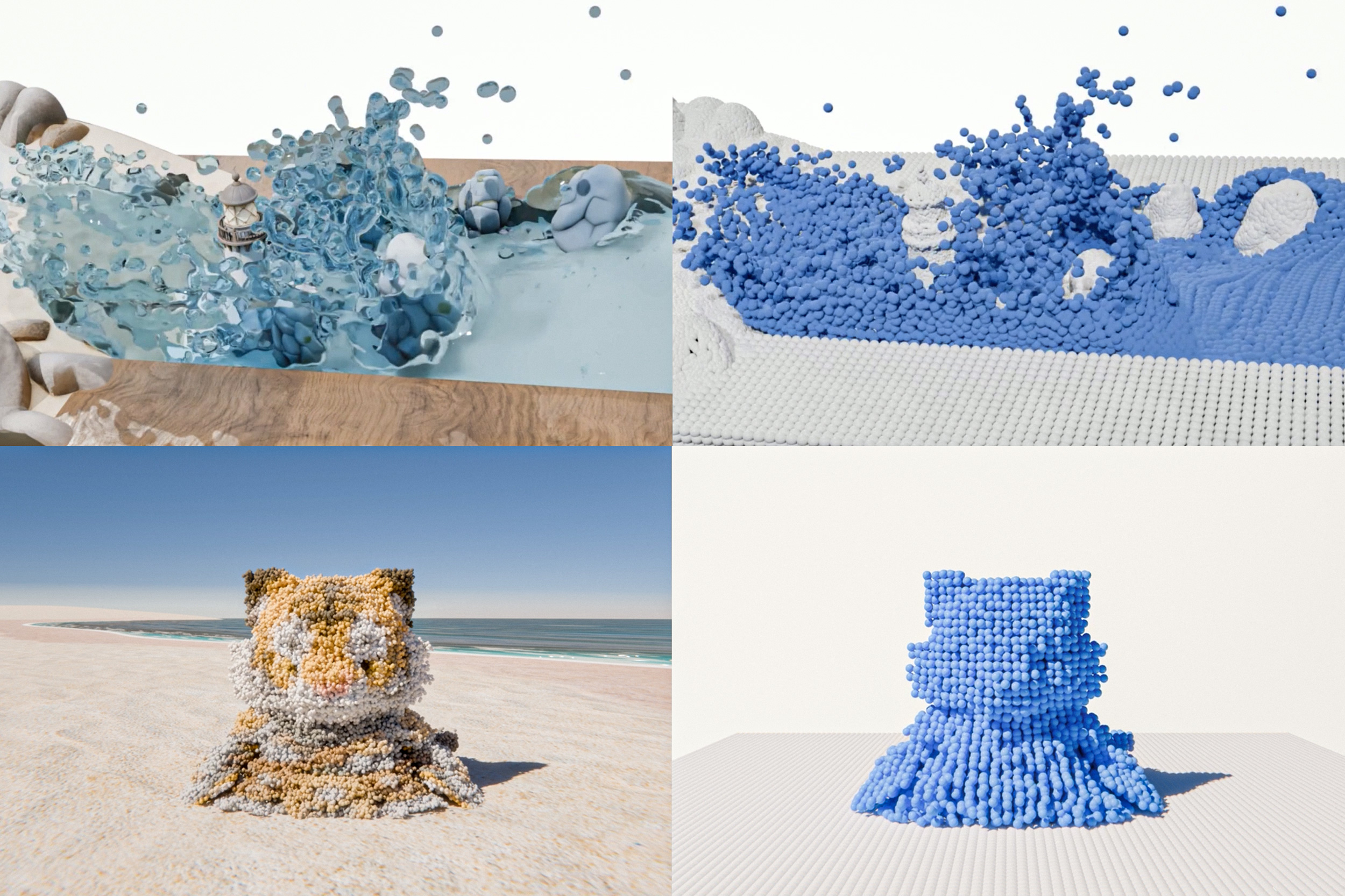
By learning how matter moves, the WorldParticle system could assist with developing soft robots, medicines, and more.
Press Inquiries Press Contact: Abby Abazorius Email: abbya@mit.edu Phone: 617-253-2709 MIT News Office Media Download ↓ Download Image Caption: “It is a similar architecture to ChatGPT. But instead of predicting one word at a time to write a piece of text, we are predicting how these particles will move, one step at a time,” says Peter Yichen Chen. Credits: Credit: Courtesy of the researchers *Terms of Use: Images for download on the MIT News office website are made available to non-commercial entities, press and the general public under a Creative Commons Attribution Non-Commercial No Derivatives license. You may not alter the images provided, other than to crop them to size. A credit line must be used when reproducing images; if one is not provided below, credit the images to "MIT."
Close Caption: “It is a similar architecture to ChatGPT. But instead of predicting one word at a time to write a piece of text, we are predicting how these particles will move, one step at a time,” says Peter Yichen Chen. Credits: Credit: Courtesy of the researchers Previous image Next image
Today, a scientist who wants to simulate a physical process must pick the right tool for that one job, such as a solver built for flowing water or another designed to model the way a protein folds. Each one is hand-coded around the specific equations that dictate how that process behaves.
Researchers at MIT, the University of British Columbia (UBC), and elsewhere have now replaced that patchwork with a single deep-learning system, called WorldParticle, that could help engineers model different physical phenomena, from sliding sand to folding proteins, with one unified artificial intelligence architecture.
Scientists and engineers could use this system to model processes that typically require separate simulators, such as a fluid sloshing against a deformable solid. This could offer a faster, more accurate way to simulate how sloshing oil might impact an elastic valve in a storage tank, for instance. It could also help engineers study where and how granular materials, like sand or soil, could move when a soft robot touches them.
The system represents every material it simulates, from a dune of sand to a protein molecule, as tiny particles and predicts where those particles will move one step at a time. Because it learns the underlying dynamics rather than being programmed with an equation, the model can adapt to materials, forces, and environments it never encountered during training.
In the long term, the researchers hope this work helps scientists discover new materials and explore physical processes they would be unable to effectively study with existing simulation methods.
“We want to have a GPT moment for simulation,” says Peter Yichen Chen, a former MIT postdoc who is now an assistant professor at UBC, and is a co-corresponding author of an open-access paper on this technique. “Every time people want to build a simulator for a particular physical phenomenon, they need to code it up from scratch. Our vision is to have a foundation model that works out of the box for any scenario you want to simulate. This is a first step in that direction.”
Chen is joined by co-corresponding and co-lead author Minghao Guo, an MIT postdoc; co-lead authors Caoliwen Wang and Siyuan Chen, UBC graduate students; Wojciech Matusik, an MIT professor of electrical engineering and computer science who leads the Computational Design and Fabrication Group within the Computer Science and Artificial Intelligence Laboratory (CSAIL); and others at UBC, Georgia Tech, Inria, Meta, the University of Pennsylvania, the University of Utah, the University of California at Los Angeles, and the University of Hong Kong. The research will be presented at the ACM SIGGRAPH Conference and Exhibition on Computer Graphics and Interactive Techniques in Asia.
For this work, the researchers drew inspiration from world models. These powerful AI systems learn the rules that govern the physical world so they can predict how objects or environments will change over time in response to certain actions or conditions.
The researchers applied these concepts to develop a unified AI architecture that can simulate multiple types of physical phenomena.
“If you study deformable objects and fluids, you would need two simulators — one for each physical regime. But if you unify them into one model, maybe you could couple the physics of these two processes and gain insights into new problems?” Guo says.
WorldParticle breaks an object into thousands or millions of tiny, three-dimensional dots, or particles, using what is known as a Lagrangian representation. It tracks the movement and velocity of the particles over space and time to simulate the material’s dynamics.
Typically, when scientists model materials and physical processes using Lagrangian particles, they use a governing equation that defines the fundamental laws which control how that material behaves over time and space. They must convert that complex equation into a formula a numerical solver can handle, repeating these steps for each material and process they want to model.
Instead, the researchers designed a neural network that learns to solve governing equations in general, eliminating the need to design a new model and solver to handle each one.
MIT News
Original Reporting Source
Explore features, ratings, and alternatives from our 19,000+ AI tools catalog.

AssistLoop's AI chatbots slash response times by 70% and boost satisfaction, scaling support for e-commerce and SaaS without extra hires.

Design professional websites effortlessly with AI.
Hypertxt.ai is an AI-powered SEO content writing tool that helps create high-quality, optimized content for improved search engine rankings. It offers various features to streamline the content creation process, from keyword research to content optimization and plagiarism checks.

