The engineering challenges of industrial drone autonomy include GNSS reliability, SLAM, sensor fusion, obstacle avoidance, and UAV validation. The post What industrial drone deployments reveal about real-world autonomy challenges appeared first on The Robot Report .
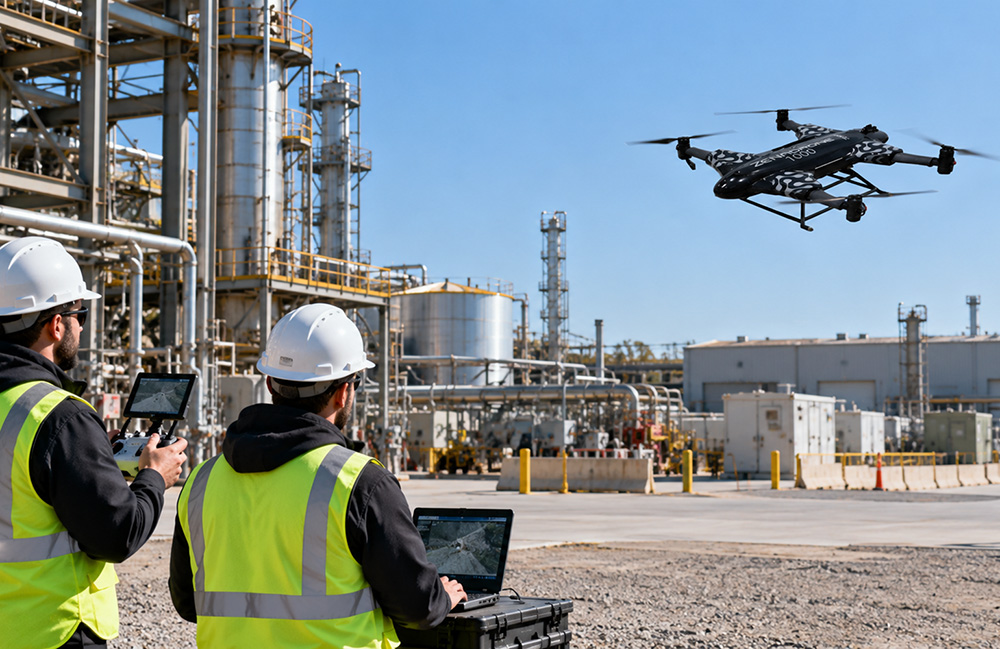
Supervised autonomous UAV inspection at an industrial facility. | Source: ZenaDrone
An autonomous drone can complete a carefully planned inspection route in a controlled environment and still struggle with the same route at an operating industrial facility. A steel structure may obstruct satellite signals, reflective equipment may distort depth measurements, and a wind gust may push the aircraft outside its planned trajectory. Each disturbance can be manageable in isolation. The difficulty emerges when several occur simultaneously.
This exposes a fundamental challenge in industrial drone autonomy: performance depends on interactions between subsystems whose assumptions are rarely independent.
A navigation algorithm may estimate position accurately under favorable sensing conditions. An obstacle detector may identify nearby structures during controlled testing. A flight controller may maintain stable tracking under a nominal payload. None of these results independently establishes that the integrated system can safely complete an inspection near energized infrastructure, confined structures, or operating machinery.
Reliable deployment requires engineers to understand how uncertainty propagates through localization, perception, planning, control, and inspection-data acquisition. It also requires evidence that the system can recognize when its estimates are no longer trustworthy.
Industrial facilities introduce environmental conditions that are difficult to reproduce in laboratory demonstrations.
Metallic surfaces, repetitive structural patterns, narrow access corridors, moving equipment, airborne particulates, and changing illumination can affect multiple sensors simultaneously. These conditions create both geometric constraints and uncertainty in the information available to the autonomy system.
Consider a hypothetical UAV inspecting pipework beside a steel-framed processing facility.
As the aircraft approaches the structure, GNSS measurements become less reliable. Repetitive pipes complicate visual feature matching, while reflective surfaces produce inconsistent depth observations. Meanwhile, the flight controller must reject aerodynamic disturbances caused by nearby structures.
The resulting problem is not simply inaccurate positioning. The autonomy stack must decide whether its remaining localization confidence supports continued flight, whether detected free space is sufficiently reliable, and whether the planned maneuver remains dynamically feasible.
These decisions are coupled. A localization error can corrupt obstacle coordinates, while a delayed perception update can cause the planner to act on geometry that no longer represents the aircraft's surroundings.
The practical engineering objective is therefore not uninterrupted autonomous operation under every condition. It is predictable behavior within a defined operational envelope, including when that envelope is exceeded.
Global Navigation Satellite System (GNSS) positioning provides an important absolute reference for outdoor autonomous UAV navigation. However, industrial structures introduce several failure mechanisms.
Buildings, tanks, and overhead equipment can block direct satellite signals. Reflections from metallic surfaces create multipath interference, causing a receiver to process signals that have traveled indirect paths.
Real-time kinematic (RTK) positioning can improve accuracy by using carrier-phase measurements and correction data. However, RTK does not eliminate obstruction, multipath, cycle slips, or poor satellite geometry. A fixed ambiguity solution should not be treated as an unconditional guarantee of accurate positioning.
The Robot Report
Original Reporting Source
Explore features, ratings, and alternatives from our 19,000+ AI tools catalog.

AssistLoop's AI chatbots slash response times by 70% and boost satisfaction, scaling support for e-commerce and SaaS without extra hires.

Design professional websites effortlessly with AI.
Hypertxt.ai is an AI-powered SEO content writing tool that helps create high-quality, optimized content for improved search engine rankings. It offers various features to streamline the content creation process, from keyword research to content optimization and plagiarism checks.

