Robotic animals are designed to be helpful rather than scary, showing promise in disaster recovery, utility inspection, and companionship. The post Unusual robotic animals can prove their utility appeared first on The Robot Report .
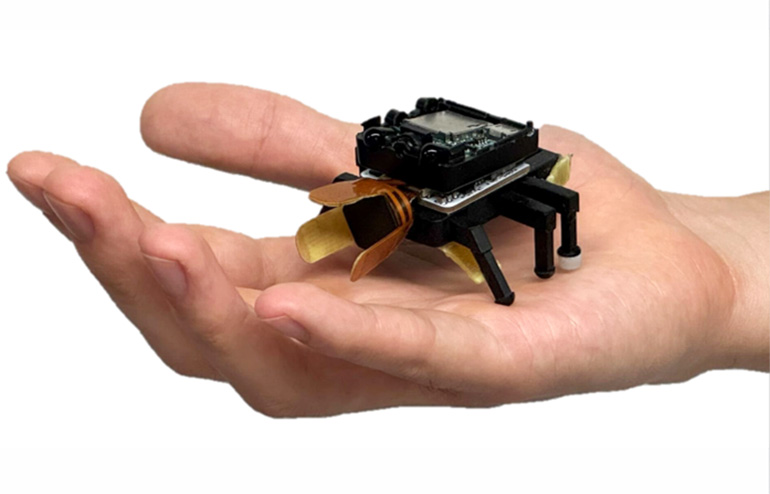
Korean researchers have developed a beetle-like soft robot. Source: KAIST
When we hear the word "robot," we still conjure up images of mechanical figures from old science fiction films. However, reality has long since evolved: We're surrounded by smart vacuum cleaners, voice assistants, and even four-legged machines that mimic dogs. But what are these robotic animals?
They're not just battery-powered toys. They're complex electronic devices, infused with elements of artificial intelligence, that replicate the appearance and behavior of real or imaginary creatures.
These devices contain sensors, speakers, motors, and processor modules that analyze external signals. They're controlled via mobile apps. Digital pets can make distinctive sounds, respond to signs of affection, answer to their names, and display a range of emotions—from delight to fear, from satisfaction to fatigue.
Manufacturers employ a variety of engineering approaches when creating these devices. Let's look at some interesting examples.
A microrobot beetle might seem like a fun little gadget. But leading research centers such as the Korea Advanced Institute of Science and Technology (KAIST) are working on developing similar insects (see image above).
So why are robot ants, robot beetles, and robot bees being created? The answer lies in solving practical and even humanitarian problems.
In the spring of 2022, a tragedy occurred in the city of Changsha, China—a six-story building collapsed. Dozens of people were trapped under the rubble. Many remained missing for nearly six days.
Rescue efforts were hampered by piles of rubble and collapsed floors. Ultimately, 53 people died, and only 10 were rescued. In such operations, every minute is precious. Rescuers use thermal imaging cameras and comb through the rubble, but this takes precious time.
But what if cockroaches come to the rescue? These insects are fast and can penetrate even the tiniest cracks, allowing them to quickly survey the disaster area. But how can they be made to search for people? A team at Nanyang Technological University (NTU) in Singapore said it has found a solution by transforming a Madagascar cockroach into a cyborg.
A miniature backpack containing a microcomputer is attached to the insect's back. It contains sensors that detect dangerous gas concentrations, as well as an infrared camera with a thermal imager, allowing it to detect bodies under the rubble. To prevent the insects from scattering randomly, but rather to remain confined to a specific area, the scientists have developed a remote control system.
Electrodes and a microchip are attached to the cockroach's body. An electrical impulse to the right side causes the insect to move to the left, and vice versa. When both electrodes are activated, the cockroach accelerates and runs straight.
This cyborg can operate for long periods in rubble: the microcomputer is powered by solar panels. One individual can survey an area of up to 100 sq. m (1,076.3 sq. ft.). The operator controls the movement and monitors the signals from the sensors.
However, there's a catch: to fully survey a large building, about 500 of these cockroaches are required, meaning 500 operators. And although the cyborg will indicate the location of the victim, it won't be able to extract them—that's a task for humans.
Stanford University engineers created mechanical ants capable of moving loads 2,000 times their own mass. For a human, this is the equivalent of moving a 150-ton whale.
Therobotreport
Original Reporting Source
Explore features, ratings, and alternatives from our 19,000+ AI tools catalog.
AssistLoop's AI chatbots slash response times by 70% and boost satisfaction, scaling support for e-commerce and SaaS without extra hires.
Design professional websites effortlessly with AI.
Hypertxt.ai is an AI-powered SEO content writing tool that helps create high-quality, optimized content for improved search engine rankings. It offers various features to streamline the content creation process, from keyword research to content optimization and plagiarism checks.