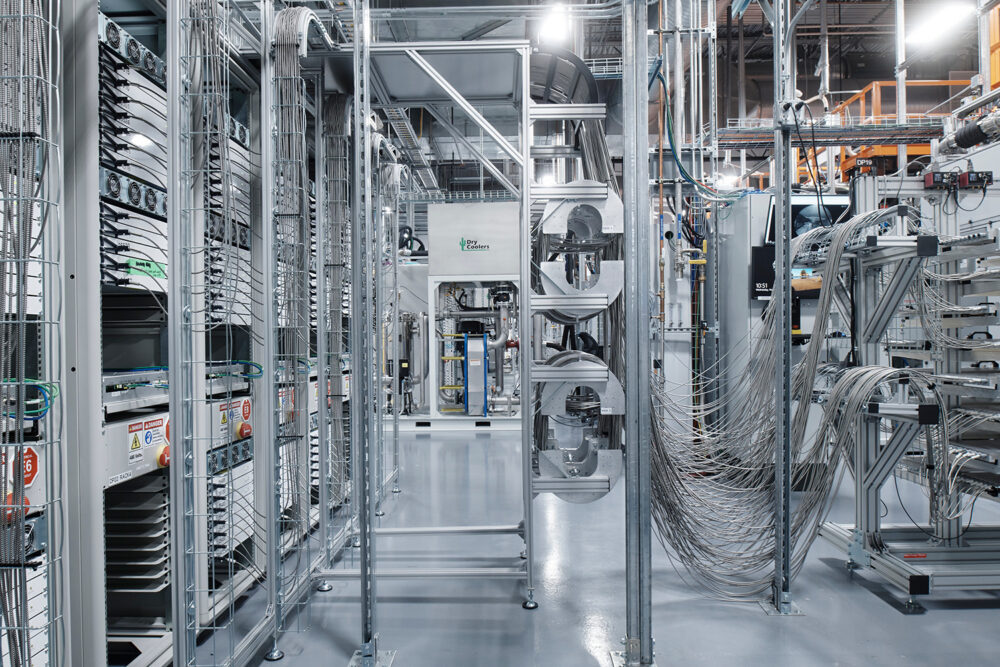
Manufacturers looking to deploy autonomous robots must close gaps in industrial data collection, interoperability, and quality feedback to enable reliable decision-making and improve production efficiency. The post The manufacturing data gap holding back physical AI appeared first on The Robot Report .
Robotics and physical AI companies have raised nearly $48 billion so far in 2026, but the rollout of fully autonomous machines in industrial settings isn’t a given. For robots to step beyond controlled environments onto the manufacturing floor, they need real-world data to learn from.
Most production facilities aren’t set up to provide it.
Consider the welding process. For a robot to improve its technique autonomously, it needs to understand how changes in welding angle, travel speed, workpiece position, and other key parameters affect the finished result. Experienced technicians develop this understanding through years of hands-on experience, but much of that knowledge isn't captured in a form robotics partners can use to train autonomous systems.
Similar gaps exist in other manufacturing processes where technicians rely on experience to make adjustments that aren't consistently documented. Manufacturers looking to deploy physical AI need to close this data gap. Without information connecting process decisions to production outcomes, even sophisticated robotic systems may struggle to adapt to changing conditions.
These limitations could prevent manufacturers from achieving the efficiency and quality improvements they expect from physical AI.
Manufacturers already collect extensive operational data, but much of it was never structured for autonomous learning. Sometimes it is collected and never even reviewed at all!
Relevant contextual information often sits in separate systems. A machine may record operating parameters while a quality management system captures inspection results, making it difficult to connect process decisions with finished-part quality.
Manufacturing leaders are increasingly aware that these silos are an obstacle. According to the Manufacturing Leadership Council's 2026 Smart Factories and Digital Production Survey, 37% of surveyed manufacturers cited a lack of data interoperability as a major roadblock to implementing their smart factory strategies, up from 22% in 2025.
However, improving interoperability alone won't get robots the data they need to learn. Manufacturers also need to ensure that production records can be tied to measurable quality outcomes.
Preparing a factory for physical AI requires more than collecting additional data or connecting disparate systems. Manufacturers need to understand what information their robotic systems will rely on, how that data reflects real production conditions and whether it can help systems make reliable adjustments over time.
Addressing these questions early, in collaboration with robotics partners, can help manufacturers identify gaps in their existing infrastructure and focus investments where they'll have the greatest impact.
Here are three areas to prioritize before deployment.
Begin by identifying the production conditions your robotic systems need to recognize and respond to. Focus on capturing the complex interactions between the process parameters and quality outcomes to show how planned and unplanned changes in materials or equipment performance affect the finished product.
Consider metal additive manufacturing, where factors like powder (or wire) characteristics, processing temperatures, and environmental conditions can influence a component's final properties and characteristic defect structure. Connecting these variables with inspection results gives your robotics partners a clearer picture of which conditions contribute to defects or variations in quality.
You can then use that information to train systems to recognize changing production conditions and develop more realistic simulations for testing their responses.
The Robot Report
Original Reporting Source
Explore features, ratings, and alternatives from our 19,000+ AI tools catalog.

AssistLoop's AI chatbots slash response times by 70% and boost satisfaction, scaling support for e-commerce and SaaS without extra hires.

Design professional websites effortlessly with AI.
Hypertxt.ai is an AI-powered SEO content writing tool that helps create high-quality, optimized content for improved search engine rankings. It offers various features to streamline the content creation process, from keyword research to content optimization and plagiarism checks.

