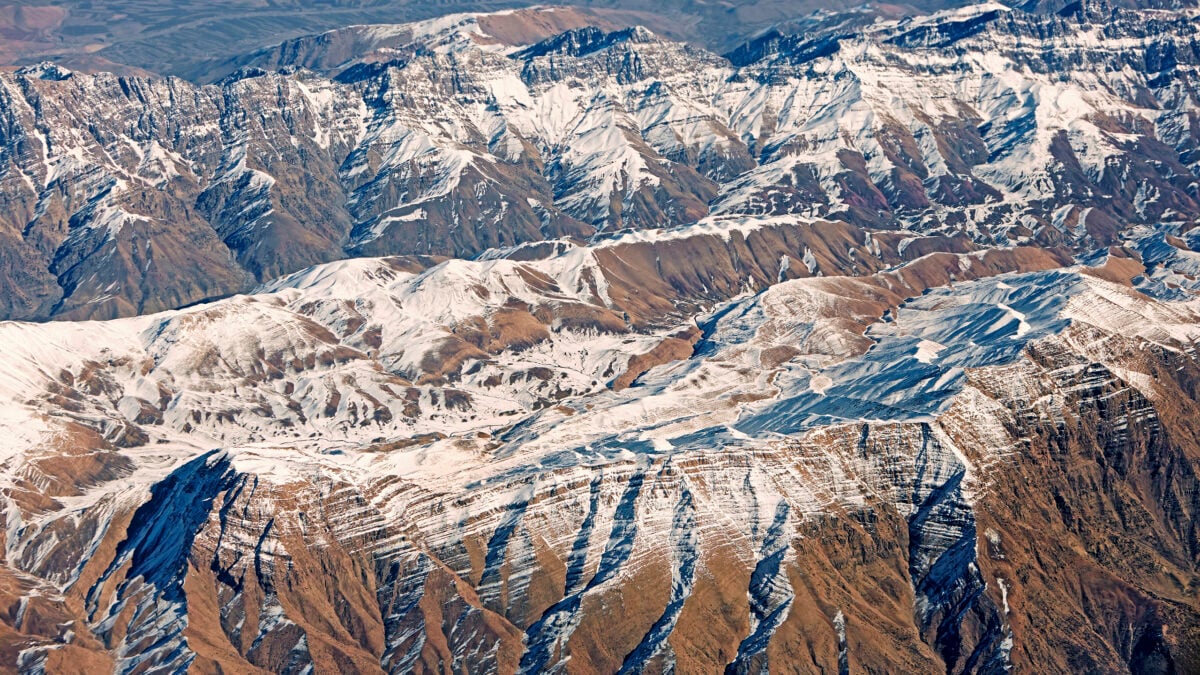
The death throes of a vanishing ocean. ScienceAlert stories are written, fact-checked, and edited by humans, never generated by AI. Don't miss a story, subscribe here.
On the scale of human generations, the tectonic plates that form Earth's crust and upper mantle are moving incredibly slowly.
They are constantly moving, though, and across millions of years, that movement leads to some globally significant shifts in the landscape.
Researchers led by a team from the Chinese Academy of Sciences have now found extensive evidence of two giant tears in a tectonic plate called the Arabian Plate, underneath southeastern Iran.
The tears are being caused by different rock densities. One part of the plate is what's known as an oceanic slab and was once part of the ancient Neo-Tethys Ocean.
The basalt rock here is heavier and thinner and is being pushed under a neighboring plate (the process of subduction).
Meanwhile, the other part of the plate is continental rock – thicker in size but less dense in composition, with lighter ingredients that make it granite-like.
This rock doesn't like to be pushed underground, and instead forms mountains when it hits resistance. That mismatch is what's causing the ruptures.
In a new study published in Nature Geoscience, the researchers have detailed their findings, explaining how the discoveries give us a new perspective on how oceans disappear and continents collide as tectonic plates shift.
What's more, there's a good chance these tears will eventually meet.
"The coexistence of these two tearing modes provides a rare snapshot of the short-lived early transition from oceanic subduction to continental collision," write the researchers in their published paper.
To measure geological activity deep underground, the researchers used a network of 69 different seismic monitoring stations to detect the vibrations coming from distant earthquakes.
As these vibrations change speed based on rock temperature and density, a picture of tectonic plate activity can be put together.
The recordings, taken between March 2017 and September 2018, revealed the two tears: one horizontal (where the Zagros collision zone meets the Makran subduction zone), and a smaller vertical one, closer to the surface (by the Makran Trench).
"We show that in the Makran subduction zone, the oceanic lithosphere has continuously subducted to depths of at least 450 km, whereas in the Zagros collision zone to the west, the continental lithosphere has subducted no deeper than 300 km, resulting in east–southward slab tearing and detachment," write the researchers.
"We further identify another slab tear that probably initiated at the junction between the Makran Trench and the transform boundary and has propagated southward as the continental plate advances northward."
ScienceAlert
Original Reporting Source
Explore features, ratings, and alternatives from our 19,000+ AI tools catalog.

AssistLoop's AI chatbots slash response times by 70% and boost satisfaction, scaling support for e-commerce and SaaS without extra hires.

Design professional websites effortlessly with AI.
Hypertxt.ai is an AI-powered SEO content writing tool that helps create high-quality, optimized content for improved search engine rankings. It offers various features to streamline the content creation process, from keyword research to content optimization and plagiarism checks.

