One of robotics' most influential advocates is gone. Can the industry sustain its momentum without him? The post Robotics enters its post-Jensen Huang era appeared first on The Robot Report .
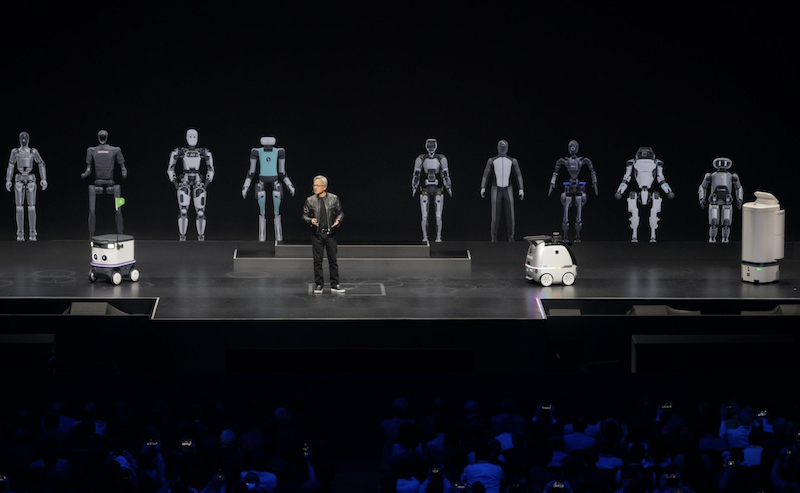
Jensen Huang keynote at CES 2025. | Credit: NVIDIA
Days before Christmas in 2023, Serve Robotics was on the verge of bankruptcy. A major investor pulled out of a committed funding round, leaving the developer of sidewalk delivery robots unable to make payroll and just days away from running out of cash.
With few options remaining, Serve Robotics co-founder and CEO Ali Kashani reached out to NVIDIA co-founder Jensen Huang. “We spoke at 6 a.m. the next day, and later that day I was having dinner with his executive team to find a way to bridge the company,” recalled Kashani. “Within days, they led a financing round that brought us back to life.”
Four months later, Serve Robotics was ringing the bell at Nasdaq to celebrate its public listing.
“I have heard similar stories from many other founders, as well as current and former NVIDIA employees, whose lives Jensen's actions have changed,” Kashani said.
Over the past several years, few people outside the robotics industry have done more than Huang to elevate its profile.
Clad in his signature black leather jacket, Huang routinely dedicated portions of his marathon keynotes to robotics. He showcased humanoids on stage, introduced development tools, highlighted startups, championed open models and research, and made the case that robots would transform the world.
Now, one of robotics' most influential advocates is gone. NVIDIA's board accepted Huang's resignation on Nov. 12, and CFO Colette Kress is serving as interim CEO while the company searches for a permanent successor.
For an industry that spent decades fighting for mainstream recognition, Huang provided something few robotics executives could: one of the biggest stages in technology.
“Jensen was fantastic in painting the vision,” said Yaro Tenzer, co-founder and CEO of RightHand Robotics.
Tenzer said Huang helped expand investors' imaginations about what robotics could become.
NVIDIA said during its third-quarter earnings call that its physical AI revenue nearly tripled year over year and is on track to exceed $25 billion in fiscal 2027. While that represents a sizable and rapidly growing business, it still accounts for only about 6% of NVIDIA's projected annual revenue of more than $400 billion. And physical AI encompasses more than robotics.
The attention Huang afforded robotics was disproportionate to its short-term commercial contribution.
“NVIDIA introduced its Isaac robotics platform back in 2017, and Jensen kept robotics in his keynotes and in the company's long-term story year after year,” said Deepak Jayaraj, vice president of hardware engineering and manufacturing at agricultural robotics developer Four Growers. “I think that steady attention made it easier for founders to make the case to investors.”
Unlike Tesla CEO Elon Musk, whose robotics advocacy is largely centered on his own company's products, Huang promoted an ecosystem of developers, many of whom compete directly with one another.
The Robot Report
Original Reporting Source
Explore features, ratings, and alternatives from our 19,000+ AI tools catalog.

AssistLoop's AI chatbots slash response times by 70% and boost satisfaction, scaling support for e-commerce and SaaS without extra hires.

Design professional websites effortlessly with AI.
Hypertxt.ai is an AI-powered SEO content writing tool that helps create high-quality, optimized content for improved search engine rankings. It offers various features to streamline the content creation process, from keyword research to content optimization and plagiarism checks.

