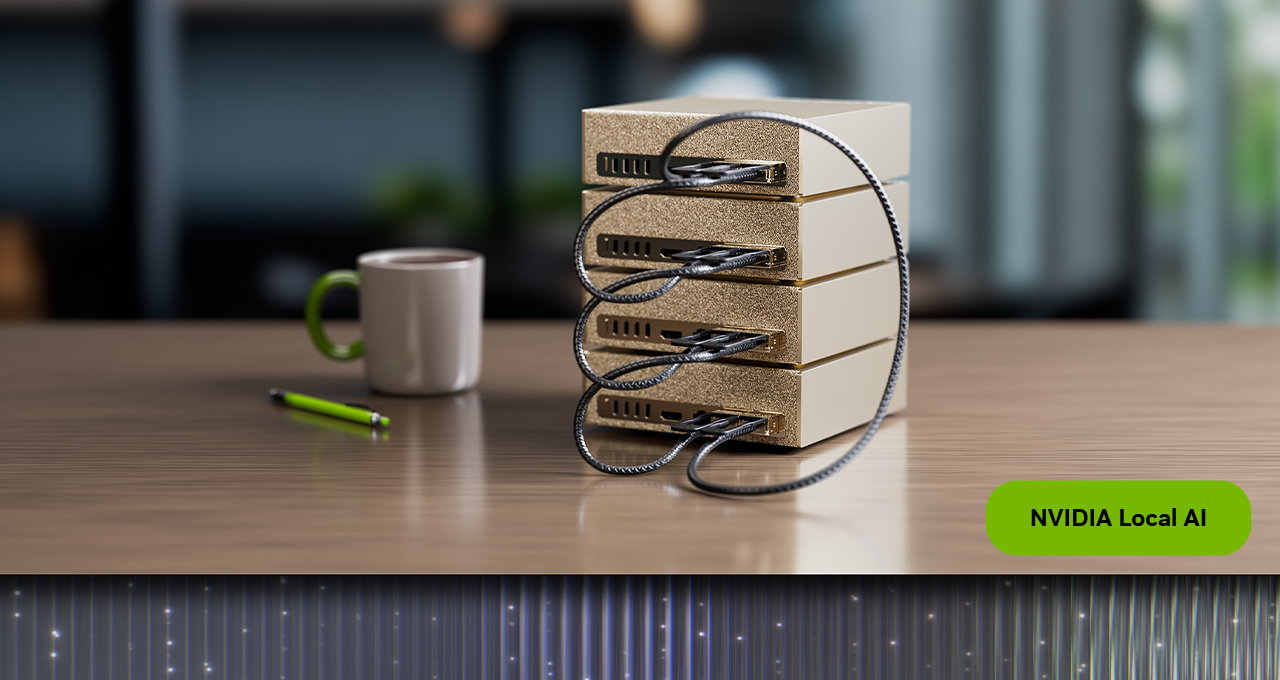
At SC26, an annual supercomputing conference taking place this week in Chicago, NVIDIA is introducing the DGX Spark HPC Developer Kit for researchers, academics and developers. The kit is a four-node cluster of NVIDIA DGX Spark systems, each connected directly to its two neighbors in a ring, with an NVIDIA HPC SDK installation playbook coming […]
At SC26, an annual supercomputing conference taking place this week in Chicago, NVIDIA is introducing the DGX Spark HPC Developer Kit for researchers, academics and developers.
The kit is a four-node cluster of NVIDIA DGX Spark systems, each connected directly to its two neighbors in a ring, with an NVIDIA HPC SDK installation playbook coming soon. Researchers get a place at their desk to run multi-node scientific workloads, AI models and agents, instead of waiting for time on a shared GPU cluster. The kit puts the GB10 Grace Blackwell Superchip on researchers’ desks.
The DGX Spark Developer Kit changes how researchers work.
It scales from one system, or node, to four — linked directly to one another over NVIDIA ConnectX-7 networking, with no network switch to buy or set up.
At four nodes, it provides 512GB of combined memory and 16TB of NVMe storage that provides researchers more capacity to distribute models and scientific workloads across the cluster. With NVFP4, researchers can deploy models with up to 700B parameters locally across the four DGX Spark clusters, such as DeepSeek V4.1.
With that much power at the desk, researchers with a fixed compute and server allocation no longer have to wait in a queue for every job. Teams can develop and debug on their own, saving server hours for production runs and keeping unpublished results, and proprietary datasets on premises.
The playbook for NVIDIA HPC SDK is coming soon, bringing GPU-accelerated C, C++ and Fortran compilers, libraries and message passing interface tools to the DGX Spark cluster — the same development tools used on NVIDIA-powered supercomputers. Teams can build and test scientific applications across four nodes, check how computation and data are distributed, and debug communication issues before scaling to larger systems.
The kit brings scientific simulation and AI models and agents to the desktop, with demonstrated four-system workloads including LAMMPS with Kokkos for materials simulation and NAMD for molecular dynamics. The broader DGX Spark community has validated GROMACS for molecular dynamics, OpenFOAM for fluid dynamics, WRF for weather modeling and NVIDIA NIM microservices such as OpenFold3 and Boltz-2 for predicting biomolecular structures.
Running on DGX Spark, new open dataset and post-training recipes for Nemotron 3.5 Super VL help researchers adapt the model for life sciences and chemistry, enabling secure scientific workflows on infrastructure organizations control.
The kit opens up new possibilities for researchers.
Researchers can explore agent-assisted workflows that prepare simulation inputs, launch runs and summarize results, while the scientists validate the setup and conclusions.
Researchers can also train AI models that approximate slow simulations, then use them to refine wing designs toward minimum drag.
Before committing supercomputer time, a team can narrow a 10-million-cell simulation to the 50-500 dimensions that matter.
The developer kit is on display at SC26 and available for sale. DGX Spark products and cables can be purchased from top OEM partners and are also available through NVIDIA Marketplace.
Partners include Acer, ASUS, Dell Technologies, GIGABYTE, H3C, HP, Lenovo, MSI and xFusion.
NVIDIA Blog
Original Reporting Source
Explore features, ratings, and alternatives from our 19,000+ AI tools catalog.

AssistLoop's AI chatbots slash response times by 70% and boost satisfaction, scaling support for e-commerce and SaaS without extra hires.

Design professional websites effortlessly with AI.
Hypertxt.ai is an AI-powered SEO content writing tool that helps create high-quality, optimized content for improved search engine rankings. It offers various features to streamline the content creation process, from keyword research to content optimization and plagiarism checks.

