A fascinating mystery. ScienceAlert stories are written, fact-checked, and edited by humans, never generated by AI. Don't miss a story, subscribe here.
Even though Mars is millions of kilometers across the Solar System, scientists have a pretty good handle on its geology.
We know, broadly, what types of minerals can be found there, and the geological processes that shape it.
But then sometimes all we have to do is scratch the surface, and a whole new mystery comes tumbling out, glinting dully under the Martian Sun.
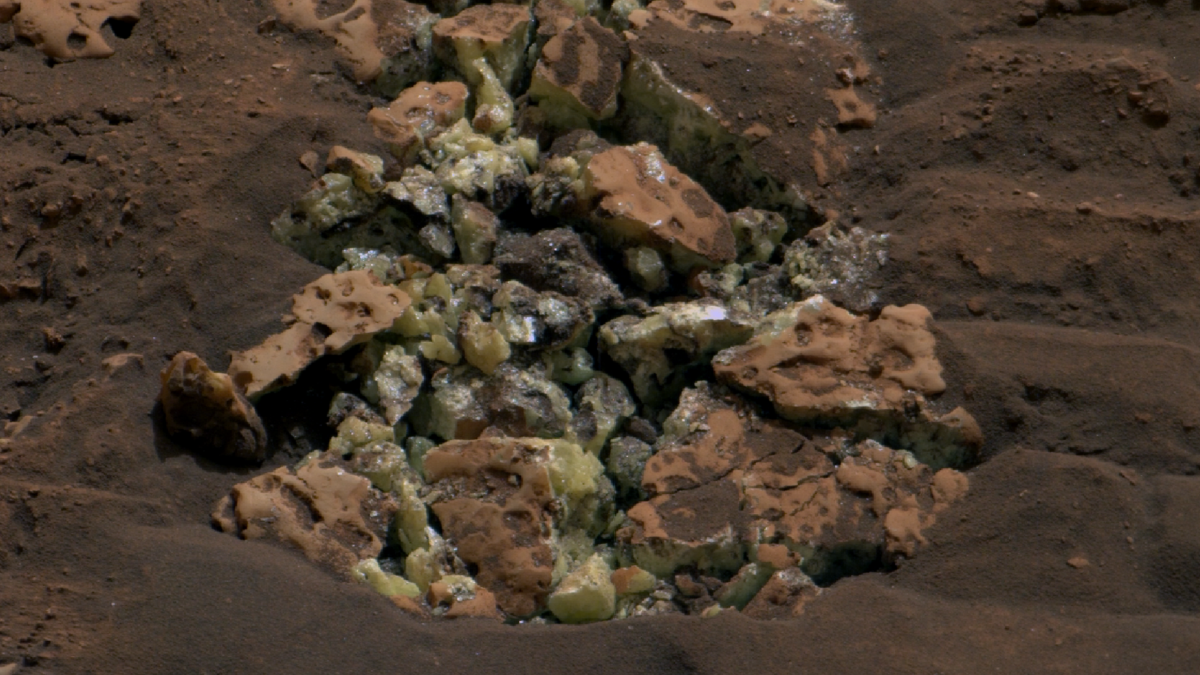
Like the time in 2024 when NASA's Curiosity rover rolled its 899-kilogram (1,982-pound) body over a completely unremarkable rock in the Gale Crater's Gediz Vallis Channel.
When the rock burst open under the strain, the pale yellow shine of its contents stumped NASA scientists – it appeared to be crystals of startlingly pure elemental sulfur – brimstone.
Although sulfates are fairly common on Mars, this marked the first time sulfur had been found on the red planet in its pure elemental form – and the surrounding ground was littered with more of the same kind of rock.
"Finding a field of stones made of pure sulfur is like finding an oasis in the desert," Curiosity project scientist Ashwin Vasavada of NASA's Jet Propulsion Laboratory said at the time.
Sulfates are salts containing sulfur and oxygen, often dissolved in water alongside other minerals. When the water evaporates, sulfate minerals can crystallize out, leaving deposits behind.
These sulfate minerals can tell us a lot about Mars, such as its water history and how it has weathered over time.
Pure sulfur is a different matter altogether. On Earth, large deposits are often associated with volcanic or hydrothermal activity, but there was no evidence of the high-temperature conditions that could have produced such a deposit directly in Gediz Vallis.
There are, to be fair, a lot of things we don't know about the geological history of Mars. But finding scads of pure sulfur just hanging about on the Martian surface suggested that something important was missing from our understanding.
Now, two new studies have begun to piece together how this strange deposit might have formed – and what it could tell us about the ancient Martian environment.
In a paper published in Science in June 2026, a team led by planetary scientist Scott VanBommel of Washington University in St. Louis took a closer look at Curiosity's observations of the sulfur-rich rocks, revealing that the discovery was even more unusual than it first appeared.
He and his colleagues studied the images the rover had taken of the region, along with its chemical analyses of the sulfur it unmarsed.
The results confirmed that the initial impression of the amount of sulfur was correct. It lay scattered across an area measuring some 2,100 square meters. One pure sulfur rock was weird enough, but this was positively preposterous.
ScienceAlert
Original Reporting Source
Explore features, ratings, and alternatives from our 19,000+ AI tools catalog.

AssistLoop's AI chatbots slash response times by 70% and boost satisfaction, scaling support for e-commerce and SaaS without extra hires.

Design professional websites effortlessly with AI.
Hypertxt.ai is an AI-powered SEO content writing tool that helps create high-quality, optimized content for improved search engine rankings. It offers various features to streamline the content creation process, from keyword research to content optimization and plagiarism checks.

