Bellwether joins support tickets, store reviews, sales calls, and NPS to CRM accounts, then stress-tests the ranking on 6,693 synthetic signals. The post How to Prioritize Product Feedback by Revenue at Risk appeared first on Towards Data Science .
Bellwether joins support tickets, store reviews, sales calls, and NPS to CRM accounts, then stress-tests the ranking on 6,693 synthetic signals.
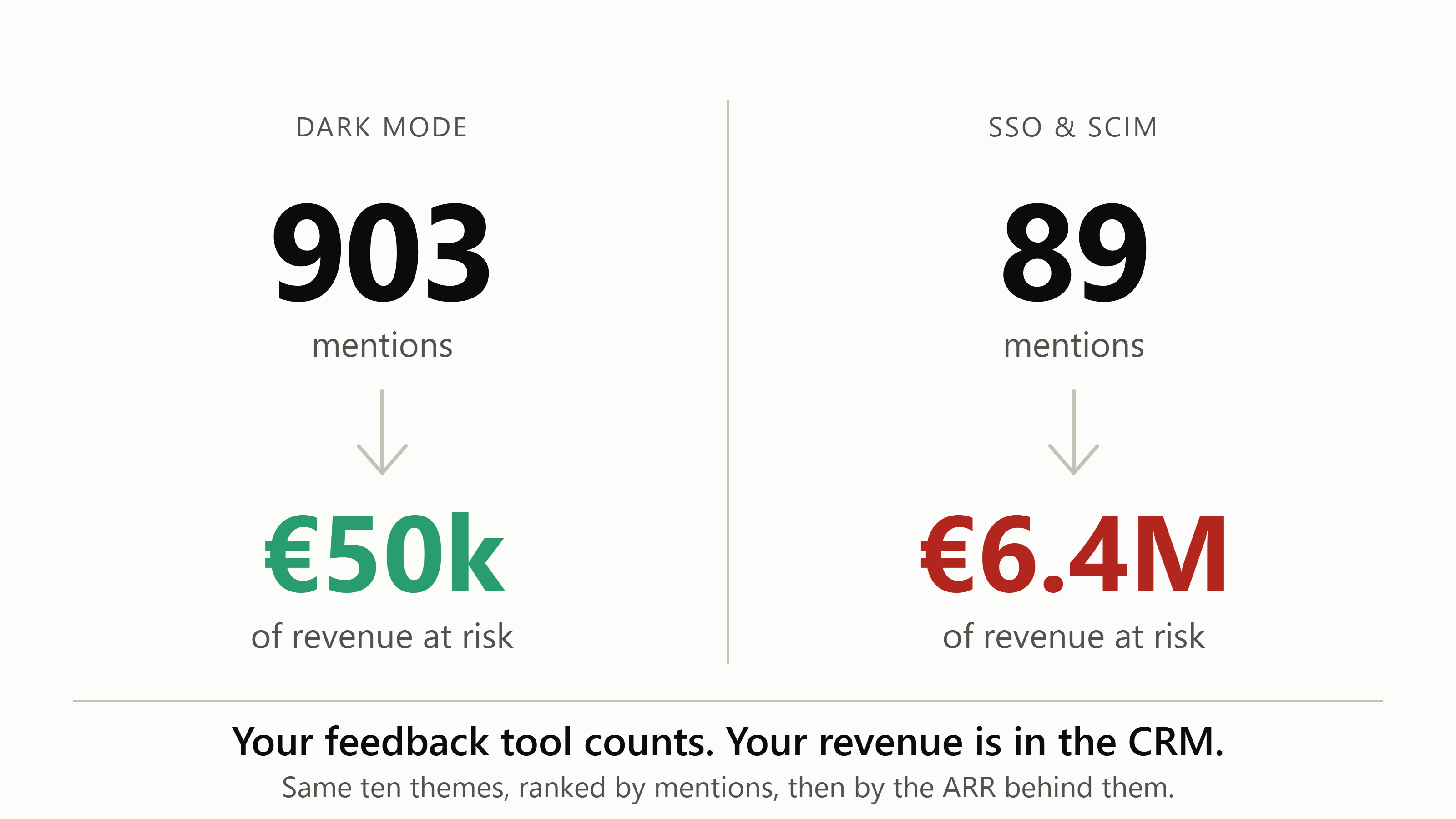
Prefer us on GoogleShareImage by Yassin ZeharRevenue-weighted feedback: the most requested theme in a synthetic B2B SaaS corpus protects €50k of ARR, while a theme with 89 mentions sits in front of €6.4M. Same ten themes, ranked by mentions, then by the revenue of the accounts that raised them.Image by Yassin ZeharIntroductionIn a previous article, I argued that SaaS PM is the best domain for data-driven professionals. This is what that statement looks like when you actually build something.
A situation that happens to every product manager: the quarterly roadmap review starts, someone opens the feedback tool, and the top of the list is the same as last quarter. Offline mode. Dark mode. Notification noise. Then the Sales director says: "My biggest account is about to churn over SSO." And SSO (single sign-on) is sitting in eighth place, with 89 mentions.
Nobody in the room can say who is right. The feedback tool counts. The CRM (customer relationship management system) knows what each account pays. The two have never been joined.
So I built the join. Bellwether is a revenue-weighted feedback engine: it takes support tickets, store reviews, sales call notes and NPS (Net Promoter Score) verbatims, grouped into themes, and weights every theme by the ARR (annual recurring revenue) of the accounts that raised it.
Learn this step by step with the interactive Product Manager roadmap.
In this article, we'll explore why mention counts are biased, how the revenue weighting is designed, how one click re-ranks the same ten themes, whether that ranking survives its own assumptions, and the three problems that turned out to be harder than the clustering.
About the data. In this version of the tool, ingestion and clustering are simulated: the themes are known by construction, and all accounts, quotes and euro figures are synthetic, built around a fictional company (“Volta”, a field-service management SaaS). “Revenue at risk” is an estimate by construction, not a measurement. The scoring layer, however, is real: the analysis script behind this article regenerates the corpus, recomputes every figure and runs the two experiments below. The code is public: github.com/YassinAnalytics/Bellwether-app.
Every product team has a feedback tool. It groups tickets into themes and sorts them by how often people ask. That is the whole product, and it is why those tools rarely change a roadmap.
The ranking looks objective. It is not. Whoever writes in most wins, and in the B2B products I worked on, the people who wrote in most were almost never the people paying the most. A support ticket from a five-person startup and a renewal call with a four-million-euro account count exactly the same: one row each.
In eight years of B2B product work, the request that changed a roadmap rarely arrived as a ticket. It arrived in a renewal call, from one account, and it described a whole segment. The only way to see that segment is to keep the account attached to the request.
Key insight: the number I needed was never in the feedback tool. It was in the CRM.
This is the default view, ranked by volume: offline mode 1,247 mentions, dark mode 903. It is the list that ends up in the roadmap review.
Volta is invented. It sells field-service management software to technicians and dispatchers.
Book: about €19.4M of ARR, 10 named accounts (6 enterprise, 4 mid-market) plus 2 pooled segments (214 SMB accounts, 1,890 self-serve accounts).
Towards Data Science - Medium
Original Reporting Source
Explore features, ratings, and alternatives from our 19,000+ AI tools catalog.

AssistLoop's AI chatbots slash response times by 70% and boost satisfaction, scaling support for e-commerce and SaaS without extra hires.

Design professional websites effortlessly with AI.
Hypertxt.ai is an AI-powered SEO content writing tool that helps create high-quality, optimized content for improved search engine rankings. It offers various features to streamline the content creation process, from keyword research to content optimization and plagiarism checks.

