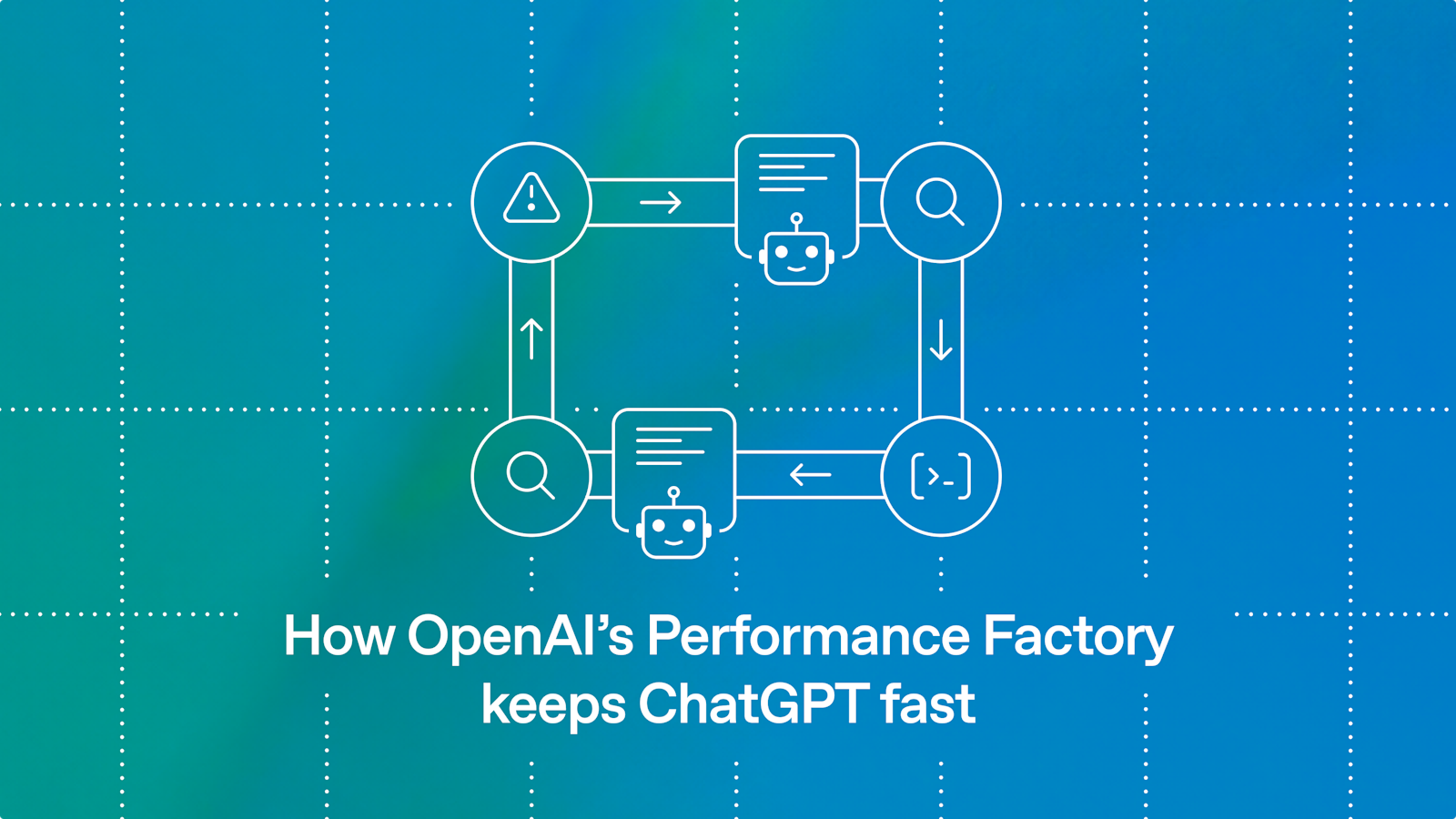
Learn how OpenAI built the Performance Factory, a system of Codex-powered workflows that finds and fixes performance issues to help keep ChatGPT fast.
Our Codex-powered system automates finding and fixing performance issues.
ShareThe path from manual investigations to automated workflowsThe path from manual investigations to automated workflowsThe Performance Factory system’s four partsTask service with configurable workflowsDispatch loop that assigns workCodex in the cloudSubscriptions that wake the agent when something changesThe first workflow: from alert to recoveryAgents find the root causeAdversarial review strengthens the diagnosisFixing the regression is the hard partWhat we learnedProtect engineers’ attentionEvaluate changes to your agentsTurn recurring failures into self-repairWhat’s next: broader applications, proactive monitoringThe path from manual investigations to automated workflowsThe Performance Factory system’s four partsTask service with configurable workflowsDispatch loop that assigns workCodex in the cloudSubscriptions that wake the agent when something changesThe first workflow: from alert to recoveryAgents find the root causeAdversarial review strengthens the diagnosisFixing the regression is the hard partWhat we learnedProtect engineers’ attentionEvaluate changes to your agentsTurn recurring failures into self-repairWhat’s next: broader applications, proactive monitoringThe staggering pace of agentic development has made traditional approaches to performance engineering unsustainable. To keep up, we built the Performance Factory, an autonomous system that uses the full capabilities of Codex and our models to find and fix regressions at an unprecedented speed. The Performance Factory, which runs in the cloud and automates investigating and resolving performance problems, enables us to keep pace with the ambition of our roadmap.
In the Performance Factory, our engineers define workflows for recurring jobs and write instructions for the Codex agents that carry them out. In particular, the Regression Workflow opens a task when a performance alert fires. An agent investigates the slowdown, records its findings in the task, and proposes a fix for an engineer to review. After deployment, another agent picks up the same task to check whether performance has returned to baseline. From investigating to authoring the fix to verifying mitigation, this first workflow in the Performance Factory has automated the entire process of fixing regressions. In just over three months, the Regression Workflow tracked more than 1,700 investigations and root caused over 600 cases. That’s 17 automated investigations every day.
Here, we’ll share how our use of Codex evolved into what’s now the Performance Factory, walk through our first running workflow, and share early lessons from building and running agent workflows in production.
As we used Codex for more of our performance work, we noticed a progression in how our team worked. We hope other service teams can learn from our process as they adopt agentic workflows in other domains.
Software work evolves from manual labor to partnering with machines to agent factories.
1. Pre-Codex. Before Codex, engineers manually examined metrics and logs, compared traces, debugged live machines, and read code to investigate a slowdown. This work was time consuming, and knowing where to look often required deep knowledge of the service. Relevant signals were easy to miss. When we encountered the same kinds of problems repeatedly—like regressions in ChatGPT’s first token latency—we built advanced tools, like CPU and allocation profilers, to make those investigations easier. Over time, we accumulated more than 30 performance tools.
2. Codex as a partner. Once we had Codex as a partner, engineers could ask, “Why did this get slower?” and work with Codex to investigate, even in an unfamiliar system. Codex could search large codebases, find relevant metrics and traces, follow interactions across services, and do appropriate profiling to piece together what had happened. But engineers still had to steer the process, knowing which performance tools to use and how to guide the investigation. Difficult investigations were more debuggable for more people, with less expertise and time required.
3. Reusable skills. To automate further, we captured our performance team’s investigation process in a shared skill called perf-forensics. It tells Codex which tools are available, when to use them, and how to work through a slowdown so Codex can try to resolve the problem from a few angles:
Investigate whether deployments or configuration changes could explain it
We tested and refined the perf-forensics skill using evals based on past regressions. For the types of regressions we focused on (for example, ChatGPT latency and availability drops), we could now give Codex an alert and get back a diagnosis in a single run, without guiding it through each step.
4. The human proxy. As we added and refined perf-related Codex skills like perf-forensics, we started to feel like a proxy between our alerts and Codex. An alert would fire, and an engineer would simply copy and paste it into Codex with the right skill, then paste the findings back into Slack.
5. Automated investigations. Next, we moved investigations to the cloud so an alert could start a Codex session automatically. Codex investigated the slowdown and posted its findings in the Slack thread, but the automation ended with that reply. An engineer still had to pick up the diagnosis, develop a fix, and check whether it worked after deployment. As alerts accumulated, even figuring out which regressions needed attention meant sifting through Slack threads.
6. The factory. We built the Performance Factory to run end-to-end agentic performance engineering workflows. It tracks what each active task needs next and assigns an agent when that step is ready. Each task keeps its state and findings, so work can pass between agents and engineers and resume after a code review or deployment. For a regression, the work starts with investigating an alert and ends with verifying recovery in production. We can turn common optimizations into workflows that run regularly across our services. A workflow that spots a potential optimization can open a task in another workflow to test and implement it.
The Performance Factory is made up of four components: a task tracker with configurable workflows, a dispatch loop that assigns ready work to agents, an API that runs Codex in the cloud, and subscriptions that wake agents when something changes (such as a GitHub review comment posting or a deployment completing).
OpenAI
Original Reporting Source
Explore features, ratings, and alternatives from our 19,000+ AI tools catalog.

OpenAI's flagship conversational AI platform featuring GPT-4o, advanced voice mode, web browsing, DALL-E 3 image generation, and custom GPTs.

