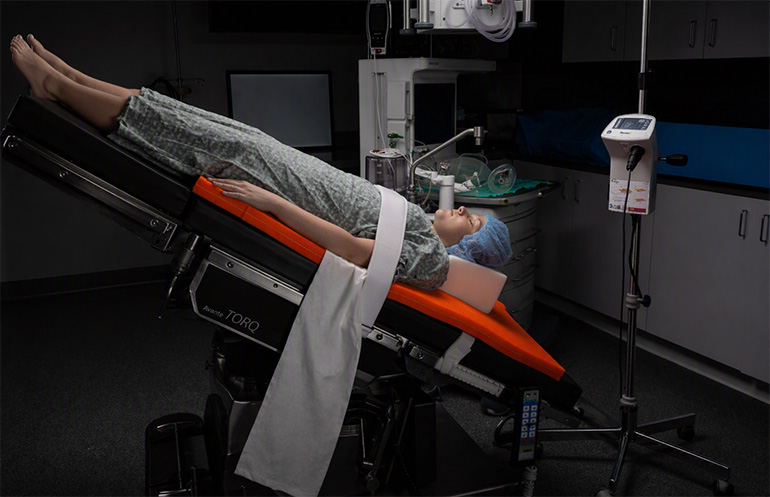
ThermAffyx addresses secure positioning and heating of patients for robot-assisted surgical procedures with a minimal OR footprint. The post Gentherm designs ThermAffyx to protect, move patients during robotic surgeries appeared first on The Robot Report .
ThermAffyx both securely positions and warms patients during robot-assisted surgeries. Source: Gentherm
Many healthcare advances come from within that industry, but innovations from other industries can also find a role. Gentherm Medical has designed its ThermAffyx Patient Safety System based on thermal management experience from the automotive industry.
The system both securely positions a patient and provides patient warming for robot-assisted surgery. Gentherm Inc. said ThermAffyx does both while minimizing the amount of space required and without the need for forced-air equipment.
The Novi, Mich.-based company launched the system at the Association of periOperative Registered Nurses (AORN) Global Surgical Conference this year. Gentherm noted that numerous medical professionals told it that "almost all of their robotics patients are hypothermic."
Adam Hauke, global director for product strategy and innovation at Gentherm, replied to the following questions from The Robot Report.
What is the challenge that ThermAffyx addresses, and how are patient positioning and hypothermia handled conventionally?
Hauke: The ThermAffyx Patient Safety System combines active patient warming and secure positioning into a single solution, helping address two critical perioperative challenges: maintaining normothermia and reducing patient movement during surgery.
The current standard of care consists of forced-air warming solutions and a securement pad. Historically, warming and positioning have been addressed independently because, in many surgical procedures, they do not significantly interfere with one another. However, that’s not the case in most robotic-assisted surgeries.
These procedures frequently require patients to remain in Trendelenburg positioning, where the body is tilted head-down to provide surgical access to the pelvis and lower abdomen. Patients may remain in these positions for extended periods while robotic systems are docked and utilized.
This positioning introduces several challenges, including increased pressure and shear forces that can contribute to pressure injuries, the potential for nerve-related complications if positioning is not optimized, and the risk of patient movement or shifting during lengthy procedures. Underbody securement pads are designed to address these positioning challenges.
At the same time, maintaining normothermia becomes more challenging because robotic equipment occupies the physical space that traditional over-body warming solutions must be deployed in. In these situations, clinicians often rely on under-body warming approaches, but they are difficult or impossible to use in robotics because they would interfere with the underbody securement pads used for safely positioning the patient.
Suddenly, warming and positioning are no longer separate considerations. They are competing for the same real estate.
How much do patients move around during surgical procedures?
Hauke: In the routine course of things in the operating room, “patient movement” is not tracked. "Patient movement," if it is recorded it is done so as "light anesthesia." It is usually referring to if the patient's anesthetic wears off prematurely and they move a hand or leg type thing.
No one is measuring anything on the OR table related to patient movement, as everything is under the sterile drape at that point. The only way the surgical team knows if a patient moves, is if there is tension on the robotic instruments typically.
Therobotreport
Original Reporting Source
Explore features, ratings, and alternatives from our 19,000+ AI tools catalog.
AssistLoop's AI chatbots slash response times by 70% and boost satisfaction, scaling support for e-commerce and SaaS without extra hires.
Design professional websites effortlessly with AI.
Hypertxt.ai is an AI-powered SEO content writing tool that helps create high-quality, optimized content for improved search engine rankings. It offers various features to streamline the content creation process, from keyword research to content optimization and plagiarism checks.