TL;DR PyTorch models now run in the web browser on the GPU through ExecuTorch, with no conversion to another framework’s format. You export with torch.export to an ExecuTorch .pte file,... The post ExecuTorch WebGPU: PyTorch Models on the GPU, in the Browser appeared first on PyTorch .
The web is the largest deployment surface with billions of users on Chrome, Firefox and Safari. Browser inference ensures privacy by keeping users’ prompts, model inputs, and outputs on the user’s device rather than the server. This reduces network latency, enables offline use-cases, and lowers server-side inference costs. With the ExecuTorch WebGPU backend, PyTorch models get a native path to GPU-accelerated inference in WebGPU-enabled browsers on desktop, laptop and mobile.
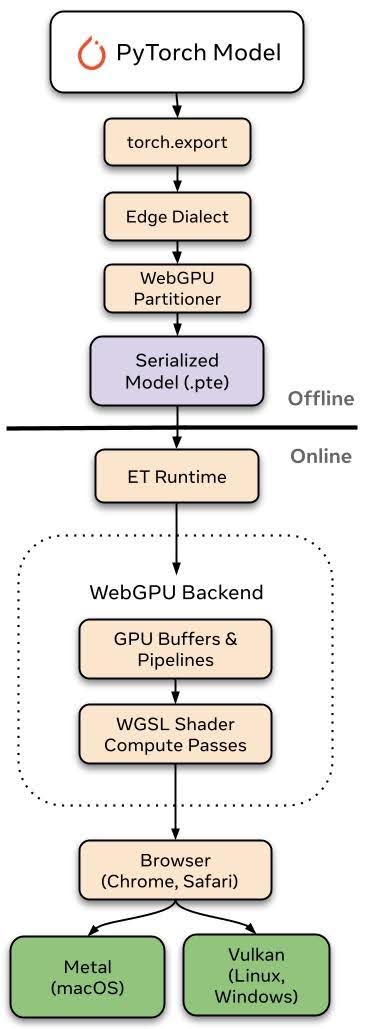
WebGPU, the modern successor to WebGL, provides native compute shaders, shared memory, storage buffers, and barriers, making it viable for high-performance ML inference directly in the browser. Today, running a PyTorch model in the browser usually means first converting it to another framework's format, such as GGUF, ONNX or TFLite. The ExecuTorch WebGPU backend lets PyTorch models reach the browser without leaving the PyTorch toolchain.
[Figure 1: ExecuTorch WebGPU backend design: a PyTorch model is exported once to a .pte file and runs in any WebGPU browser through the ExecuTorch Wasm runtime]
Three principles guided the WebGPU backend's design:
We benchmarked ExecuTorch WebGPU against ExecuTorch's own Webassembly (wasm) CPU backend (XNNPACK, multi-threaded) on the same machine, using quantized Llama 3.2 1B and Qwen3-0.6B in Google Chrome on Apple M1 Pro. Each data point is the median of 5 runs after 3 warmups, across 128 to 8K tokens of context, with identical token IDs for both backends. Both are timed with wall-clock time, since GPU timestamps aren't available for CPU execution. WebGPU uses 4-bit groupwise weights (group size 64) with fp32 activations; the CPU uses XNNPACK's 4-bit weights with 8-bit dynamic activations.
[Figure 2: ExecuTorch WebGPU is 4–7× faster than ExecuTorch Wasm (XNNPACK) on prefill and 2–10× faster on decode, measured in Chrome on Apple M1 Pro]
We've validated the WebGPU backend across models with very different architectures, demonstrating that the operator coverage generalizes beyond autoregressive text generation:
The ExecuTorch WebGPU Playground runs many of the models above, all on the same WebAssembly + WebGPU runtime. All the prompts, photos, camera frames and audio never leave your device. Each model's Hugging Face repo includes the .pte files, a model card, and the exact export recipe.
The backend is still in early development. We'll keep making the backend faster and more stable, and expand operator, data type, and model coverage.
ExecuTorch is open source, and we'd love your contributions to the WebGPU backend. If something breaks or a model you care about isn't supported, open an issue or reach us on the ExecuTorch Discord. Contributions are welcome too, whether that's new operators, new models or performance improvements.
Learn more at ExecuTorch Documentation | ExecuTorch repo | WebGPU Backend
PyTorch
Original Reporting Source
Explore features, ratings, and alternatives from our 19,000+ AI tools catalog.

AssistLoop's AI chatbots slash response times by 70% and boost satisfaction, scaling support for e-commerce and SaaS without extra hires.

Design professional websites effortlessly with AI.
Hypertxt.ai is an AI-powered SEO content writing tool that helps create high-quality, optimized content for improved search engine rankings. It offers various features to streamline the content creation process, from keyword research to content optimization and plagiarism checks.

