Agents are now users of software, doing work on people's behalf. Whether you're building the agent or the software it uses (API, CLI, MCP server, SDK), evals give you a way to measure how well that work gets done. Agents probably missed your launch video and billboard on Highway 101, but they still go through the same funnel a human does to find and use a product: Discovery , Selection , Access , and Success . You can build evals for any stage of this funnel. Here, we’ll focus on the final stage
Agents are now users of software, doing work on people's behalf. Whether you're building the agent or the software it uses (API, CLI, MCP server, SDK), evals give you a way to measure how well that work gets done.
Agents probably missed your launch video and billboard on Highway 101, but they still go through the same funnel a human does to find and use a product: Discovery, Selection, Access, and Success.
You can build evals for any stage of this funnel. Here, we’ll focus on the final stage, Success: whether the agent completes the user’s task correctly.
That's more difficult to check than it sounds. An agent can place a “successful” order for a hot latte when the user asked for an iced one. The request worked, so the logs in your Observability stack look fine. And because LLM outputs vary between runs, one good manual test can’t tell you whether a fix worked. You need to repeat the same tasks and grade the outcomes, before and after the change.
That’s what an eval is, a test you run many times and score. Here’s how we build one.
Copy link to headingThe agentic testing pyramidIf a test asks “did it work?”, an eval asks “how often does it work, and how well?”
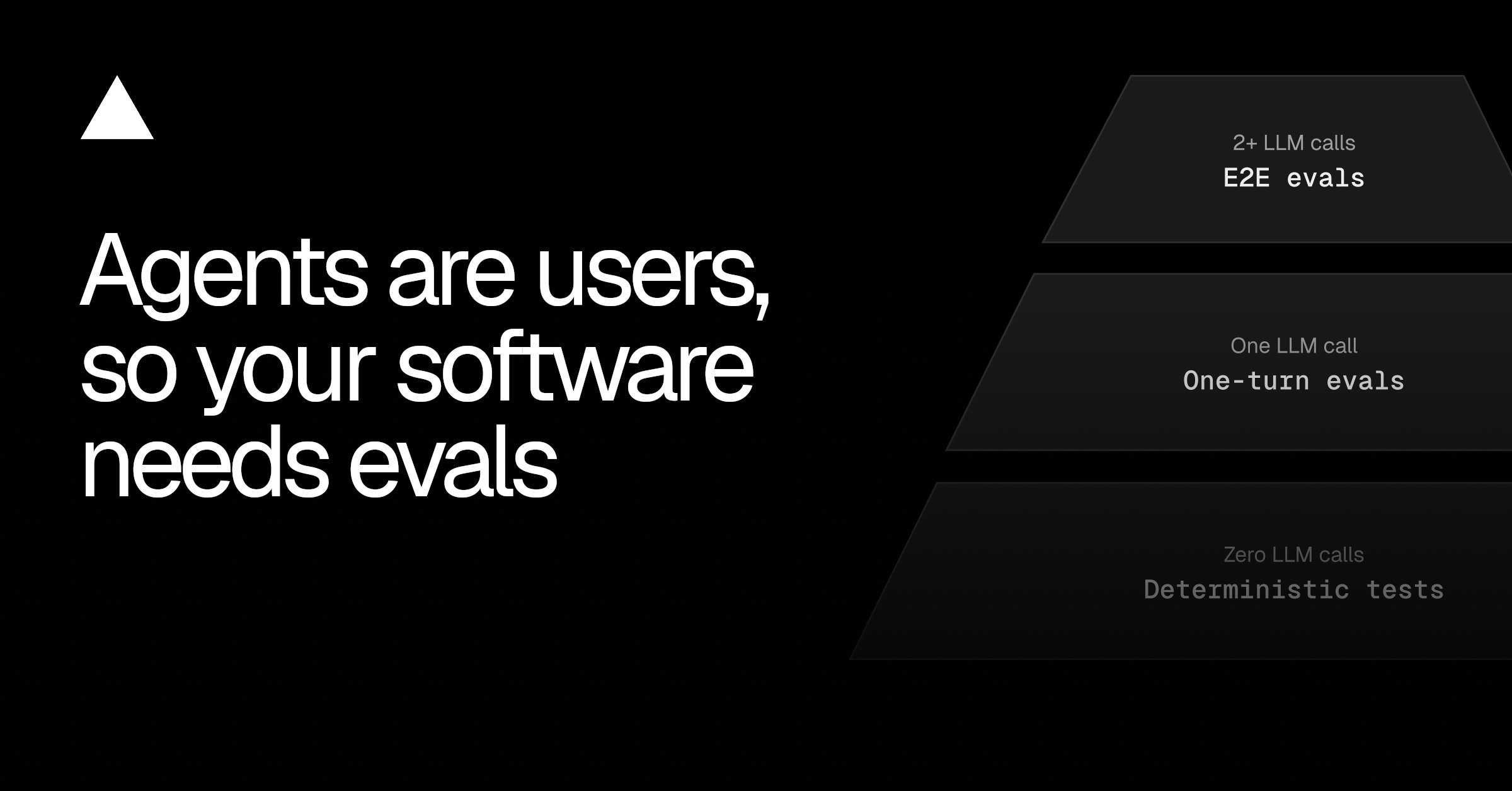
We group agentic software tests by how many LLM calls they typically need: deterministic tests (0), one-turn evals (1), and E2E evals (2+ across a whole task). This has turned out to be a great proxy for the effort to build them, the time they take to run, and the cost of running them. Just like in the practical test pyramid, the cheap and fast tests should make up the bulk of your test suite.
To use the pyramid, start with the problem you want to catch and pick the lowest tier that can catch it. For Success, that's the top. A one-turn eval checks a single decision, like which command the agent runs first. But Success depends on the whole sequence of steps (e.g. search for cafes → filter on user criteria → place the latte order). Each one can look reasonable on its own, and the agent can still get the wrong outcome.
An E2E eval lets the agent work through the whole task in an environment, then checks whether the final result meets the user’s requirements. You’ve probably seen a few already; most popular coding benchmarks, like SWE-bench and Terminal-Bench, are E2E evals.
Copy link to headingExampleSay you own SF Beans, an API for ordering coffee in San Francisco. One of the best ways to give agents access to your service is through a CLI, so you’re shipping sfbeans.
Here’s a typical request from one of your customers:
Get me a large iced latte with whole milk, ready for pickup by 9:00, under $8 including tip. I’m in the Mission.
Fog City Roasters: ice machine is down, so no iced drinks today (temperature)
24th St Beans: latte is $7.50 on the menu, but $9.27 after tax and tip (budget)
Dolores Drip: latte is $5.50, but the earliest pickup is 9:20 (time)
Vercel Blog
Original Reporting Source
Explore features, ratings, and alternatives from our 19,000+ AI tools catalog.

AssistLoop's AI chatbots slash response times by 70% and boost satisfaction, scaling support for e-commerce and SaaS without extra hires.

Design professional websites effortlessly with AI.
Hypertxt.ai is an AI-powered SEO content writing tool that helps create high-quality, optimized content for improved search engine rankings. It offers various features to streamline the content creation process, from keyword research to content optimization and plagiarism checks.

