We carry them with us. ScienceAlert stories are written, fact-checked, and edited by humans, never generated by AI. Don't miss a story, subscribe here.
Tens of thousands of years ago, the last Neanderthal disappeared from our world.
But the ghost of this ancient human relative lives on – its lingering traces haunting the Homo sapiens genetic code.
It manifests in some curious ways – certain hair textures, for example, or how the body stores fat, may be influenced by DNA inherited from ancestors that mingled with their Neanderthal neighbors.
That inheritance may be shaping more than what we look like. A new study has found a tiny stretch of Neanderthal DNA associated with a measurable difference in the size of the occipital lobes – the region that occupies the back of the brain.
And intriguingly, the same genetic variant is also linked to a slightly lower risk of schizophrenia – but no association with general cognitive ability.
"Differences in the occipital region of the brain between Neanderthals and modern humans have long been inferred from the fossil record," write anthropologists Hugo Zeberg and Svante Pääbo of the Max Planck Institute for Evolutionary Anthropology in a paper published in PNAS.
"Here, we show that a common genetic variant influencing occipital brain volume in present-day people was inherited from Neanderthals."
History used to paint Neanderthals as closer to apes than humans in terms of cognitive ability; more recently, anthropologists have begun to discover that our hominid cousins may have had complex social and symbolic lives, artistic abilities, engineering ingenuity, and other traits once considered uniquely human.
Likewise, too, their brains were not small. In fact, they were comparable in size to the brains of modern humans – sometimes even larger.
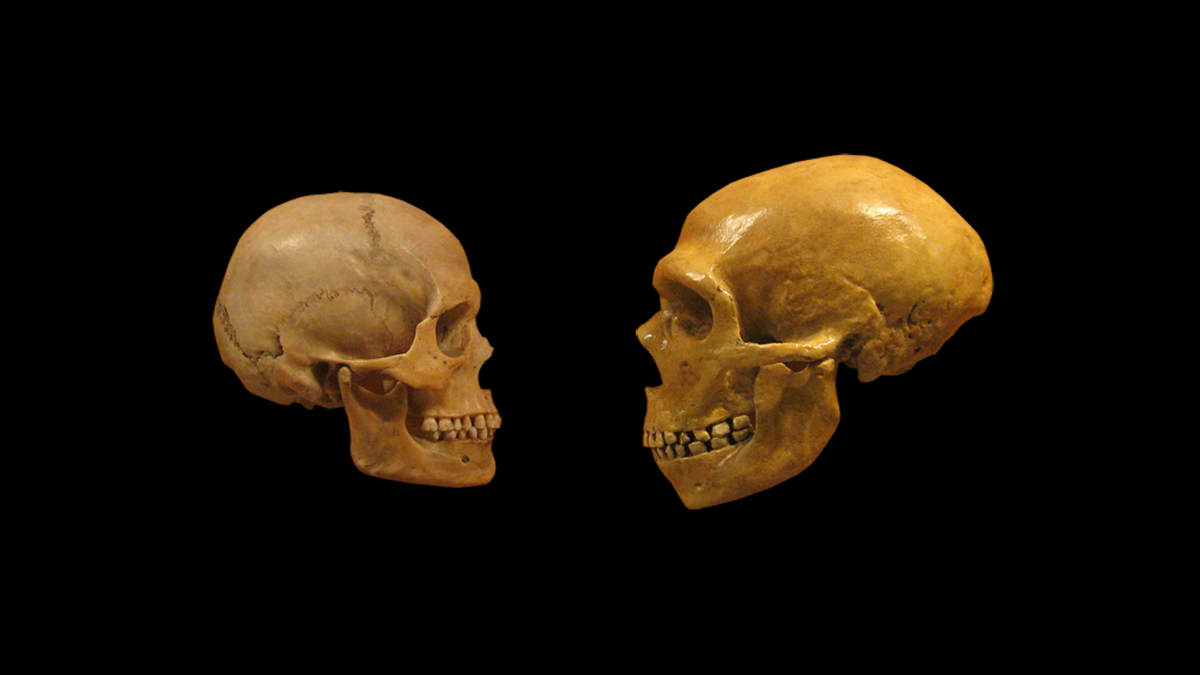
Where they differed was in shape. The skulls of modern humans are relatively rounded, or globular; Neanderthal skulls were more elongated, extending farther from front to back.
This suggests that, although our brains were similar in overall size, the tissue inside may have been distributed differently.
One region of particular interest is the occipital lobe, which sits at the back of the brain and contains the visual cortex, responsible for processing information received from the eyes (yes, you 'see' things in the back of your head).
Previous research examining the internal shapes of fossil skulls suggests that Neanderthals may have had proportionally larger occipital lobes than modern humans.
But fossil skulls can only tell us so much about the soft tissue they once contained. To learn more about the evolutionary history of our brains, scientists need to look deeper – into the genetic instructions that help build them in the first place.
This is where Zeberg and Pääbo enter the story. They specifically wanted to know whether humans had inherited any Neanderthal genetic variants associated with the size of the occipital lobe.
ScienceAlert
Original Reporting Source
Explore features, ratings, and alternatives from our 19,000+ AI tools catalog.

AssistLoop's AI chatbots slash response times by 70% and boost satisfaction, scaling support for e-commerce and SaaS without extra hires.

Design professional websites effortlessly with AI.
Hypertxt.ai is an AI-powered SEO content writing tool that helps create high-quality, optimized content for improved search engine rankings. It offers various features to streamline the content creation process, from keyword research to content optimization and plagiarism checks.

