Quantum
Home Blog A game you cannot win unless you have a quantum computer November 19, 2026
Shashwat Kumar and Rodrigo Cortiñas, Research Scientists, Google Quantum AI, Google Research
On a superconducting processor, we turned one of quantum mechanics’ strangest features into something you can measure, benchmark, and put to work across systems as large as 105 qubits.
Here is a Sunday paper-style puzzle you can try right now. Draw a 3×3 grid. Fill every cell with either +1 or −1, subject to two rules: each row must multiply to +1, and each column must multiply to −1.
You didn’t manage it, right? There is an elegant reason for that. For a row to multiply to +1, it needs an even number of −1s. For a column to multiply to −1, it needs an odd number. Add up the rows and you learn the grid contains an even number of −1s. Add up the columns and you learn it contains an odd number. Well…That’s impossible!
The grid would have to be two contradictory things at once. No such table exists; it is a paradox.
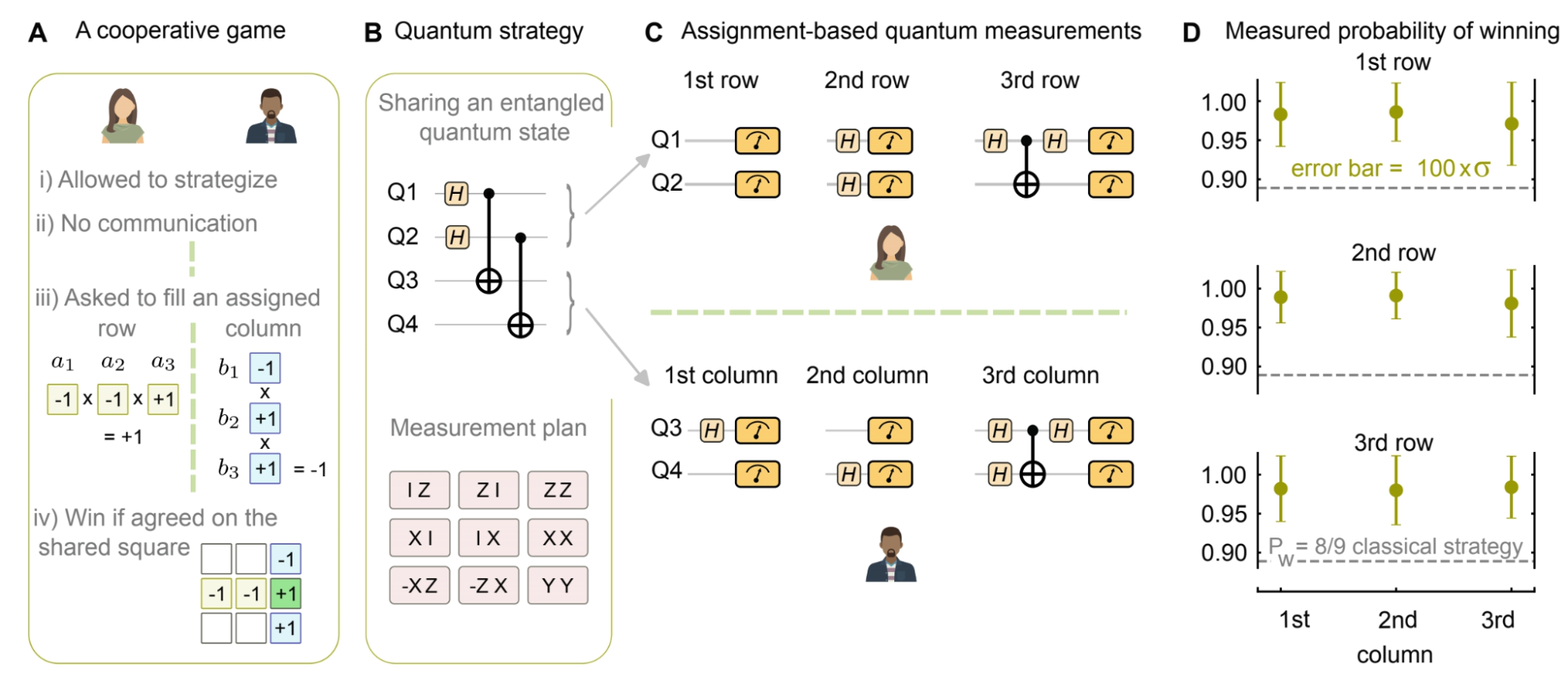
Now turn the puzzle into a game: Each round, Alice is handed a row and Bob a column. Without talking, Alice fills her row by the row rule and Bob fills his column by the column rule. They win if they put the same number in the square where their row and column intersect. Any plan made in advance is just a pre-written table, meaning at best they will win 8 out of 9 rounds. This changes if they use a quantum computer. It won't fill in the impossible grid, but in principle, it lets them win every round.
The reason is a property called quantum contextuality, arguably the strangest feature of quantum mechanics. Einstein once famously asked whether the moon is there when nobody looks, his way of insisting that physical properties ought to exist whether or not anyone measures them. For quantum systems, contextuality is the precise, experimentally testable statement that the answer can be no: you cannot assign fixed, pre-existing values to everything you might measure.
What a measurement yields can depend on which other compatible measurements you make alongside it (i.e., on its context). This is not only a deep philosophical statement, but more so, cutting-edge science and the basis of a new technology. And in the game above, Alice and Bob can use it to engineer a solution. Their answers are not looked up in a hidden table written in advance; the table does not exist. Their answers come into being as they measure, and quantum correlations stitch them together more tightly than any classical rulebook permits.
Entanglement usually gets top billing as the “magic ingredient” of quantum computing. But a growing body of theory suggests contextuality is the deeper resource, the thing that actually powers certain quantum algorithms past their classical counterparts. The catch is that, until recently, contextuality had been demonstrated almost exclusively in small systems of a few particles. Whether it survives, and stays useful, in the many-body systems that real quantum computers are made of was an open question.
That is the question we set out to answer. In "Quantum-classical separation in bounded-resource tasks arising from measurement contextuality," published in Science, we demonstrate and measure contextuality on our superconducting quantum processors. Our qubits win the magic square game 98.3% of the time, exceed the classical limit on a contextuality test, and outperform classical strategies in tasks spanning up to 105 qubits. Along the way, these tasks proved to be a sensitive new benchmark for quantum hardware, catching subtle errors that random-circuit tests miss.
We ran what is commonly called the magic square game on our Willow quantum processor. Alice and Bob each hold two qubits, sharing two entangled Bell pairs instead of a pre-written table, and measure them using preset settings for their assigned row or column to get their ±1 entries.
The best conceivable classical strategy loses at least one round in nine, winning at most 88.89% of the time. When we played all nine versions of the game 100,000 times apiece, our qubits lost roughly one in sixty, winning 98.30% of them (0.9830 ± 0.0001).
The gap is meaningful and statistically significant: our qubits coordinated better than any pre-written table allows. That's because no cell has a value fixed in advance. Each answer takes shape only when it is measured alongside the rest of its row or column (its context), and shared entanglement makes Alice's and Bob's answers for the shared cell agree.
With shared entanglement and a prearranged measurement plan, Alice and Bob can in principle agree at the intersection in every round. On our hardware, noise causes about one loss in 60.
Google Research
Original Reporting Source
Explore features, ratings, and alternatives from our 19,000+ AI tools catalog.

AssistLoop's AI chatbots slash response times by 70% and boost satisfaction, scaling support for e-commerce and SaaS without extra hires.

Design professional websites effortlessly with AI.
Hypertxt.ai is an AI-powered SEO content writing tool that helps create high-quality, optimized content for improved search engine rankings. It offers various features to streamline the content creation process, from keyword research to content optimization and plagiarism checks.

