

SEC InsightsSEC insights AI Tool
Enhanced document analysis for informed decisions.
SEC insights03 Rating
Enhanced document analysis for informed decisions.
Pricing & Model
free_trial
Open Source & API
Proprietary
No Public API
Foundational Model
Proprietary Engine
Key Integrations
Web App Only
Teams exploring sec insights can use SEC Insights for sec.
Teams exploring sec insights can use SEC Insights for information.
Teams exploring sec insights can use SEC Insights for analysis.
Teams exploring sec insights can use SEC Insights for insights.
Common queries about SEC Insights answered
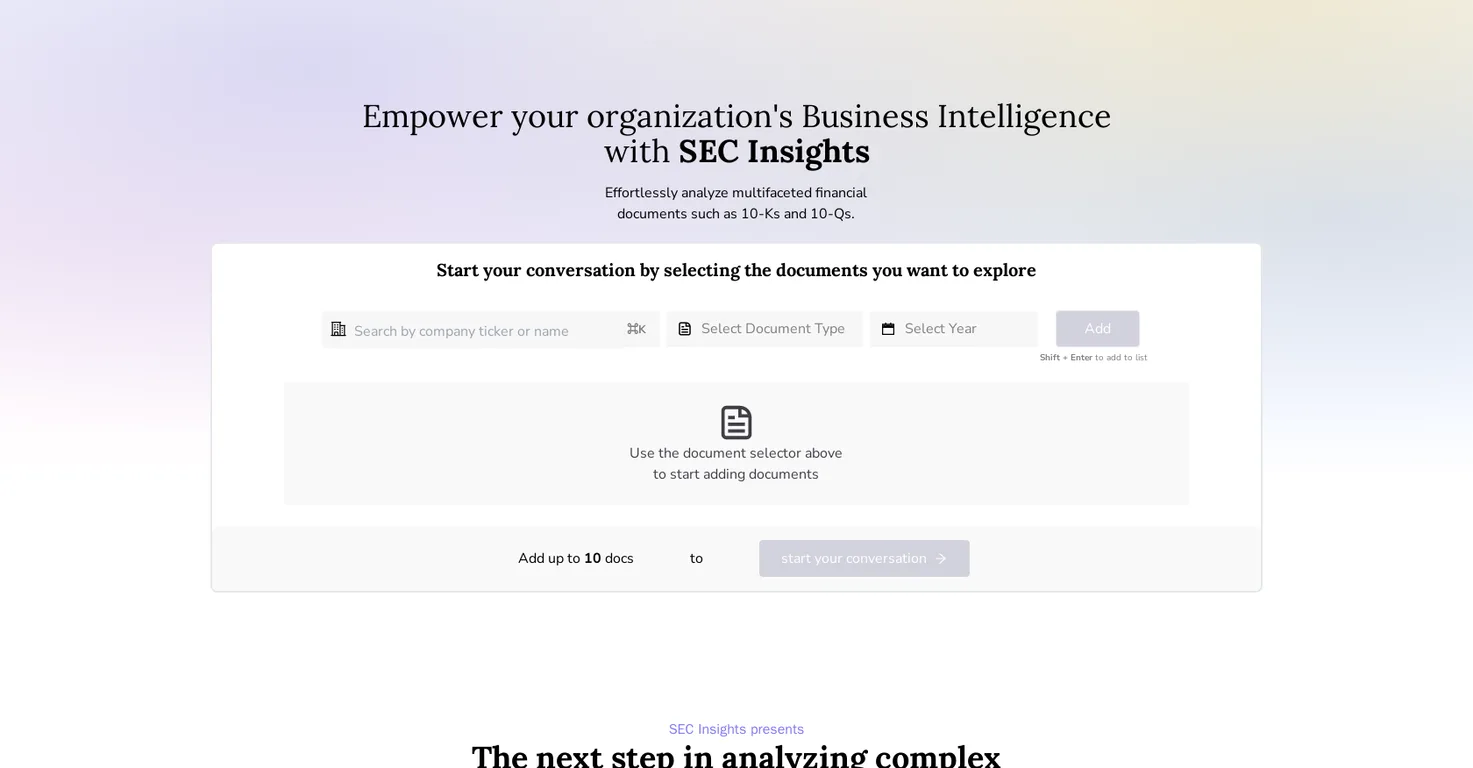
SEC Insights is an AI tool that facilitates the analysis of complex financial documents such as 10-Ks and 10-Qs. It is designed to enhance an organization's Business Intelligence and provides comprehensive insights by enabling users to explore and analyze selected documents.
SEC Insights offers features such as analyzing up to 10 documents simultaneously, highlighting paragraph-level citations across multiple documents, and understanding how generated answers were derived. It extracts insightful information from multiple documents, aiding in deep comparisons and contrasts.
Real ratings and feedback from the community
Be the first to share your rating and comments for this AI tool!
Explore similar AI tools in this category

Videos
Compare Fliki's free and paid tiers to see how this text-to-video AI tool simplifies social media, blog-to-video, and content marketing production.

Build Apps
Lovablev2.2 turns your app ideas into live web apps instantly with AI and simple prompts-no coding required for fast MVPs and prototypes.
To use SEC Insights for analyzing financial documents, start by selecting the documents you want to explore. After adding up to 10 documents, SEC Insights will analyze these documents and provide comprehensive insights derived directly from their algorithm.
Yes, SEC Insights enables simultaneous analysis of multiple documents. It allows for the addition of up to 10 documents at a time.
SEC Insights aids understanding of generated answers by showing the algorithmic process that derived those answers. It does more than provide insights, it helps users comprehend how these insights were generated.
The maximum number of documents that can be added at a time on SEC Insights is 10 documents.
SEC Insights provides comprehensive insights by allowing for the simultaneous analysis of multiple documents. It extracts valuable information from multiple documents, facilitating deep comparisons and contrasts.
SEC Insights aids in the simultaneous examination of multiple documents by allowing users to add and analyze up to 10 documents at a time. Its ability to extract meaningful insights from multiple documents helps in deep, comparative analysis.
Yes, SEC Insights guides users to paragraph-level citations. This feature navigates through dense financial information precisely and enhances clarity and understanding.
SEC Insights facilitates deep comparisons and contrasts by extracting insightful information from multiple documents. This method allows comprehensive, comparative analysis.
With SEC Insights, users can analyze complex financial documents such as 10-Ks and 10-Qs.
No, SEC Insights does not offer financial advice. It is advised to consult a Certified Public Accountant before taking any financial actions.
To discuss enterprise use cases or provide feedback to SEC Insights, users can use the 'Get in Touch' option available on their website.
While SEC Insights appears to be designed with organizations in mind, there isn't specific information to suggest its use is exclusively intended for organizations.
SEC Insights enhances Business Intelligence by simplifying the process of analyzing complex financial documents. It provides comprehensive insights, enables a deep comparison analysis, and improves understanding of generated answers.
SEC Insights provides the facility to explore desired documents by allowing users to select which documents they want to analyze. It then simplifies the analysis of these complex financial documents.
With SEC Insights, users can extract meaningful insights from inquiries across multiple documents. This is facilitated by its capability to simultaneously examine and analyze multiple documents, facilitating deep comparisons and contrasts.
SEC Insights presents insights from its algorithm by providing answers to inquiries and explaining how those answers were generated. It offers a peek 'under the hood', thus providing more than just the output of the analysis.
SEC Insights bolsters decision-making within an organization by simplifying the process of analyzing complicated financial documents. It provides comprehensive insights derived from these documents, improving understanding and facilitating informed decisions.
SEC Insights offers an unmatched level of clarity and comprehension by guiding users to paragraph-level citations across multiple documents and demonstrating how insights were derived from the selected documents.

Viral Video Production
Vireel turns raw ideas into viral TikTok, Reels, and Shorts with AI formulas and real-time analytics to boost engagement for creators.

Meta Creation
Lexi AI is an AI-powered research assistant that helps users read, summarize, and extract key information from various documents. It allows users to chat with their documents, ask questions, generate new content, and organize their research efficiently.
Fliki
Compare Fliki's free and paid tiers to see how this text-to-video AI tool simplifies social media, blog-to-video, and content marketing production.

